
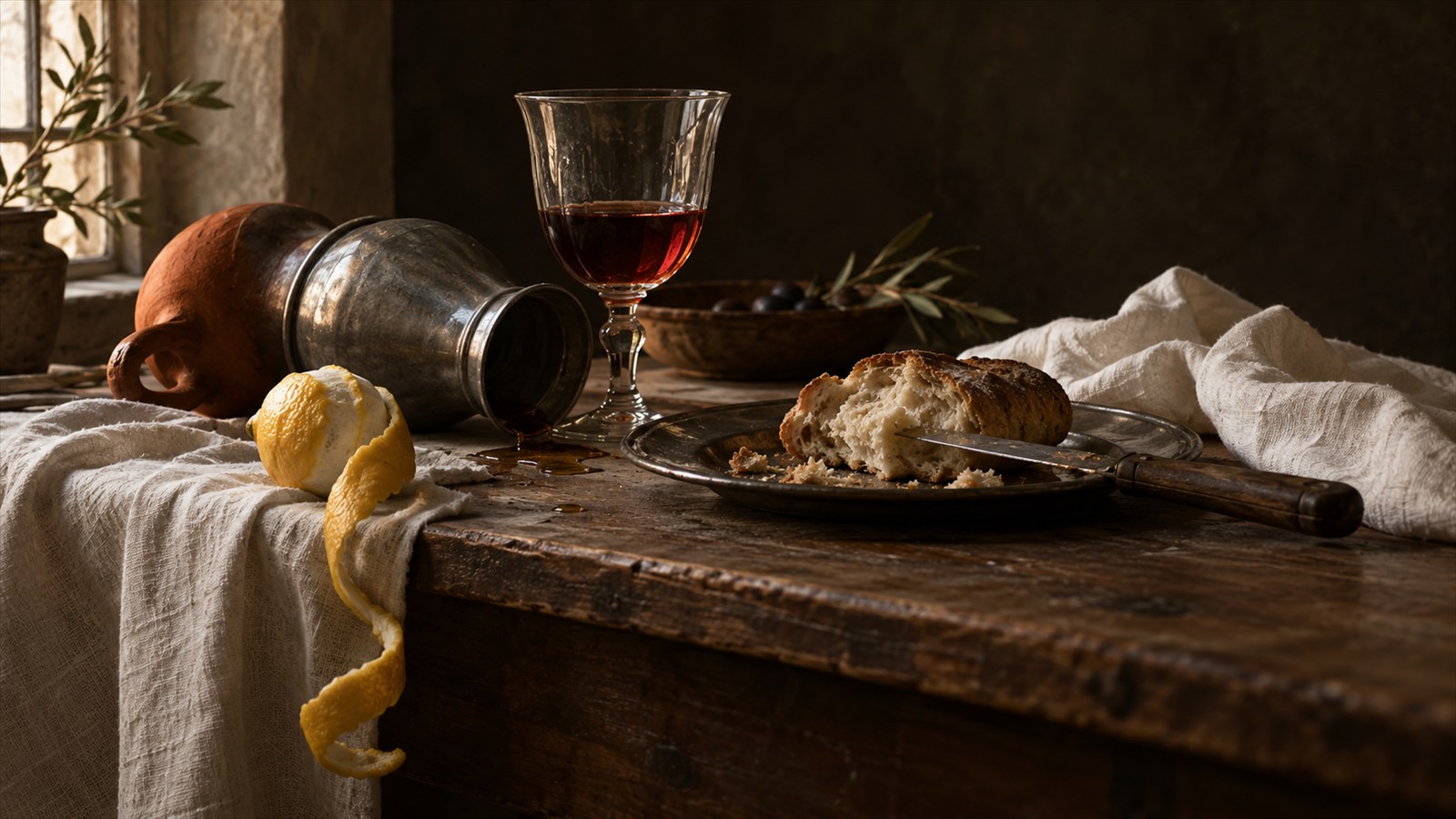
Two Dutchmen spent their lives painting the table after the meal
There's one kind of table photograph I almost never see: the after.
After everyone has got up. The napkin crumpled beside the plate, the glass half down, the lemon peel curling, a knife left lying across. The table once it has actually been used for something.
I went into an art encyclopedia looking for something else and found that this was once an entire genre, and that two seventeenth-century Dutchmen spent their working lives painting exactly that scene.
Pieter Claesz. and Willem Claesz. Heda
First, a confusion I need to clear out of the way: both men have Claesz. in the name and the encyclopedia does not say they were related. I'm not going to invent that they were.
Pieter Claesz. was born around 1597 in Burgsteinfurt, Westphalia, and died in 1661 in Haarlem. His entry says it plainly: his most characteristic subjects were tables laid for a meal, or containing the remnants of a meal.
Willem Claesz. Heda was born around 1593 and died around 1680, both in Haarlem. He painted a few portraits and religious works first, then specialised in still life. His earliest dated work is a Vanitas, from 1621.
And about the two of them together the encyclopedia has a line I kept rereading: they were the great painters of laden tables or the remains of a meal.
The great ones. Not the odd ones, not the minor ones. The great ones.
And look at what is on those tables: a glass, a pewter jug, china, bread. The same objects I've been writing about all year, including the toast, which began as an imitation of a bell. They were already there in 1630, with someone already deciding they were worth looking at.
The part that made me put the book down
Heda could paint expensive things.
The entry says he occasionally painted rare materials and sumptuous, aristocratic compositions of the kind Willem Kalf was making in Amsterdam. There's a still life from 1648 in the Hermitage and a Still Life with Ham from 1656 in Budapest.
And then the line: he preferred the table settings of bourgeois homes.
Preferred. He had the technique for luxury, he had the commissions, and he chose the ordinary table.
I won't pretend the encyclopedia explains why, because it doesn't. But I know what it does to me, writing about tables every day and spending half that time arguing with the idea that a good table is an expensive one.
Free
Take the Christmas table checklist
It arrives straight away. After that, my newsletter — leave whenever you like.
The man who started in disorder and ended in geometry
Pieter Claesz.'s arc is the part I liked best, because it is a person learning to lay a table.
Early on, he followed the dry style of Floris van Schooten, in which objects and earthy or metallic colours sat side by side in disorder. That's the book's word: disorder.
After 1630, perhaps under Heda's influence — the encyclopedia writes "perhaps", and I'm keeping the perhaps — he began to integrate his forms more closely, to seek a unity of impression, and to construct geometric schemes based on the Golden Section.
Read that again. A man arranging the remains of a lunch according to the golden ratio.
From 1640, the tones got warmer, the paint lighter, the tonality more transparent, and the arrangement of curving and straight lines more subtle. The example the book gives is Luncheon with Pewter Jug, 1643, in Brussels.
Thirty years to get from disorder to the right curve beside the right straight line. A whole life solving the same problem I solve in the hour before people arrive, except he solved it in paint and with far more patience.
What "monochrome" means here, and why it matters to your table
Heda is rightly celebrated, the book says, as a painter of "monochrome" still lifes, whose effect comes from refinement of values, half tones and transparent glazes over a single colour.
Monochrome here doesn't mean drab. It means he took colour out of the contest so something else could show: the difference between the shine of pewter and the shine of glass, between the white of a pipe and the white of a cloth.
The example described is Still Life with Tobacco, 1637: the greys and greens of a shadowed zone, where a pewter pitcher stands, against the beige-grey of a luminous area, where a white pipe stands out.
A whole table built in two temperatures of grey.
That's what I'm taking into the season, and it isn't about painting: a table with little colour forces you to notice materials. Glass, metal, linen, china. On a table full of colour, nobody sees the glass. I've written before about how a cut crystal glass changes completely with the light behind it rather than beside it, and it's the same idea: remove one variable and another one appears.
This is also, quietly, a Thanksgiving argument. A brown-and-cream table is not a table you failed to decorate. It's the one where the plates show.
Being honest about this source
The encyclopedia does not explain why the leftovers of a meal became a subject worth painting.
It records that they did. It gives the names, the dates, the museums, it describes the colours. But it doesn't say what the objects meant, or why this sold, or what a buyer saw in it. Heda's earliest dated work is called Vanitas and the encyclopedia never stops to say what a vanitas is.
So I won't either. There's plenty of writing out there explaining these paintings as sermons about passing time, and that may well be right, but it isn't what this book claims, and I'd rather hand you what it claims.
What I can say safely is what's written: two men, fifty years, the table laid and the table undone, repeated until it became the thing they are remembered for.
What I'm going to do with it
Photograph the after.
Not only the finished table, everything aligned and nobody sitting down, which is the picture everyone takes, me included. The after as well: napkins dropped, glasses half down, the candle already low.
Because that's the one that shows the table worked. A laid table is a promise. An undone table is the receipt.
And if two Dutchmen could turn that into museum walls, I can stop treating the mess at the end of the night as a production failure.
If you want the rest of what we're putting together for the season, it's all on one page, with a table checklist to download.
And for the part of the table that appears in every one of those paintings, folded beside the plate: The Art of Napkin Folding has the classic folds step by step. Lifetime access.
Tell me: do you ever photograph the table after everyone gets up? I never did, and now I want to see how it looks.
Free
Take the Christmas table checklist
Everything that matters on a Christmas table, on a single sheet. Print it, or fill it in on your computer.
It arrives straight away. After that, my newsletter — leave whenever you like.