
On 8 November 1291, Venice Threw the Glass Furnaces Out of the City
By the middle of the thirteenth century Venice was the most advanced glassmaking city in the world. By 1255 there was a complex guild system there, with specialists in jewellery, bottles, mirrors, lenses and windowpanes.
And there was a problem.
"The prolific number of furnaces that burned day and night in the wooden glasshouses posed a threat to the lives of the citizens."
"On November 8, 1291, the doge and the Great Council forbade the furnaces to operate within the city, and the glasshouses were moved to Murano, a neighboring island about three miles outside the city."
An honesty note I want to make straight away: the book never uses the word "fire." It says furnaces burning day and night inside wooden buildings, threatening people's lives. The reading is obvious, but the word is mine.
The secrecy came afterwards, and as a consequence
Almost everyone tells this part wrong, and I was telling it wrong too.
The book's next sentence is: "This move not only centered the glass industry in one area; it also prevented the establishment of glasshouses elsewhere and assured the secrecy of new glass techniques."
Look at the verb. Assured. That's a result, not a motive. Secrecy hardened into policy afterwards, over the following century and a half.
In 1376 the Venetian Senate raised glassmakers to the status of burghers, citizens of Venice, "to encourage loyalty among the workers, and to compensate them for their loss of freedom." The masters' daughters were granted the right to marry noblemen, an enormous privilege in that society.
And in 1454, to protect the monopoly, Venice decreed under Article 26 of the Statutes of the Inquisition of State that a glassmaker who emigrated incurred the penalty of death.
The book closes the subject with a deliciously dry line: "However, glassmakers succumbed to the lure of bribes." And they left anyway, for the Netherlands, England, France, Germany, Bohemia, Austria and Spain.
Before all that, glass was a luxury. One tube changed it.
In 50 B.C. the glass blowpipe was invented. The process, the book says, "is thought to have developed in Sidon", then a Syrian colony of Rome. Notice it states the date and hedges the place, so I'll do the same.
Then comes the chapter's strongest judgement:
"The blow pipe is the single most important invention in the history of glass. It took glass out of the realm of luxury and made possible the mass production of inexpensive utilitarian shapes for the common people: bottles, plates, spoons, tumblers, flasks, ointment jars, lamps, and vases."
Before blowing, glass was formed around a core, one piece at a time. After blowing, it became a household thing.
Also: glass in its natural state isn't clear. It's greenish or brownish amber, from the iron and aluminium that come with the material. In 2 A.D. Roman artisans invented crystallinum, decoloured with antimony or manganese, known as "glass soap" because it neutralised the impurities.
Somebody had to invent transparency. It didn't arrive free.
Free
Take the Christmas table checklist
It arrives straight away. After that, my newsletter — leave whenever you like.
The Roman cup that changes colour depending on the light
This is my favourite part of the chapter, and the one thing in it I'll actually use in December.
The Lycurgus cup, made in the fourth century A.D., is in the British Museum. The book describes it like this:
"When lit from the front, the Lycurgus cup is olive green to pea green, but when lighted from the back the color is wine red to deep purple", a tone made by minute particles of colloidal gold suspended in the glass. "Depending on the light transmitted through the particles, two or more colors become visible."
Same cup. Two colours. The only difference is where the light comes from.
That runs straight into something I'd written about shine before: the shine that reads as expensive is the shine light passes through, not the shine that bounces off. The Lycurgus cup is that sentence turned into an object.
And England gets in because of a mistake
In 1673, trying to find a substitute for Venetian cristallo, George Ravenscroft developed flint glass. It failed: the unbalanced composition produced a glass sickness called crizzling, very fine cracks that lead to the gradual disintegration of the piece.
In 1676 he fixed it, swapping sand for flint and using lead oxide as the flux. The result is lead crystal: clearer, heavier and thicker than cristallo.
Then the book gives the reason England dominated glass for over a century and a half: the refractive property of lead crystal advanced scientific optical glass, and that combined with "the brilliance of facet-cut crystal at the table."
There's an even better sequence, and it involves tax. In 1745 England levied a glass excise by weight. Glassmakers cut the lead to weigh less, which also cut the clarity, and "to compensate for this loss of brilliance, artisans enhanced the refractive quality with facet-cut ornamentation."
Cut crystal exists because a tax took the lead out of it. I love it when decoration has a fiscal cause.
And then everything got cheap
In 1827 Enoch Robinson developed the machine press, which the book calls "the most important glass-making discovery since the blowpipe." It tripled production, turning out two dishes a minute with little or no hand-finishing.
The effect on the ordinary household is a date I won't forget:
"By 1850, the average homemaker owned a suite of glassware that contained glasses made for service of white wine, red wine, and dessert wine."
Three glasses, in 1850. Notice what isn't on the list: no water goblet.
Four practical things I took from it
One glass is enough. At a simple meal, the book says, "usually one wine glass is used and perhaps a water goblet." The profusion of crystal belongs to a formal multi-course dinner, and even there it isn't compulsory.
Clear for wine, coloured for water. The reason is good: "white wine looks pale in dark-colored glass and red wine takes on a muddy appearance." If you own beautiful coloured glasses, put water in them and keep the wine in plain.
Hold the stem, and the reason isn't manners. Two reasons, both technical. First: "just as a cup handle protects fingers from heat, the stem provides a way to hold cool drinks without warming the contents of the bowl." Second, from the care chapter: "Stemware is made in two or three pieces. Holding it by the bowl or the foot can create stress that may cause the part to detach." That isn't etiquette. That's engineering.
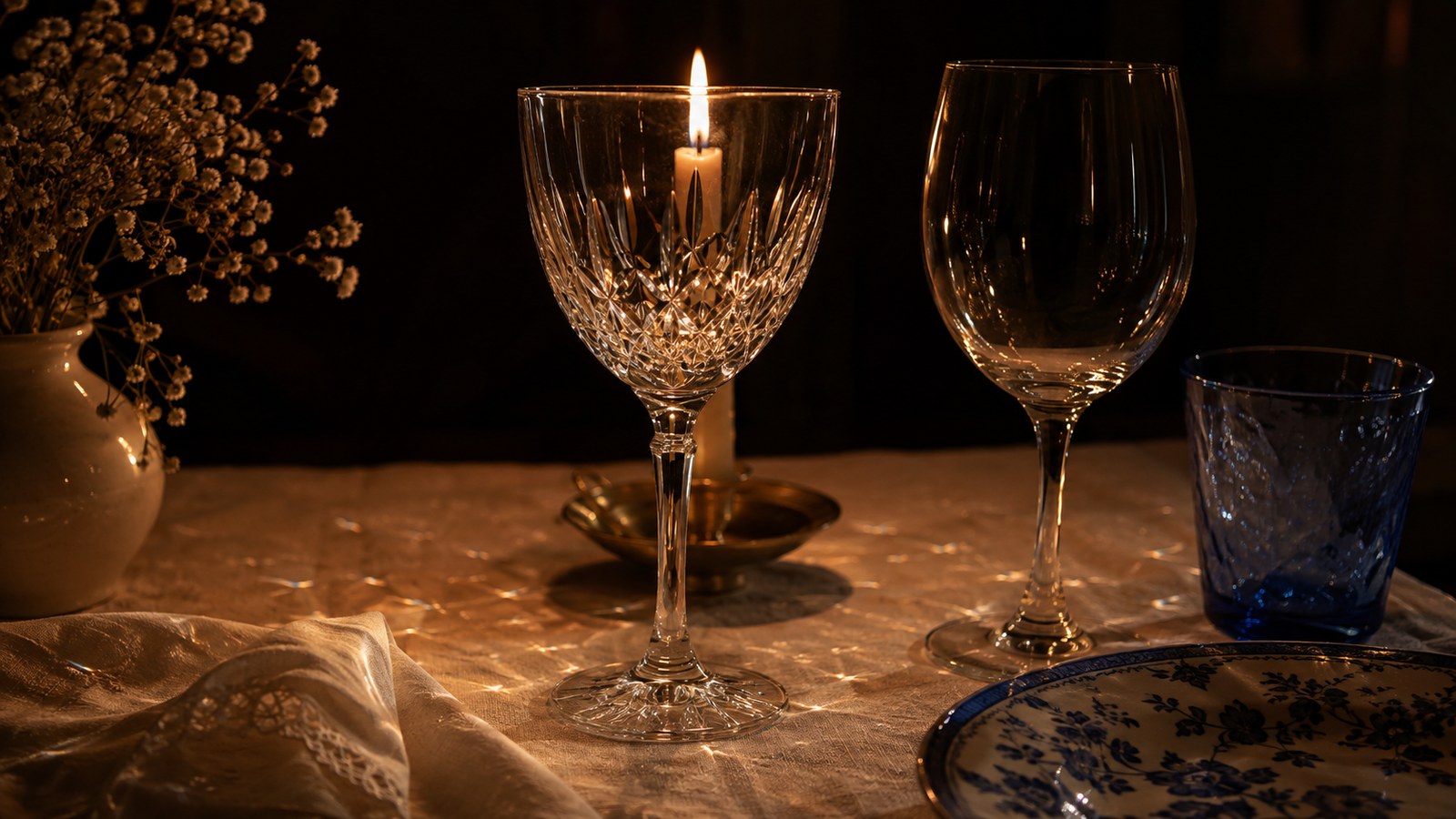
Put the light behind the glass. This one is mine and I'm marking it as mine: the book never says it. But the Lycurgus cup says transmitted light does something reflected light cannot, and an empty glass with a candle behind it turns into colour. With one caution the book does give, in the care chapter: keep the flame's heat away from the crystal, and don't let a candle burn lower than three inches from the top of its holder.
What stays with me
The set of glasses in your cupboard began as a public-safety problem in 1291, became a state monopoly, escaped by bribery, was fixed by accident in 1676, was cut because of a tax in 1745 and made cheap by a press in 1827.
Nobody planned any of that. And still the object that reached your table does one very simple thing: it takes the light in the room and gives it back.
If you want the rest of what we're building for the season — Thanksgiving on 26 November as much as December — it's all gathered on one page.
And if you want the table detail that gives you the same lift and care for nothing: The Art of Napkin Folding has the classic folds step by step. R$ 47.00, lifetime access.
Tell me: do you have glasses put away that you never use? Here it's six inherited ones, coming out of the cupboard this year.
Free
Take the Christmas table checklist
Everything that matters on a Christmas table, on a single sheet. Print it, or fill it in on your computer.
It arrives straight away. After that, my newsletter — leave whenever you like.