
Modern Glitter Came Out of a Mistake Made by a Cattle Rancher in 1934
The method for producing the particles in modern glitter was, in the book's own word, "a mistake."
Henry Ruschmann was a machinist and cattle rancher from New Jersey. In 1934 he happened across a way of cutting coloured plastic that produced tiny sparkling fragments. He didn't know what he'd created, but he could tell it was something. He founded a family business to protect it, Meadowbrook Inventions — which still exists today on the grounds of the original cattle farm, and remains the biggest manufacturer of glitter in the world.
The company slogan, which I think is perfect: "our glitter covers the world."
The end of the year is the season a house gets deliberately covered in shine. The tree, the glass, the thread in the cloth, your own face. Worth understanding what the stuff actually is.
Shine is older than almost everything
Before plastic, shine was mineral.
From as early as the Paleolithic era, mica was used in cave paintings to make them sparkle.
Sit with the scale of that. Before writing, before the wheel, somebody was already mixing sparkling powder into a wall because the wall looked better when light hit it.
And the name preserves the intention: mica probably derives from the Latin micare, meaning "to flash."
The detail that reorders the timeline
One sentence in the book I read three times:
"With the exception of the industrial production of synthetic glitter in 1934, the major developments in makeup have all taken place over the past twenty years."
So nearly everything that exists in shine today is very recent. And in the middle of that short list, one isolated event, from 1934, made by accident on a farm.
What old shine was made of
Here the answer is odd and true.
"Classically, pearl makeup was produced using natural mica… as well as fish scales."
Fish scales. The book doesn't explain the chemistry or say which fish, and I'm not going to invent it.
That pearl effect first became popular in the sixties, and the book admits "the stuff available then was all fairly unsophisticated."
Free
Take the Christmas table checklist
It arrives straight away. After that, my newsletter — leave whenever you like.
Why cheap shine looks cheap
This is the technical part, and it applies to everything you'll put on a table this season, not just to a face.
Old pearl had "large, jagged metallic particles that just sat on top of the skin."
Sat on top. That's the definition of cheap shine.
Modern synthetic pearls are smaller and more uniform, and they have "the crucial property of transparency." That is the turn: "it's the quality of transparency that allows light to travel through the pearl."
Through, rather than bouncing off.
Then came borosilicate glass pearls, coated with pigment, where "the power of reflection is increased, allowing color changes using the natural prism of light." And at the far end, mirror pearls: the glass particle is coated with metallic silver or gold pigment "so that it acts like a mirror."
The image the book uses, which I'm stealing permanently: "just think of a chandelier when the sunlight hits it — the principle and effects are the same."
The rule that falls out of it
Here's the most useful thing in this post, and it isn't about makeup.
Shine reads expensive when light passes through it. It reads cheap when light only bounces off the top.
That explains things I'd never connected:
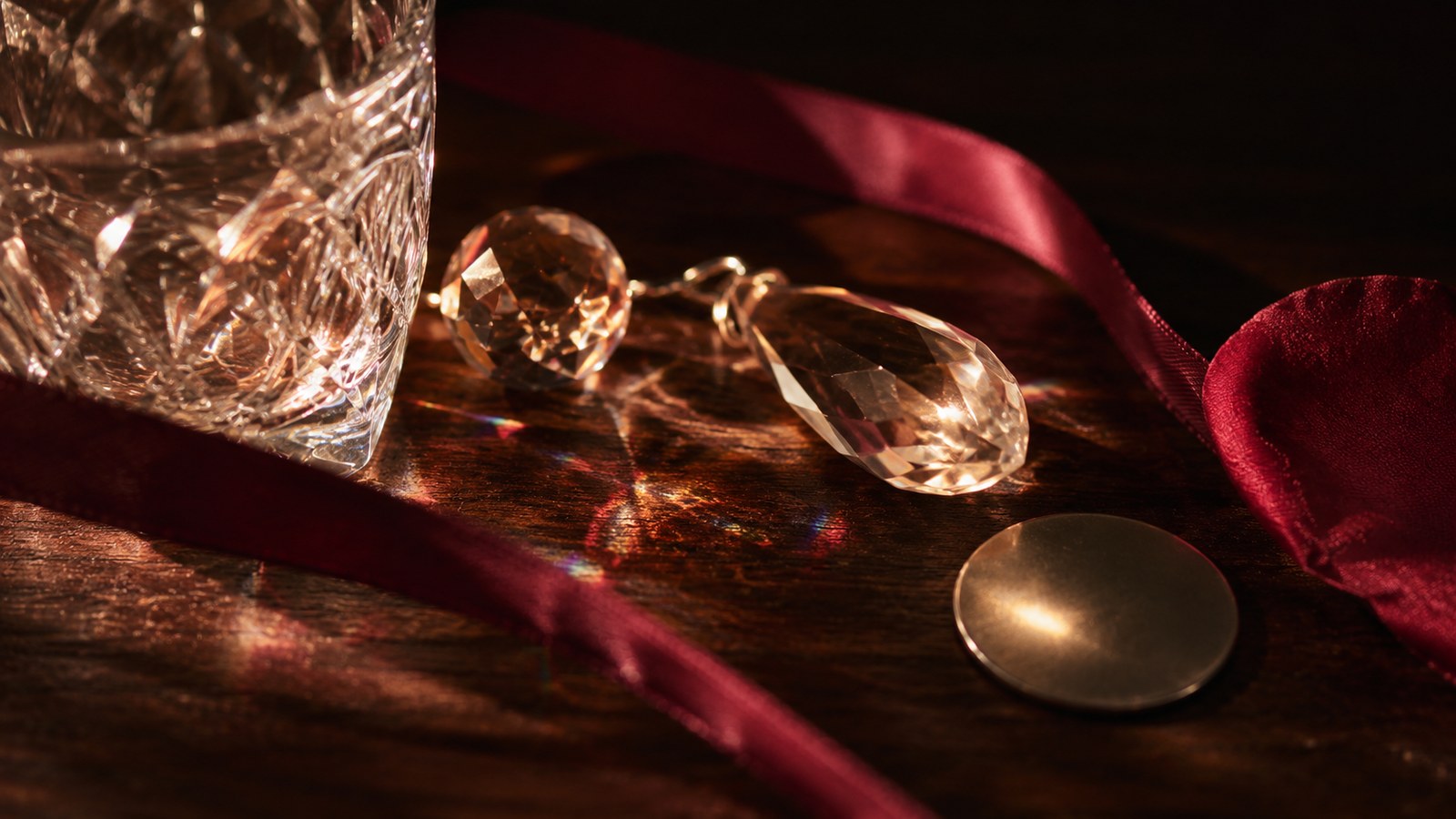
Why a plain glass tumbler on a candlelit table outperforms a metallic ornament. Glass lets light through; the metallic thing returns all of it at once, in one spot, and reads as flash.
Why a little satin sheen on a face disappears beautifully while heavy shimmer reads as children's party glitter. Same physics, different scale.
Why a fine metal thread in a fabric works and a big sequin blows out in a photograph.
One question, for anything shiny you're tempted to buy this season: does light go through this, or does it just bounce?
Where each kind belongs
The book is specific and I found it useful.
Very fine satin-finish synthetic pearls go into highlighters, blushers and foundations. That's the shine that doesn't read as shine, it reads as good skin.
Mirror pearls go into lipstick, eyeshadow and eyeliner. There the effect is the point.
One line that sizes the industry: according to the head of L'Oréal Luxe's labs, "L'Oréal has twenty pigments but over one thousand pearls."
Twenty colours. More than a thousand ways to reflect light. The whole makeup industry is far more interested in light than in colour.
Where the technology came from, which surprised me
The shine in your eyeshadow came from cars.
Pearl pigment in cosmetics "was inspired by the technology of the car industry (in fact, the paint for pearl pigments still comes from car manufacturers)." And car paint "was revolutionized in the eighties."
There's a straight line between the bodywork of an eighties car and your highlighter.
Why almost none of it is natural
A note I found honest and entirely unromantic.
The pigments are synthetic because "natural pigments are so unpredictable: they can change color or go off."
Iron oxides survived, in synthetic form — and the book closes on a line I liked: "in some ways we're looping right back to the makeup of ancient Egypt."
Two things the book doesn't say
Worth recording, because the temptation to complete the story is strong.
It does not say what Ruschmann was trying to do when the mistake happened, or what problem he was solving. There's no scene. I badly wish there were.
And it connects none of this to Christmas, ornaments or decorating. That bridge is mine, not the book's.
What I'm doing with it
On the table: glass, crystal, old silver, water. Things light passes through or travels along. Fewer single-colour metallic objects.
On a face: fine satin on the high points, and the strong shine saved for one place only.
And a new calm about where all of it came from. The shine on your holiday table began with a man who raised cattle and got a machine wrong. It doesn't have to be so serious.
If you want the rest of what we're writing for the season, it's all collected here. And on why the light in a room decides what exists on your face, I wrote a whole post about that.
If the table half interests you more than the face half, I made a course on napkin folding — a fold is the cheapest way to make a surface answer light. R$ 47.00, lifetime access.
Tell me: are you shine or matte at a holiday table? I was matte on principle and changed sides after reading about chandeliers.
Free
Take the Christmas table checklist
Everything that matters on a Christmas table, on a single sheet. Print it, or fill it in on your computer.
It arrives straight away. After that, my newsletter — leave whenever you like.