
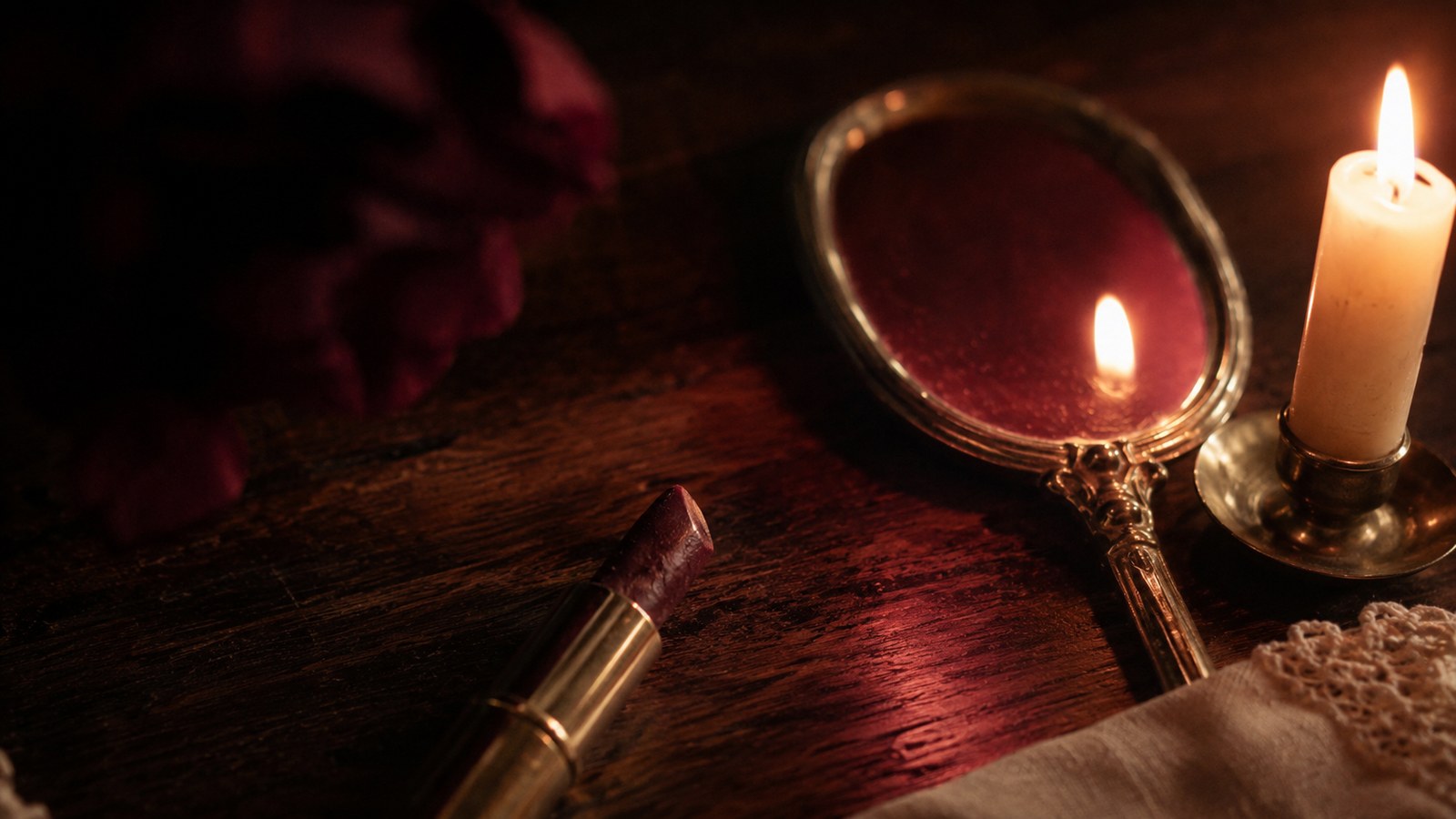
Until 1926, Film Couldn't See Red: Red Lipstick Photographed Black and Blue Eyes Photographed White
The orthochromatic film used in early cinema was sensitive to blue and essentially blind to red. On screen that meant: actors' skin appeared twice as dark as it really was, blue eyes photographed white, and anything red turned black.
Panchromatic stock, sensitive to the whole spectrum, didn't really come into use until after 1926.
So for decades an actress's red lipstick became a black mouth. And makeup had to be entirely redesigned, not for the face but for the light and for the material recording that face.
Hold on to that idea, because it applies to your dining room in December: makeup was never made for a face. It was made for a light.
The light kept changing, and makeup followed
From the end of the eighteenth century onward, theatre lighting changed technology in sequence: kerosene lamps, then gaslight, then limelight, then electric light.
Limelight was the first form of spotlight. It was first used in a theatre in 1837 and in wide use by the 1860s.
And the change forced the rest: with the arrival of gas illumination, limelight and the first fully electric theatres came necessary developments in stage cosmetics to match. An illustration from 1894 in the weekly the Graphic shows Sarah Bernhardt at her dressing table, building her own face.
The actress Billie Burke, writing a column in the Chicago Day Book between June 1912 and January 1914, put it in a sentence that still holds: "the make-up for the stage and the make-up for the lights of the streets are very different."
Swap two words and read it again. The makeup for the bathroom and the makeup for the dinner table are very different.
The year somebody's face broke
1930. Marlene Dietrich shot to fame in The Blue Angel and arrived in Los Angeles that year.
She came from Berlin cabaret and met film's arc lights for the first time, described as extremely harsh. And she noticed something specific: her face became completely flattened.
Not dark, not unflattering. Flat. The light came so frontally and so hard that it erased every difference between one part of her face and another.
She had to build the structure back, with stage makeup and by reworking her brows.
That is the exact opposite of the problem at a dinner. At a table the light is scarce, low, warm and comes from a flame. It doesn't flatten, it carves. But the principle is identical — the light in the room decides what exists on your face, and it decides before you do.
Free
Take the Christmas table checklist
It arrives straight away. After that, my newsletter — leave whenever you like.
What the actors were doing wrong
An observation I found generous to everyone.
In early films, actors painted their faces as if projecting to the back row of a theatre rather than to a camera a few feet away.
That wasn't vanity. It was people applying exactly the right technique for the wrong light.
The problem was obvious enough that in 1917 George Westmore set up the first studio makeup department, clocking in from five to eight each morning before a full day at a hair salon. His stated reason: on-screen makeup looked ludicrous, and had no continuity between scenes.
After that, every technical change demanded a new product. Max Factor made greasepaint in cream rather than stick form, in twelve shades, because stage sticks cracked on film. And when Technicolor arrived he had to invent something else from scratch: Pan-Cake, in 1937, a cream powder applied with a damp sponge, the first consumer foundation that didn't crack. Pan-Stik followed in 1948.
Fifty years later the reason was still light. MAC was founded in 1985 because the cosmetics then available had finishes that reflected too much light in photographs. The answer was matte. An entire brand born from a complaint about light.
The trick Dietrich invented in a trailer
This is my favourite, and it solves exactly the problem of a table lit by candles.
In 1930, in her trailer, Dietrich showed one of the Westmores how she made her own eyeshadow: she turned the saucer from under her coffee upside down, held a lit match under it until it carried a sooty smudge of carbon, mixed in a couple of drops of baby oil with her fingers, and blended it from the lash line up toward the brows.
Everyone else was using heavy black. Hers read three-dimensional because, in the recorded words, "the oil glistened in the reflected lights."
What she'd worked out is that shine is what gives depth back when light is scarce. A matte shadow swallows what little light there is. A surface that reflects returns it.
It's the same reasoning behind Marilyn Monroe reportedly wearing a layer of heavy cream under her foundation, which gave her a glow under studio lights.
And it's the exact inverse of the rule we learned for flash photography — where, incidentally, the rule still stands: no shimmering shadow when there'll be a camera flash, because it reflects the flash straight back.
Two opposite lights, two opposite answers. There is no correct makeup. There is makeup correct for a light.
The mistake nearly everyone makes
Here's the practical part, and it's a question of where you're standing.
The rule all three books repeat, in different words: test colour in the light it will be seen in.
Bobbi Brown, on foundation: "always test foundation in natural light. Walk to a window or doorway to check the match." The right shade is the one that disappears. She also says she makes up a model facing a window or, better still, on set under the lighting that will actually be used.
Riku Campo wants three things to read a face honestly: bright daylight, a large handled mirror, ideally 25 centimetres across or more, and a bare face. He also says to carry a hand mirror so you can step outside and check a shade in natural light.
He has one warning about mirrors I wish I'd read ten years ago: "beware of magnifying mirrors. If a hair cannot be seen with your own naked eye, chances are no one else will see it either."
Put the three together and what's left is this. A bathroom is a small room with pale tile and white light coming from above and close. A dining room in December is large and dark, with yellow light coming from below and far away.
None of the books I read discusses the direction light comes from at a dinner table — that's my observation, not theirs. But all three say the light you apply in and the light of the evening have to agree.
What I'm doing at dinner
Something reflective, in the right place, because the light will be scarce and shine is what gives relief back.
Nothing shimmering if I know there'll be a flash.
And if I can manage it, a hand mirror near the table, to check once in the light I'm actually in.
If you want the rest of what we're writing for the season, I've gathered it on one page — the table, the house, the meal. And on candlelight from the other end of history, painters solved this same problem on canvas.
Tell me: do you do your makeup in the bathroom or near a window? I switched not long ago and there's no going back.
Free
Take the Christmas table checklist
Everything that matters on a Christmas table, on a single sheet. Print it, or fill it in on your computer.
It arrives straight away. After that, my newsletter — leave whenever you like.