
In 1969 a Caravaggio Nativity Was Cut Out of a Church in Palermo. It Never Came Back.
I went looking for something trivial — which Christmas painting is the most beautiful — and landed in a police case.
Caravaggio's Nativity is from 1609. In 1969 it was stolen from a church in Palermo, Sicily. According to the art books on my shelf, it has never been recovered.
That made me stop and look differently at a subject I'd assumed was merely pretty.
The technical problem nobody mentions
Here's the thing I hadn't noticed in thirty-odd years of looking at these pictures.
The Nativity happens at night. It's a night scene, in a place with no decent window, before any form of lighting we would recognise.
Which means every painter who took that commission also took on a hard technical problem: painting something nobody can properly see.
And the solution most of them adopted is elegant and strange. In Nativities, the Child is frequently the principal source of light. The light doesn't come in through a door. It comes out of the middle of the picture.
That isn't the painter being mystical, it's composition. Put the light source at the centre and everyone has to lean toward it, which gives the painting a geometric centre and an emotional centre in the same place. It's a drawing decision before it's anything else.
The Dutchman nobody's heard of who got there first
One of the earliest free-standing paintings of its kind in northern Europe is by Geertgen tot Sint Jans, a painter who died around 1495, aged about twenty-eight according to the chronicler Karel van Mander.
His Nativity is tiny, and it's described as a beautiful nocturnal scene, a study of the effects of artificial light.
A man who lived less than thirty years, in the fifteenth century, solved the problem by turning the picture into an exercise about light. Before there was a word for that.
Free
Take the Christmas table checklist
It arrives straight away. After that, my newsletter — leave whenever you like.
The specialist in winter
Changing subject without changing season: if you've ever seen an ice-skating scene with hundreds of small figures on it, you've probably seen an Avercamp.
Hendrick Avercamp was baptised in Amsterdam on 25 January 1585 and buried in Kampen on 15 May 1634. He spent nearly his whole career in a provincial town.
He was the first Dutch painter to specialise in winter landscapes, and the type became hugely popular. His work combines sensitive observation of nature with a crowd of small, very lively figures.
Two things about him I can't get out of my head.
He was deaf and mute, and was known as de Stomme van Kampen, the mute of Kampen.
And he was such an outstanding draughtsman that he sold tinted drawings as finished works, at a time when a drawing was usually just a study for something else.
His nephew Barent Avercamp, who lived from 1612 to 1679, spent his career imitating his uncle's style.
The painter candlelight rescued from oblivion
Georges de La Tour worked his whole life in Lorraine, an independent duchy until France invaded it in 1633.
Only about forty paintings by him are known, and the books describe the most characteristic of them the same way: meditative nocturnal scenes lit by a candle or a flaming torch.
After he died he was quickly forgotten. He was not rediscovered until the early twentieth century.
He is now generally regarded as the greatest of all Caravaggio's followers, and the difference is that he took the Italian's light and shade and used it in his own way — contemplative rather than theatrical.
Three hundred years of obscurity, then that verdict. It's a consolation for several things.
The painting that isn't nocturnal
And my favourite fact from all of this, because it dismantles the whole subject.
Rembrandt's The Night Watch, from 1642, is not a night scene.
The name wasn't used until the nineteenth century, by which point the picture was so darkened by old, dirty varnish that it looked nocturnal. It was cleaned soon after the Second World War and emerged as a daylight scene.
Its real title is a long bureaucratic sentence about the militia company of Captain Frans Banning Cocq.
So for more than a century, the most famous painting in Dutch art had its name, its fame and its whole mood decided by dirt.
As a footnote, a line from 1678: Rembrandt's former pupil Samuel van Hoogstraten wrote that it made the other paintings in the same hall look like packs of playing cards.
What this changed about how I look
I started looking at these pictures for the light source before looking at the scene.
It's a silly game and it improves everything. Where's the candle. What does it reach. What has it deliberately left out. In a Nativity the answer is almost always the middle, and the rest of the picture is organised around it.
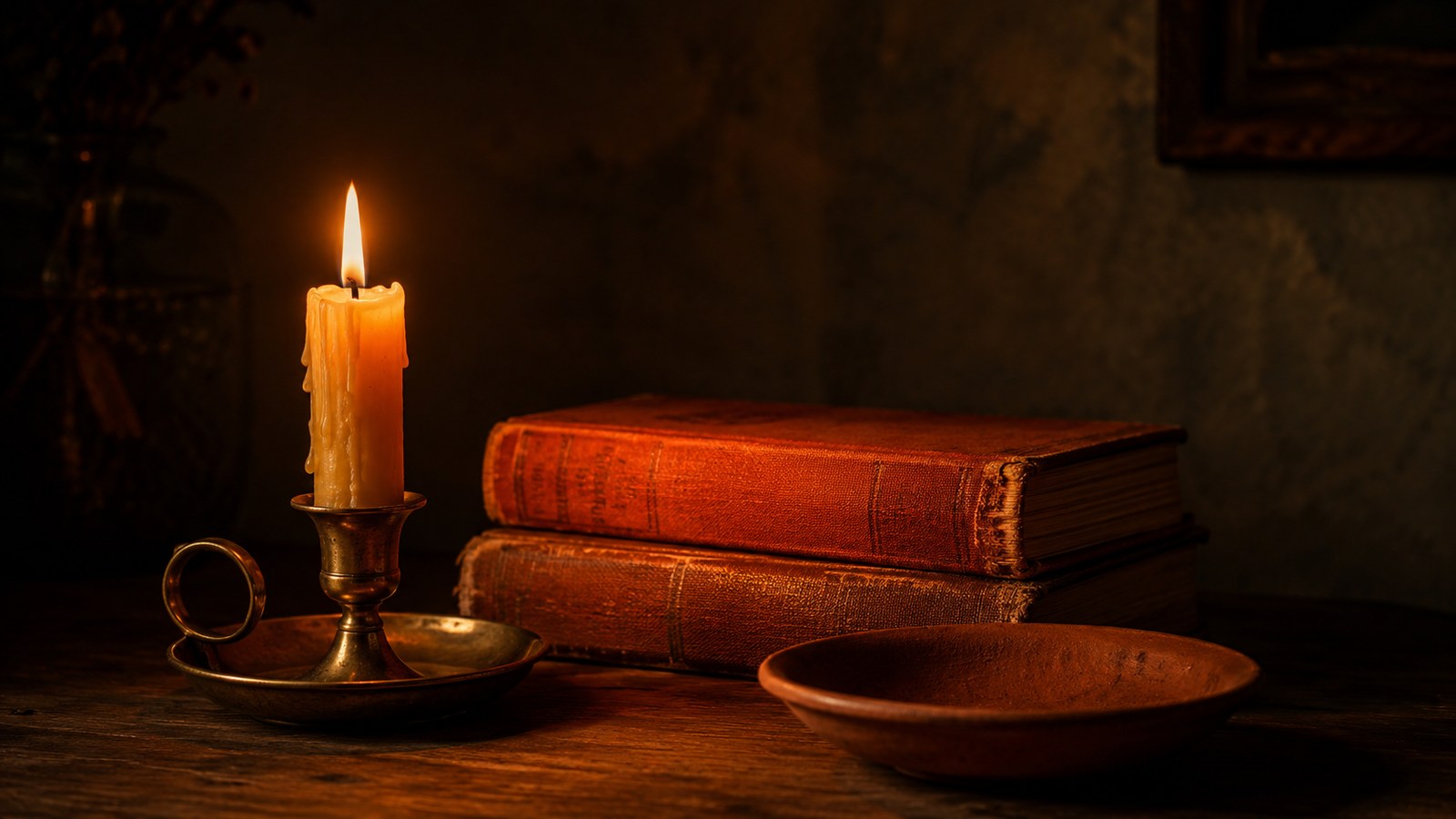
It applies to your own room in December too. A low candle in the centre of a table does exactly what it did in a painting from 1609. It pulls everyone toward the middle and switches off the rest.
If you want the rest of what we're writing for the season, I've gathered it on one page. And on reading a painting for the painter's decision rather than its subject, I wrote about Rembrandt's self-portraits, which is the same exercise.
Tell me: is there a picture or a card your family puts out every year? There is here, and it's ugly, and nobody is allowed to remove it.
Free
Take the Christmas table checklist
Everything that matters on a Christmas table, on a single sheet. Print it, or fill it in on your computer.
It arrives straight away. After that, my newsletter — leave whenever you like.