
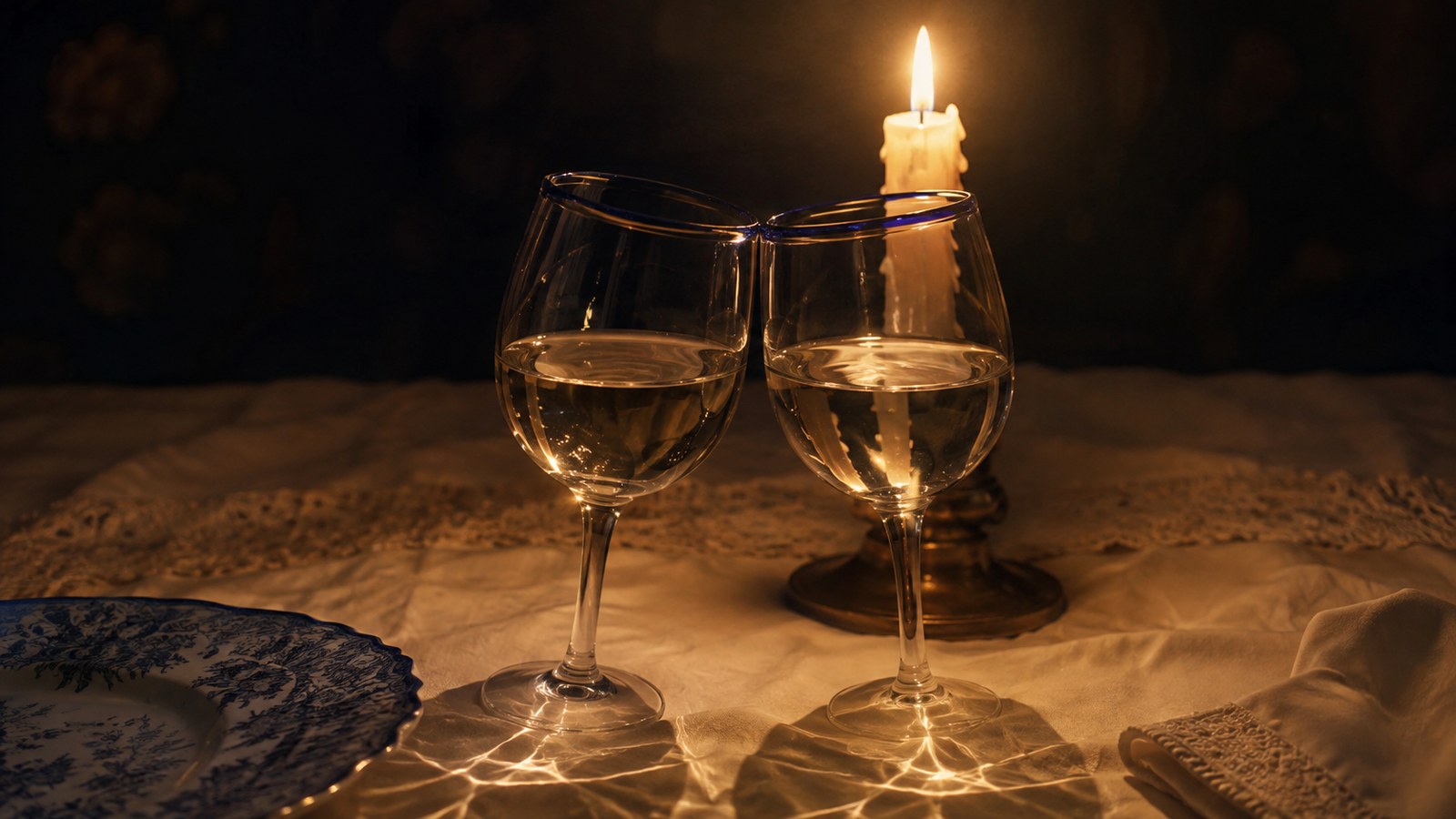
Clinking Glasses Began as an Imitation of a Bell
Why do we clink glasses?
The book I was reading gives an explanation I hadn't heard, and it's very specific:
"In the early Christian era, people believed that the devil entered the body through alcoholic drinks and was deterred by the sound of bells."
And then the sentence that resolves the gesture:
"To ward off the evil spirit, guests clinked their glasses together, making a bell-like tone that today traditionally follows a toast."
Notice the book's care: it writes "people believed", not "the devil was deterred". It's recording a period belief, not endorsing one. I'll keep the same care.
And notice what survived. The bell tone is still there. The glasses still touch. The reason evaporated about fifteen hundred years ago and nobody noticed.
The oldest origin is a safety demonstration
"The custom of raising the first glass of wine to one's health is attributed to ancient Greece, when a sip was taken to demonstrate that the drink was not poisoned."
Hold on to "is attributed to". The book chooses that verb deliberately, names no source at all, and I'm not going to convert it into "it began in Greece".
It adds one line: "In Homer's Iliad, Ulysses drank to the health of Achilles." No book, no line number, no citation.
What interests me is the mechanism. The host's first sip was a guarantee. Look, I'll drink first. The toast begins as trust demonstrated in public, and that is the one function it has never lost.
What it does not say, and what nearly everybody repeats
I went in with a certainty and came out without it.
You have probably heard that "toast" comes from a piece of spiced bread dropped into the wine.
This book says no such thing, anywhere. The word "bread" does not appear once in the chapter.
What it says is only this: "The modern word toast is from the Latin term tostus meaning 'parched'." It gives the Latin root and stops. It never joins tostus to bread, and never mentions bread in wine at all.
Recording that for honesty: the bread story may well be true, but it didn't come from here, and I'm not lending a source authority it doesn't claim.
Free
Take the Christmas table checklist
It arrives straight away. After that, my newsletter — leave whenever you like.
The explanation it does give is better, and it's a joke from 1709
"In the mid-seventeenth century the word acquired its modern-day meaning, as a sentiment given to honor someone."
And then the book quotes an etymology published in a Tatler in 1709, introducing it with two words that change everything: "somewhat tongue-in-cheek".
The story, in short. At the Cross Bath, a celebrated beauty was standing in the water. One of the crowd of admirers took a glass of the water she stood in and drank her health to the company. And then:
"There was in the place a gay fellow, half fuddled, who offered to jump in, and swore though he liked not the liquor, he would have the toast."
And it ends: "this whim gave foundation to the present honour which is done to the lady we mention in our liquor, who has ever since been called a toast."
That "somewhat tongue-in-cheek" is not optional. Strip those two words and an eighteenth-century joke becomes an asserted etymology. It's exactly the kind of thing that circulates online as fact.
Wassail is a carol traded for a drink
This is the loveliest part of the chapter, and the most useful in December.
"In the fifth century, Rowena, the beautiful daughter of Hengist, a Saxon leader in northern Germany, drank to Vortigern, a British king saying: 'Louerd King, waes hael,' meaning 'Lord King, be of health'."
And the book continues: "through the sixteenth century in England taking a sip of wine in honor of a person was known as drinking a health."
Drinking a health. As though you were handing something over.
"In time waes hael evolved as the Anglo-Saxon term wassail a word for 'be well,' used primarily at Christmas and New Year to toast one's health."
And the detail that finishes it:
"On the twelve days of Christmas, the poor who sang Christmas carols door-to-door carried a large wooden bowl to exchange carols for wassail."
A wooden bowl, carried door to door, trading music for a drink. The whole gesture of the season in one sentence: you turn up at somebody's door, you offer the thing you know how to do, and you get something warm back.
How a toast is actually given
Here the chapter turns practical, and the biggest surprise is how short it is.
"A toast is short and simple (so as not to delay the meal)." It can come any time after the first glass of wine is poured, and runs "no longer than a few minutes at most".
"Even a single word suffices as a toast", it says, offering the German prosit as an example. One word.
If a speech is called for, the speech waits until the end of the meal, not the beginning.
The host goes first. "Customarily, the host makes the first toast to the honored guest. However, any number of toasts can be expressed at a meal."
How to get attention without shouting: tap your own glass gently with a utensil, then stand.
And there's one architectural detail I loved, because it's about a real house: "When tables are set in adjoining rooms, the host stands in the doorway, so that everyone may hear his words."
Leaving your own table to stand in a doorway so that both rooms can hear. Anyone who has ever run a Thanksgiving with a grown-ups' table and a second table in the next room knows exactly what that sentence is describing.
Who stands: after the toast, everyone but the honoured guest stands, raises a glass toward them, repeats the name, and takes a sip. For any toast after the first, nobody stands.
And the person being toasted doesn't drink. "The honoree remains seated and refrains from sipping wine; to do otherwise is to honor himself." The book outsources the explanation to a sixteenth-century line: "Drink to all healths, but drink not to thine own."
How to respond: "with a nod of his head and a simple 'Thank you.'" To return the toast, either straight away or at any point in the meal.
The rule I turned around
There's a hard sentence in the chapter: not joining a toast is an offence to the person being honoured.
But the book's very next line settles it: those who don't drink wine "raise a hand as if holding a glass, or raise a glass of water and take a sip."
So what matters isn't the wine. It's the raised hand.
That covers every table with someone pregnant, someone driving, someone who doesn't drink, and children. Everyone can join a toast, and always could. The glass is optional. The gesture isn't.
One last note, and it's mine: the book writes the host entirely as "he". He taps the glass, he stands in the doorway, he nods his thanks. I've rewritten all of it for whoever is actually on her feet all evening in most of the houses I know. The rules are the same. The subject isn't.
The part I won't forget
The toast is the only moment at a table where somebody has to speak. And by design it is extremely short.
A few minutes at most. One word will do. Short so the food doesn't get cold.
If you've been putting off making a toast in your own house because you think you're bad at speaking in public: the written rule gives you a few seconds and one word. And who sits where was settled long before that.
If you want the rest of what we're building for the season, it's all gathered on one page.
And if your table will have glasses raised and dishes going hand to hand, it's worth getting the still things right: The Art of Napkin Folding has the classic folds step by step. R$ 47.00, lifetime access.
Tell me: does anyone in your family make a toast, or does everyone pretend it isn't the moment? Here it's my father, always, and always too long.
Free
Take the Christmas table checklist
Everything that matters on a Christmas table, on a single sheet. Print it, or fill it in on your computer.
It arrives straight away. After that, my newsletter — leave whenever you like.