
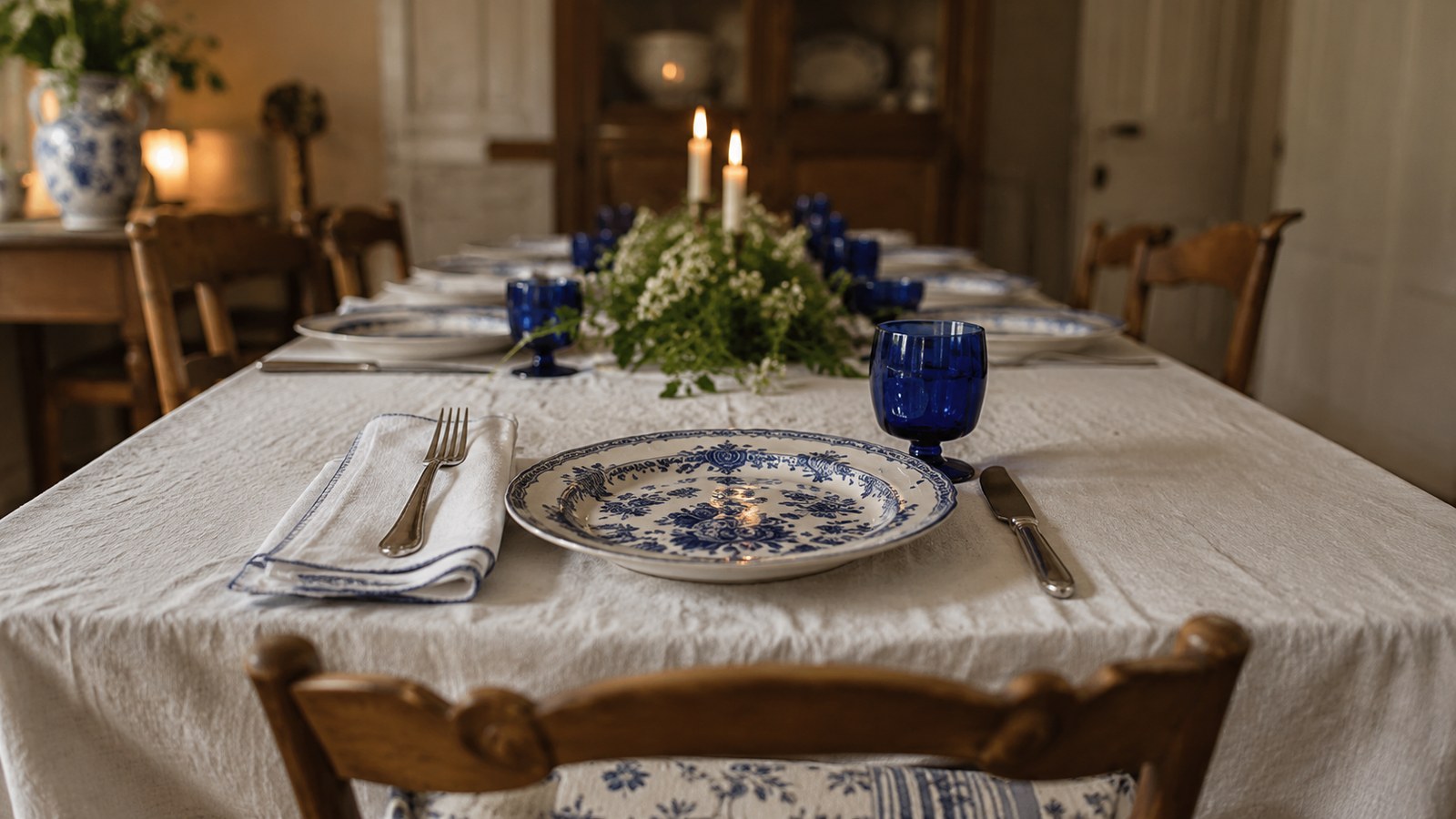
In Poland, the Christmas Table Is Laid for Someone Who Wasn't Invited
My table is 1.20 by 0.80 metres. White, rectangular, bought back when we never had anyone over.
Every year, twice — once in November and once in December — I do the same arithmetic and get the same unhelpful answer.
The sum nobody wants to do
There is a technical number for this and it is less generous than you would like. The classic recommendation is fifteen inches between one place setting and the next, which works out to roughly twenty-four inches from the centre of one setting to the centre of the one beside it.
On my table that means two along each long side and one at each end. Six.
There are nine of us.
One genuinely useful thing I learned while checking that figure: a tablecloth gives you more room than placemats. A mat marks out fixed territory that nobody may cross. A cloth lets the elbows sort themselves out, and in a squeeze that is real space, not a consolation.
The custom I didn't know about
I found this while looking for a solution to that sum, and it changed the subject entirely for me.
In Poland the Christmas Eve supper is called Wigilia. The table is laid with a white cloth over straw, and the rule is that the number of diners should be even, for luck, while the number of courses should be odd — at least twelve.
And there is one more rule: an extra place is set. Not for anybody in particular. For whoever might arrive unannounced, because on that night nobody is turned away.
I sat with that one for a while.
Free
Take the Christmas table checklist
It arrives straight away. After that, my newsletter — leave whenever you like.
Portugal does it too, and darker
In Portugal, at the Consoada eaten after midnight mass, families also set empty places. But there the place is for the alminhas a penar, the souls of the dead, and crumbs are left on the hearth.
That is the direct ancestor of the Brazilian Christmas Eve table I grew up with. It arrived already carrying a chair that nobody sits in.
I still don't know quite what to do with that. I do know I stopped looking at the spare chair as a logistics problem.
In the 1800s you could hire a guest
This part is too good not to pass on.
In the nineteenth century, when someone cancelled late and left thirteen at the table, there was an option: hire a stranger to fill the fourteenth chair. The role had a name, the quatorzième, the fourteenth — and by the accounts in the table books, being one was a highly remunerative profession.
Somebody in Paris made a living eating dinner at other people's houses to fix the arithmetic.
On numbers, Jane Austen had already settled the matter in Mansfield Park, and I can't argue: "five is the very awkwardest of all possible numbers to sit down to table."
Who sits where, and why
This is the part I actually changed at home.
Alternating men and women goes back to the eleventh century, when two people shared one plate and one bowl. Eighteenth-century England went the other way entirely and put the women at one end of the table and the men at the other.
Three things I've adopted, and the reason for each:
At a family gathering, and only at a family gathering, the seat of honour goes to the oldest person. Not the most important guest, not whoever cooked. The oldest.
Couples are separated. The reason isn't etiquette, it's conversation: a couple tells the same story and corrects each other halfway through, and the whole table stops to watch. The exception is newlyweds, defined as married less than a year, who stay together.
The corners have owners. A corner for anyone left-handed, for anyone using a cane or a walker, and for anyone arriving late or leaving early, so no gap opens in the middle. At a table where dishes travel hand to hand, a corner is the easiest place to serve and be served.
Two tables is not a defeat
When it genuinely doesn't fit, the classic answer is simpler than I expected: open a second table, and split the hosting couple, one at each.
It isn't the grown-up supervising the children. It's that each table needs somebody keeping the conversation moving, so the two people who can do that don't sit together.
On timing, a note that gave me some peace: a formal dinner historically began at half past eight or nine in the evening and ran well past midnight, with a late supper served in the small hours to revive everyone. A meal that ends after midnight was never a scheduling failure. It was the schedule.
What I'm doing this year
Seven places on a table for six, with a cloth, and the seventh chair deliberately tight.
And if a place is left over I'm not clearing it away. I'm taking the Polish version: it stays laid, for whoever turns up.
If you want the rest of what we're writing about the season, I've put it all on one page — the table, the house, the meal, growing as December gets closer. And if your squeeze is napkins rather than chairs, the folds I actually use are all explained here, in the folding course.
Tell me something: in your family, who sits at the head? Here it's my grandmother, and nobody has ever discussed it out loud.
Free
Take the Christmas table checklist
Everything that matters on a Christmas table, on a single sheet. Print it, or fill it in on your computer.
It arrives straight away. After that, my newsletter — leave whenever you like.