
In a Custard, One Egg's Proteins Have to Hold 18 or 20 Tablespoons of Liquid. In Scrambled Eggs, Three.
I went looking for why a baked custard turns holey and found one sentence that explains the whole thing, complete with the author's own exclamation mark:
"And because the protein network is stretched out into such a large volume — in a custard, the proteins from a single egg have to embrace not three tablespoons of liquid but 18 or 20! — the coagulum is far more delicate, and easily disrupted by overheating."
Three tablespoons in scrambled eggs. Eighteen or twenty in a custard.
Same egg. Six times the work.
The ladder, and where each part firms up
First the plain egg, nothing mixed in. Every part of it has its own temperature:
- Egg white begins to thicken at 145°F and becomes a tender solid at 150°F.
- The yolk begins to thicken at 150°F and sets at 158°F.
- A whole egg, yolk and white mixed, sets around 165°F.
- At about 180°F, ovalbumin coagulates and "the tender white gets much firmer."
- The ceiling on all of it is the boil, 212°F.
And the rule that governs the entire chapter: "egg dishes should be cooked only just to the temperature at which their proteins coagulate, which is always well below the boiling point."
One technical note I owe you, which is dull but matters if you cook in Celsius. The book's own °C conversions drift 2 to 4 degrees low above about 175°F. If you're working from the Celsius column, recompute from the Fahrenheit. I've kept Fahrenheit as the primary figures here for exactly that reason.
Why a custard sets later
Because everything you mix into the egg gets in the way of the proteins finding each other.
Milk dilutes. Sugar dilutes and does more: "A tablespoon of sugar surrounds each protein molecule in a one-egg dish with a screen of several thousand sucrose molecules."
A screen of sugar around every protein. They need more heat to find each other through it.
The result, with a number: a mix of one cup of milk, a tablespoon of sugar and an egg "begins to thicken not at 160°F, but at 175 or 180°F."
And the general range: "the coagulation temperature in a custard is between 10 and 20°F higher than in the undiluted egg, between 175 and 185°F."
And here is the hole
This is the sentence I came looking for:
"Exceed the coagulation range by just 5 or 10°F and the network begins to collapse, forming water-filled tunnels in the custard, grainy curds in the cream."
Water-filled tunnels. That's the technical name for the holes.
It isn't air. It isn't leavening. It isn't the recipe. It's the protein network, stretched to its limit holding twenty tablespoons of liquid, tearing and letting go of the water it was holding.
And the margin is five degrees.
Five degrees between a smooth custard and a weeping one. Which is why it feels temperamental: it isn't temperamental, it's tight.
Free
Take the Christmas table checklist
It arrives straight away. After that, my newsletter — leave whenever you like.
The five things that give the margin back
Low heat, always. The book has an image I'll be using for the rest of my life: "Turning up the heat is like accelerating on a wet road while you're looking for an unfamiliar driveway. You get to your destination faster, but you may not be able to brake in time to avoid skidding past it." And it adds: coagulation has momentum, and "doesn't stop the second you turn off the heat."
Hot into cold, never cold into hot. Scald the milk, then pour the hot milk into the eggs while stirring. That takes the egg "gently but quickly to 140 or 150°F, just 30 to 40°F short of the setting temperature." The reverse, "adding cold eggs to the hot milk — would immediately heat the first dribbles of egg close to the boil and cause premature coagulation and curdling."
A water bath, with two details I was getting wrong. First: "It's a mistake to cover the whole water bath, since this forces the water to the boil." Cover the individual dishes, not the roasting pan.
Second is a myth taken apart. Plenty of people put a folded tea towel in the bottom of the pan. The book: "this can backfire: the towel prevents the water from circulating under the cups, so the water trapped there reaches the boil and rocks the cups around. A wire rack works better."
And a floor: the bath has to reach at least 185°F, "otherwise the mix may never completely set."
Take it out underdone. "It's best taken from the oven while the center is still slightly underdone and jiggly. The egg proteins continue to set somewhat with the residual heat, and the custard will in any case be firmer once cooled to serving temperature." The test is to bump the dish: the contents should move only sluggishly.
Cooling is part of the recipe, not waiting. "Cooling firms protein gels." A custard doesn't finish in the oven. It finishes in the fridge.
A pinch of salt, and the reason is wonderful
I didn't know this one:
"Mix an egg with a cup of plain water and you get curdled egg floating in water; include a pinch of salt and you get a coherent gel."
Same amount of egg, same amount of water. The difference is salt.
The positive ions act as a shield between the proteins, which is why any liquid with dissolved minerals will make a custard and plain water will not.
And a bonus myth demolished: "There's no truth to the common saying that acidity and salt 'toughen' egg proteins." What they actually do is the opposite: they make the egg coagulate at a lower temperature, and with a more tender texture.
Crème caramel, with the step nobody mentions
The book describes the object exactly:
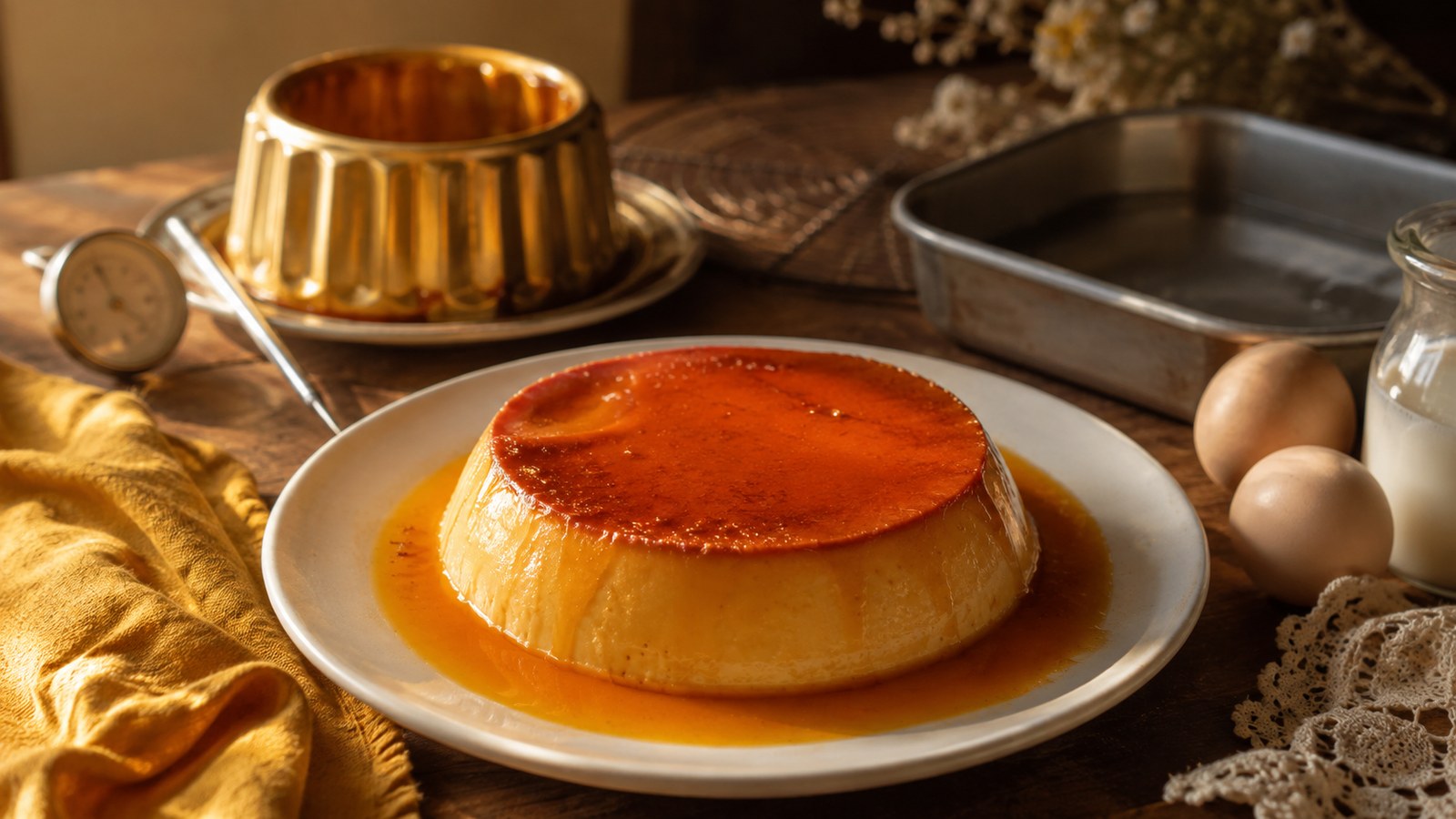
"Crème caramel is a freestanding sweet custard with a layer of moist caramel on top. It's made by coating the bottom of the dish with a layer of caramelized sugar before the custard mix is poured in and cooked. The caramel does harden and stick to the dish, but moisture from the custard mix softens it, and the two layers become partly integrated."
And then the practical detail that saves the dessert:
"The custard is turned out of the dish while still slightly warm and the caramel soft. If the custard must be refrigerated before serving, leave it in the mold; the caramel can be softened again by placing the dish in a shallow pan of hot water for a minute or two before unmolding."
One or two minutes of hot water underneath. That's what fixes the custard that won't come out.
And the proportion, for a custard that has to stand up on its own outside the dish: at least three yolks per cup of liquid. Swapping milk for cream reduces the number of eggs you need, because cream "contains 20 to 40% less water."
Two history notes I loved
Crème brûlée wasn't baked. "From the time of its invention in the 17th century until early in the 20th, crème brûlée was a stirred cream, prepared on the stovetop by making a crème anglaise, pouring it into dishes, and caramelizing the sugar topping with a red-hot metal plate, or 'salamander'."
A red-hot metal plate laid onto the sugar. Three hundred years before the blowtorch.
And custard has a relative in the bakery. The word "began as 'croustade' in medieval times, and meant dishes served in a crust." Flan "comes from the late Latin for 'flat cake'."
The cream started out as the filling. The crust is what gave it the name.
What I'm taking into the season
That a custard isn't a difficult recipe. It's a tight one.
Five degrees of margin, a protein network holding twenty times its own weight, and a dessert that only finishes setting once it's cold.
If you want the other half of the dessert physics, sugar's temperature ladder follows exactly the same logic, in steps. Eggs and sugar are the two things in a kitchen that change state by number rather than by time.
And if you want the rest of what we're building for the season — Thanksgiving on 26 November as much as December — it's all on one page.
If your table will have dessert going hand to hand: The Art of Napkin Folding has the classic folds step by step, and it's the cheapest detail there is. R$ 47.00, lifetime access.
Tell me: does your custard weep? Mine always did, and now I know it was the oven and not my mother's recipe.
Free
Take the Christmas table checklist
Everything that matters on a Christmas table, on a single sheet. Print it, or fill it in on your computer.
It arrives straight away. After that, my newsletter — leave whenever you like.