
By the 1600s, Court Confectioners Were Building Whole Table Settings Out of Sugar
I opened a food-science book looking for an explanation of caramel and found this:
"By the 17th century, court confectioners were making whole table settings and massive decorations out of sugar."
Whole table settings. Out of sugar.
It isn't the only record. Of seventeenth-century Italy the book says "various banquet decorations, including dishes, were made from sugar." And sugar sculpture is far older than that: "There are records of a 10th-century feast in Egypt that was adorned with sugar models of trees, animals, and castles!"
The exclamation mark at the end of that sentence is the author's, not mine. He was impressed too.
Before it was dessert, sugar was a material
And before that, it was medicine.
"Europe barely knew what we now consider ordinary table sugar until around 1100, and it was a luxury until 1700."
European sweets began as "confections", from the Latin conficere, "to put together", "to prepare", composed by apothecaries to balance the body's principles. The book notes that several of those medicinal sweets are still with us: lozenges, pastilles and comfits.
And the first non-medical sweet in Europe comes with a date and two hedges I'm going to keep intact: "It's thought that the first nonmedical confection in Europe may have been made around 1200 by a French druggist who coated almonds with sugar."
It's thought. May have been. That's how the book has it.
The moment it becomes an art
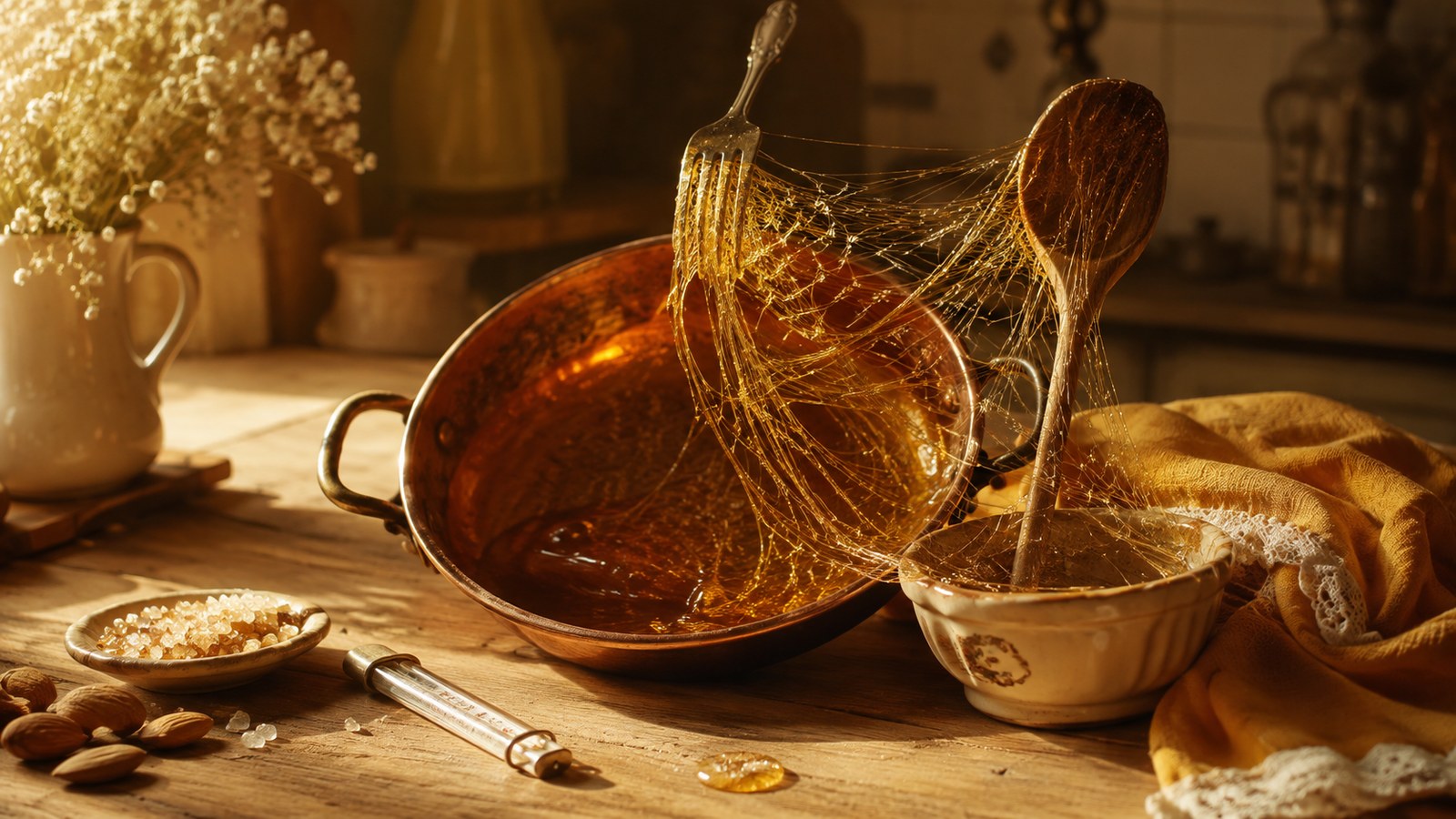
"In the 15th and 16th centuries, confectionery became more of an art, done with greater sophistication and intended more and more to delight the eye. Molten sugar was now spun into delicate threads and pulled to develop a satiny sheen, and confectioners began to develop ways of determining the different states of a sugar syrup."
Notice the order. First comes the wish to delight the eye. Then comes the need to measure the syrup. The technique arrived because the decoration demanded it.
And there's one surviving example I find brilliant and slightly unhinged. A seventeenth-century French recipe called "Slices of Ham": cook the sugar to the feather, divide it into three containers, colour one white and two red, and lay alternating layers "until the sugar has the thickness of a ham, and cut it by the slice in the form of a slice of ham."
A sugar ham, sliced. In the middle of the table. In the sixteen-hundreds.
Free
Take the Christmas table checklist
It arrives straight away. After that, my newsletter — leave whenever you like.
Something I looked for and didn't find
The book never says whether anyone ate any of it.
It describes the sugar table setting, the sugar dishes, the sugar ham, the sugar castles of Egypt, and at no point does it report the reaction of anyone sitting there, whether it was eaten, kept or destroyed, nor does it name a confectioner, a court or a particular banquet.
If you read somewhere the scene of a guest snapping the castle, it didn't come from this book, and I'm not going to invent it.
The temperature ladder, which is the useful part
Here's why all of this could exist, and it's the most applicable thing I've read all year.
Sugar doesn't change state gradually. It changes in steps, and every step has a number. The book gives the whole table:
- Thread, 215–235°F. Syrups and preserves.
- Soft ball, 235–240°F. Fondant and fudge.
- Firm ball, 245–250°F. Caramel candies.
- Soft crack, 270–290°F. Taffy.
- Hard crack, 300–310°F. Butterscotch and brittle.
- 320–335°F. Hard candies and toffee.
- 340°F. Light caramel, for colour and flavour.
- 355–360°F. Spun sugar and sugar cages.
- 375–380°F. Dark caramel.
- 410°F. Black caramel.
Two notes from the book itself that are worth gold. Above 330°F the syrup is more than 99% sucrose, stops boiling, and begins to break down and caramelize. And: for every 1,000 feet above sea level, subtract 2°F from every boiling point in that table.
The seventeenth-century confectioners had no thermometer. They had a finger, cold water, and a scale described in four words. The book is dry about it: "Then as now, the confectioner needed tough fingers."
The secret to creamy fudge is waiting
This is the piece that changed my thinking most, and it has nothing to do with the recipe.
Hot syrup makes few large crystals, and the result is grainy. Cool syrup makes many small ones, and the result is creamy.
So: cook to 235°F, and let it cool to around 110°F before you start stirring. Then beat continuously, for about fifteen minutes, until crystallisation is finished.
The classic mistake is stirring while it's hot, because stirring feels productive. It is exactly the opposite of what works.
Two more: wooden spoon, not metal, because metal pulls heat away in one spot and creates a locally super-supersaturated patch. And a difference of 1 or 2% in water content is already enough to change the texture noticeably.
The number that explains "sandy in the mouth"
"Our tongues sense particles larger than about 0.02 mm as gritty."
Twenty micrometres. That's the exact frontier between creamy and grainy, and it's why fudge is a question of temperature and patience rather than of ingredient quality.
A neighbouring fact, which explains why caramel scorches when you don't expect it: fructose caramelizes at 220°F, glucose at about 300°F, and sucrose melts near 320°F and only caramelizes around 340°F. If your recipe has honey or fruit in it, it has fructose, and it will darken long before plain sugar does.
Two etymologies I didn't know
Sugar comes, via Arabic, from the Sanskrit sharkara, meaning gravel, small chunks of material.
And candy comes from the Sanskrit khandakah, which was the word for sugar itself.
The name of sugar is the name of a small stone. Which makes complete sense for something you can carve.
What I take from this to a holiday table
That edible decoration isn't a modern Instagram flourish. It's the oldest thing in this whole history, and for centuries it was the most expensive and most admired part of the table.
The difference is that today it costs almost nothing. A pan, a kitchen thermometer and ordinary sugar make spun sugar at 355°F. Same technique as five hundred years ago, for the price of a coffee.
On why sweetness closes a meal rather than opening it, I've written a whole post, and the answer is evolutionary rather than culinary. This one is about what sweetness becomes when it stops being food and turns into an object.
And if you want the rest of what we're building for the season — Thanksgiving on 26 November as much as December — it's all on one page.
If your table will have sweets going hand to hand, a folded napkin handles half the mess: The Art of Napkin Folding has the classic folds step by step. R$ 47.00, lifetime access.
Tell me: have you ever made spun sugar at home? I tried once, burnt the lot, and now I know it was temperature and not a lack of talent.
Free
Take the Christmas table checklist
Everything that matters on a Christmas table, on a single sheet. Print it, or fill it in on your computer.
It arrives straight away. After that, my newsletter — leave whenever you like.