
The US Supreme Court Ruled the Tomato a Vegetable Because of Where It Falls in a Meal
In the 1890s, a New York food importer claimed duty-free status for a shipment of tomatoes on the grounds that a tomato is a fruit. The customs agent disagreed and charged him.
The case reached the Supreme Court, and a majority decided that tomatoes were "usually served at a dinner in, with, or after the soup, fish, or meat, which constitute the principal part of the repast, and not, like fruits, generally as dessert."
Therefore: vegetable. The importer had to pay.
The comment in the book where I read this is dry and perfect: "even the United States Supreme Court has preferred the cook's definition over the botanist's."
One note of honesty before going on: the book says only "in the 1890s." It gives no exact year and no case name, and I'm not going to supply either.
What that ruling actually says
It says the order of a meal is stronger than botany.
A court, forced to choose between the scientific definition of a thing and its position in the sequence of a dinner, chose the sequence.
And that interests me in September, thinking about a holiday table, because the order of the meal is the one part of dinner nobody ever revises. We change the menu every year and never touch the running order.
Where the line actually falls
Botany and cooking use the same word for different things.
Beginning in the seventeenth century, botanists defined a fruit as the organ that develops from the flower's ovary and surrounds the plant's seeds.
And "vegetable", in the culinary sense, "took on its current sense just a few centuries ago, and essentially means a plant material that is neither fruit nor seed."
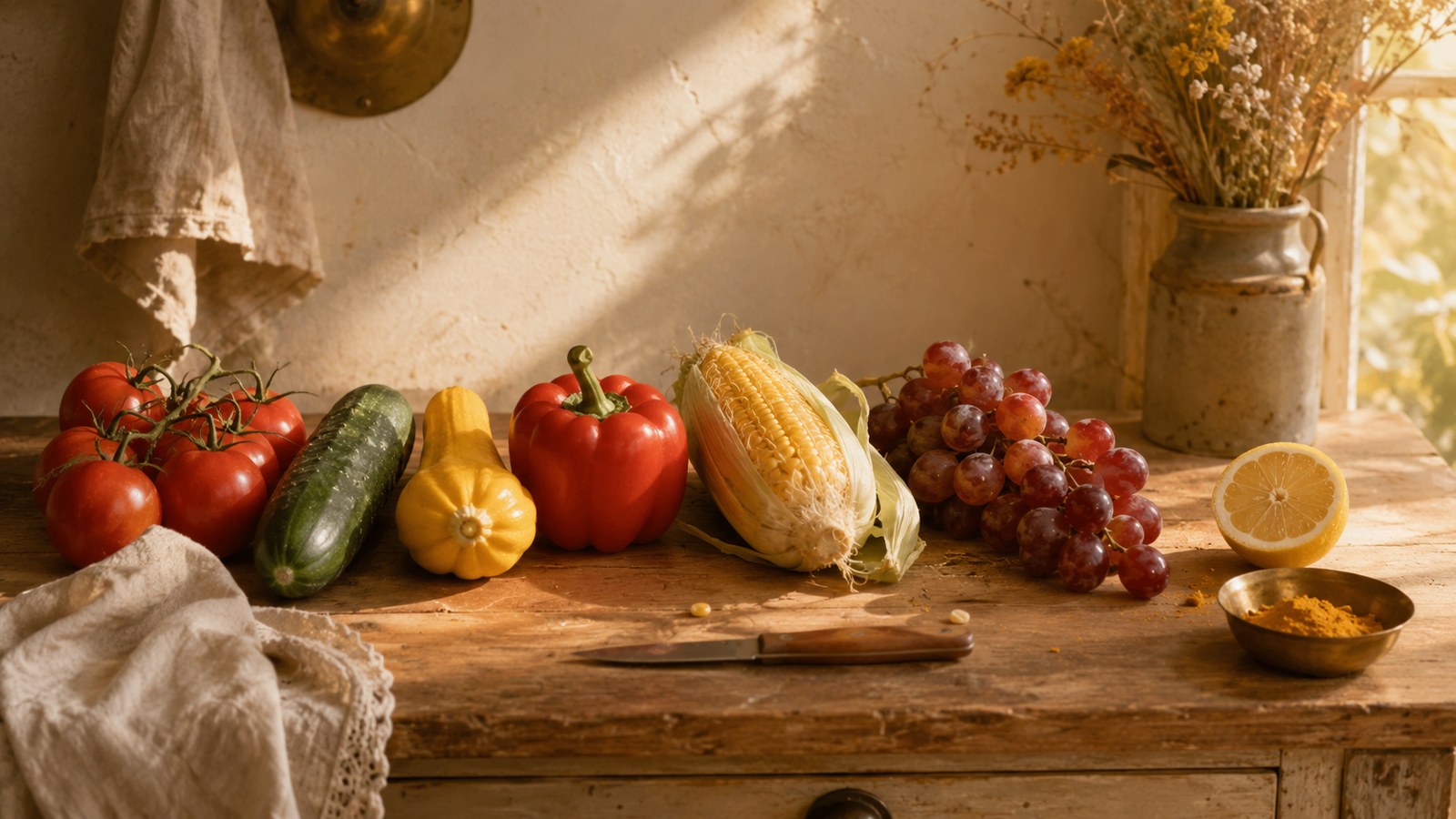
By the botanical test, these are fruits: peppers, pea pods, cucumbers, eggplants, and even corn kernels.
Two etymologies I found telling. Vegetable comes from the Latin vegere, "to invigorate or enliven". And fruit comes from fructus, whose meanings include "gratification, pleasure, satisfaction, enjoyment."
Both words already carry their place in the meal. One sustains you. The other is the prize.
Free
Take the Christmas table checklist
It arrives straight away. After that, my newsletter — leave whenever you like.
Why sweetness closes a meal
The best question in this post is the book's own: "why do we customarily prepare vegetables as side dishes to the main course, and make fruits the centerpiece of the meal's climax?"
Its answer is evolutionary and not remotely culinary: fruit was built to be eaten. It "tends to have a high sugar content, to satisfy the innate liking for sweetness shared by all animals."
The average sugar content of ripe fruit is 10 to 15% by weight.
And ripening does two things at once: unripe fruit stores sugar as "tasteless starch", which converts; and acid content drops, "a development that makes the fruit seem even sweeter."
Sweeter and less sour simultaneously. Two moves in the same direction.
One aroma figure closes the argument: vegetables, herbs and spices emit "a dozen or two" volatile molecules. Fruits typically emit several hundred — which the book calls "far more than any other natural ingredient."
So fruit at the end of a meal isn't habit. It's the most aromatic thing on the table, served at the moment everyone has stopped eating and can finally notice it.
The order is ancient, and it isn't the only one
Here's the part I wish more people knew.
The Greeks habitually ate fruit at the end of meals.
In Rome, lettuce was served at both the beginning and end of meals, and fruit as dessert. Lettuce twice. And in passing, the Romans had about 25 named apple varieties and 35 pears.
And the structure we use has dates: "fruit has been eaten as dessert at least since the Greeks; recognizable salads go back to the Middle Ages, and boiled vegetables in delicate sauces to 17th-century France."
Three layers, three eras. What looks like a natural sequence is a stack of historical decisions.
Salad at the end, and the reason
There's a box in the book called "Browning Enzymes, Breath Fresheners, and the Order of the Meal", and it convinced me.
The oxidising activity of browning enzymes "can help clear our breath of persistent garlic, onion, and other sulfurous odors!" The mechanism: "the reactive phenolic chemicals produced by the enzymes combine with sulfhydryl groups to form new and odorless molecules." Phenolic catechins in green tea do the same.
The raw foods that work, named: pome and stone fruits, grapes, blueberries, mushrooms, lettuces, burdock, basil, and peppermint.
And the conclusion, with the author's own caution: this "may be one of the benefits of ending a meal with fruit, and one of the reasons that some cultures serve a salad after the main course, not before."
Three honesty notes, because this is where it would be easy to overreach. He says "may be", not does. He credits "a group of Japanese scientists" with no date and no names. And he doesn't say which cultures serve salad afterwards — not France, not Italy, just "some cultures".
Still, for a meal built on onion and garlic and served late, a raw salad or fruit at the end has a job I didn't know about.
Three things I'm doing differently
Move the salad to the end. It's the cheapest change on the list and it solves two problems: the one above, and the fact that nobody wants salad before the main course at eleven at night.
Serve the same thing two ways. The line I underlined: "cooks can create several layers of flavor in a dish by combining well-cooked, lightly cooked, and even raw batches of the same vegetables or herbs." One ingredient, two states, in one dish. Costs nothing and doubles the complexity.
Stop refrigerating certain things. Tropical and subtropical produce "keep best at the relatively high temperature of 50ºF/10ºC, and are often better off at room temperature than in the refrigerator" — the named list includes melons, eggplants, squash, tomatoes, cucumbers, peppers, and beans.
Two practical details I kept: cooking intensifies the flavour of most vegetables, and "carrots, for example, taste far sweeter when cooked", while green-leaf and cucumber aromas are delicate and reduced by cooking. And to stop a cut surface browning, lemon works because "the browning enzymes work very slowly in acidic conditions."
A timing warning for anyone shopping at a market: "many varieties of corn and peas lose half their sugar in a few hours at room temperature."
What I keep thinking about
The tomato became a vegetable because it arrived before dessert.
Which means the order you serve things in isn't decoration on top of a meal. It's strong enough to redefine what a food is, in a courtroom.
So rearranging your own table, with fruit and salad at the end, one vegetable at two stages of cooking and the tomatoes out of the fridge, isn't fiddling with a detail. It's moving the structure.
If you want the rest of what we're writing for the season, it's gathered on one page, with a table checklist to download. And on the other invisible structure of a meal, who sits where and why is here.
And if your table will have dishes travelling hand to hand, a folded napkin is the cheapest detail there is — the course has the classic folds step by step. R$ 47.00, lifetime access.
Tell me: does salad come before or after at your house? Here it came before out of habit, and changed this year.
Free
Take the Christmas table checklist
Everything that matters on a Christmas table, on a single sheet. Print it, or fill it in on your computer.
It arrives straight away. After that, my newsletter — leave whenever you like.