
Every sauce is the same thing: something getting in the water's way
I had always treated sauces as six separate subjects.
A flour sauce is one thing. A purée is another. Mayonnaise is another. Jelly is another. Pan gravy is another. And each one came with its own private fear of going wrong.
Then I read a sentence in a kitchen science book that collapsed all of it into one thing, and I can't unsee it.
The mechanism, once
Thickening a liquid means filling it with large molecules or particles that obstruct the flow of water.
That's it. Nothing else is happening.
Water wants to run. You put something in its way big enough to block that run. The liquid starts moving slowly, and we call that "having body".
What changes from technique to technique is only which obstruction you use:
| Technique | What's in the way |
|---|---|
| White sauce, roux | swollen starch granules |
| Fruit or vegetable purée | fragments of cell wall |
| Reduced stock, aspic | gelatin extracted from collagen |
| Mayonnaise, hollandaise | oil droplets pressed against each other |
| Foam | air bubbles |
Same idea, five obstructions. And once you see it that way, you can improvise with what's in the fridge instead of hunting for the correct recipe.
There's also a single target, and it's one description: a good sauce sits between the firmness of meat and the thinness of water. Fluid enough to coat everything evenly, thick enough to cling to the food, to the tongue and to the roof of your mouth — and that clinging is what stretches the flavour out in time. A thin sauce passes through. A sauce with body stays.
The word "gravy" means "full of lumps"
This is my favourite thing in the chapter, and it's a joke made by history.
The English word gravy — the sauce made from a roast, the one everyone is afraid of making lumpy — comes from the Old French grané.
And grané comes from the Latin granatus: "made with grains", "grainy".
Which is to say: the sauce is named after the defect everyone is trying to avoid while making it.
An extra detail: the original grané wasn't a sauce at all. It was a kind of stew made with meat and its own juices — not a separate mixture of seasoning and liquid. The name migrated from the whole dish to the liquid part.
The book, to its credit, says the derivation is apparent but mysterious — nobody has reconstructed the exact path. I like it when a book admits that.
And there's a companion fact: the Latin word for sauce was ius, the direct ancestor of "juice". Later ius was replaced by derivatives of salsus, "salted" — which became sauce in France and salsa in Italy and Spain.
So the word sauce comes from salt, and the word gravy comes from lumps. The two things a sauce most depends on and most often gets wrong.
Free
Take the Christmas table checklist
It arrives straight away. After that, my newsletter — leave whenever you like.
How people tried one obstruction at a time
The history is basically a list of experiments.
Rome. In the recipe book attributed to Apicius, more than a quarter of the nearly 500 recipes are sauces. A quarter. And they thickened with absolutely anything: the pounded seasonings themselves, pounded nuts, pounded rice, pounded liver, pounded sea urchin, bread, pieces of pastry, pure wheat starch, egg yolks both raw and cooked.
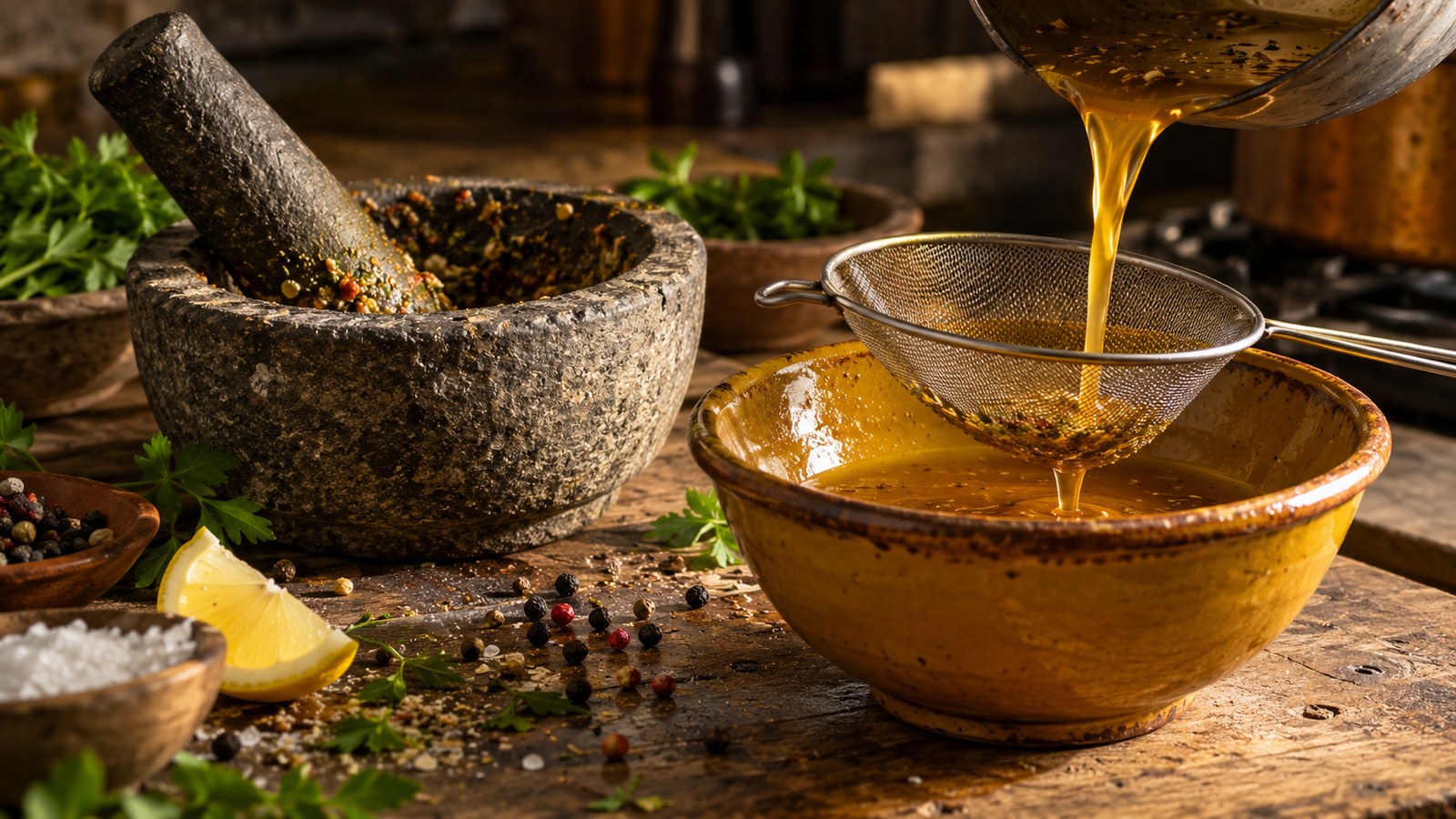
The central instrument of that kitchen was the mortar. Not the pan: the mortar.
The Middle Ages. Bread becomes the most common thickener, and toasted — toasting adds colour and flavour. Pure starch drops out. Butter and cream still aren't going into sauces.
In this period the Roman fermented fish sauce disappears and is replaced by vinegar and verjus, the juice of unripe grapes. And through the Crusades and contact with Arab trade, local Mediterranean flavourings get pushed aside by imports: cinnamon, ginger, grains of paradise. The thickening nut of choice becomes the almond.
And the second indispensable tool appears alongside the mortar: the cloth sieve, the tamis. Its job is removing coarse particles of spice and thickener to leave a finer consistency.
A mortar to break things down, a sieve to take out whatever stayed too big. The whole kitchen of sauce in two objects.
Still in the Middle Ages, two large discoveries. First, that you can thicken a meat broth just by boiling water off — concentration, adding nothing. Consommé and solid jelly come out of that. And jelly had a practical function we've forgotten: it coats cooked meat or fish and protects it from the air and from spoiling.
Second, in the fifteenth century: to make jelly transparent, cooks began using whipped egg white as a protein fabric that cleans the liquid from within, collecting particles as it goes. That is still how consommé is clarified today.
Between 1400 and 1700 the modern sauce is born. Fewer spices, a lighter hand. Vinegar and verjus give way to lemon. And bread and almond leave the stage, replaced by flour and by butter and egg emulsions — which is where hollandaise, mayonnaise and the plain white sauce of milk, butter and flour enter the story.
The excess that puts it all in perspective
One eighteenth-century detail I have to share with somebody.
A consommé recipe of the period called for, to produce a small quantity: a kilo of beef, a kilo of veal, two partridges, a hen and some ham.
All of it cooked until the liquid evaporated and the meat began to stick and caramelise on the pan, then more stock and vegetables added, cooked four more hours, and strained.
And the solid meat didn't appear in the final dish. It existed purely to donate its flavour to a liquid.
That was the logic of French high cooking in that period: a sauce doesn't exist to add new flavour to a dish, but to deepen the flavour already there and stitch it into the rest of the meal.
I'm not recommending it. But it's worth remembering the next time you feel guilty about using shop-bought stock.
What I do with this in December
Three practical things.
One: the bottom of the roasting tin is your sauce. That brown stuff stuck to the base is exactly the concentration the Middle Ages discovered — liquid that has already evaporated. Scrape it up with a little hot liquid and you have the base. If you've ever fought the war between a turkey's breast and its legs, the consolation prize is in the bottom of the tin.
Two: choose the obstruction by what you have, not by the recipe. No flour? A vegetable from the roast, blended, thickens. Want gloss rather than body? Cold butter whisked in at the end. Want it to set in the fridge? Bones and time, which give you gelatin.
Three: the sieve fixes more than technique does. The lump is so old it named the sauce. Passing it through a fine mesh is precisely what medieval cooks invented for this, and it's still the fastest correction available. It isn't cheating, it's the tool.
And if you're planning the order of the courses, the sequence of a meal has reasons that aren't just custom.
What I left out
To be clear: this is an enormous chapter, and I used the first part of it — the history and the general principle.
Left out, and worth a whole post later: the practical material on emulsions, which is where mayonnaise and hollandaise break and where the book gives the rules for not breaking them. I didn't read that section for this piece, so I'm not giving you advice about emulsions that I haven't checked.
If you'd like the rest of what we're putting together for the season, I've gathered it all on one page, with a table checklist to download.
And for the table that sauce is being served at: The Art of Napkin Folding has the classic folds step by step. R$47.00, lifetime access.
Tell me something: at your house, is the gravy strained or does it go to the table however it comes out of the tin? Here it went however it came out, and I've just discovered its name is an accusation.
Free
Take the Christmas table checklist
Everything that matters on a Christmas table, on a single sheet. Print it, or fill it in on your computer.
It arrives straight away. After that, my newsletter — leave whenever you like.