
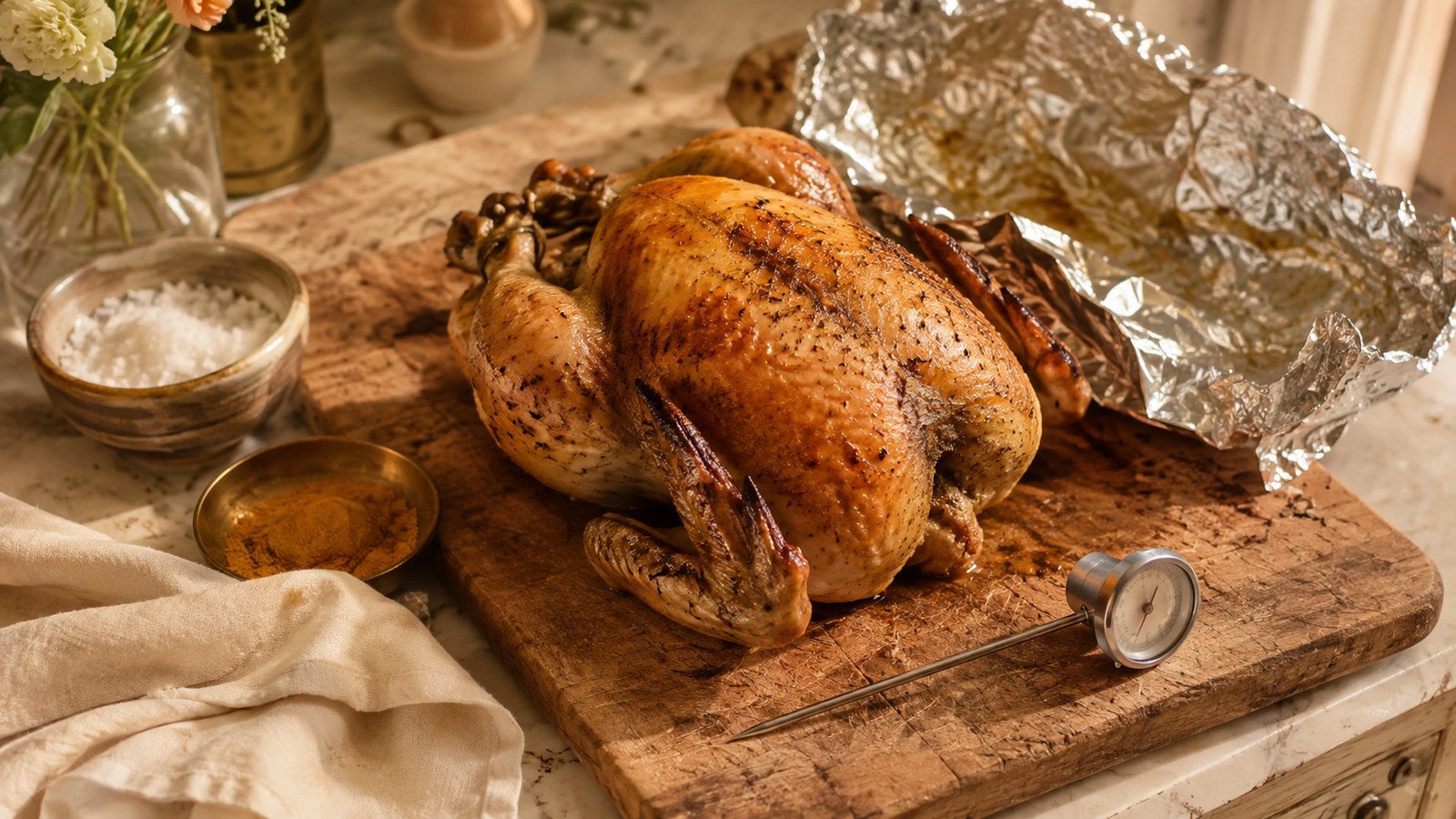
Your Turkey Isn't Dry Because You Cooked It Badly. It's Dry Because of Two Muscles That Disagree.
Every year, somewhere between Thanksgiving and Christmas, someone at the table says the same sentence while carving: "I think it went a bit far."
I spent years assuming that was a lack of practice. It isn't. It's anatomy, and you can prove it with numbers.
The argument inside the bird
Breast meat gets dry and tough above 68 °C. Leg meat is still chewy below 73 °C.
Read that again slowly. The two parts you are roasting at the same time, in the same oven, want different temperatures, and the leg wants a temperature at which the breast is already gone.
The reason is collagen. Poultry legs run 5 to 8% collagen. Breast runs 2%. Collagen needs heat and time to turn to gelatine; lean muscle needs neither.
Turkey makes the sum worse because it barely flies. Turkeys take off when startled and otherwise don't, so the breast is almost entirely white fibre from a little-used muscle, while the leg averages half white and half red.
You did not misjudge it. You were handed an impossible negotiation.
The exact moment the juice leaves
There is a band where this happens and it's narrower than you'd think.
Between 60 and 65 °C, meat suddenly releases a lot of liquid, shrinks visibly and turns chewier. What's happening is that the collagen sheath around each cell contracts and squeezes, like a hand closing.
In that squeeze the meat loses a sixth or more of its own volume.
And the window in which meat is cooked but still juicy is about 15 °C wide, total. That's nothing. A badly calibrated oven eats the entire window without telling you.
Brining, and what it actually does
Brine isn't seasoning with a fancy name. It's chemistry, and it has numbers.
A light brine is 3 to 6% salt by weight. In practice: 30 g of salt per litre for 3%, 60 g per litre for 5.5%. Anywhere from a few hours to two days, depending on thickness.
At 3%, salt dissolves part of the protein structure supporting the contracting filaments. At 5.5%, it starts dissolving the filaments themselves. The meat holds more water and takes some brine on board.
The gain is measurable. Weight goes up by 10% or more. Roasted, the meat still loses around 20% of its weight in moisture, but starting from higher up, the effective loss is roughly halved.
Here's the part I find most useful, because it's the forgiving part: since brine works from the outside in, even a brief, incomplete soak makes a difference. It reaches first exactly the region that overcooks first.
Two hours the night before beats nothing. It does not have to be overnight to count.
The cost: it gets salty, including the drippings in the pan. If you're making gravy from those, taste before you add salt.
Free
Take the Christmas table checklist
It arrives straight away. After that, my newsletter — leave whenever you like.
A hot oven flatters you
Below 125 °C the surface of the meat sits around 70 °C, because evaporating water cools it on the way out. Little moisture is lost, doneness is even from centre to edge, and — the thing that matters most on a night when everything runs late — there is a large window of time in which the bird is properly done.
Above 200 °C, the meat loses a lot of moisture and the centre goes from done to overdone in a few minutes. Moderate is around 175 °C.
On basting every half hour: it does not moisten anything. A watery baste cools the surface as it evaporates, which slows the roast down. A layer of fat or a film of oil does the opposite — it blocks that evaporation, and can cut cooking time by a fifth.
And minutes-per-kilo is wrong at the root. Cooking time is proportional to thickness squared, or to weight to the two-thirds power. A bird twice the weight does not take twice as long.
Resting isn't folklore
This is the part I used to get wrong with the most confidence.
First, carryover: a large roast keeps climbing by as much as 10 °C after it leaves the oven. Pull it at exactly the right temperature and it overshoots on the board.
Second, the rest itself. The reason isn't "the juices redistributing", it's temperature: as the meat cools, the structure firms and its water-holding capacity increases. Cooler meat gives up less liquid when the knife goes in.
The numbers are startling: half an hour minimum for a large roast, and ideally down to 50 °C, which can take well over an hour. Some cooks allow a rest as long as the roast.
For a meal that starts late, that's the best news of the night. The bird can come out of the oven early. It isn't going cold, it's working.
Carving: sharp knife, across the grain. Sawing with a dull blade compresses the tissue and squeezes the liquid out.
Leftovers are better cold
Don't reheat it.
Leftover roast chicken tastes fresher served cold. Reheating speeds up the oxidation that produces that stale, cardboard flavour, and poultry and pork are more prone to it than beef or lamb because of their unsaturated fat.
Which means the cold plate the next day isn't the consolation prize. Technically, it's the better version.
Why bread has to be stale first
The same night usually ends in something made of old bread: French toast, rabanada, bread pudding. Here's a thing I didn't know.
Stale bread is not dry bread. In the landmark study on this, in 1852, the Frenchman Jean-Baptiste Boussingault sealed bread hermetically so it couldn't lose a drop of water. It went stale anyway. What stales is the starch reorganising, not the water leaving.
Two practical consequences:
The fridge is the worst place for it. Bread kept at 7 °C stales as much in one day as bread at 30 °C does in six.
And stale bread is exactly what holds French toast together. The reorganised starch forms extremely ordered, stable regions, and that's what keeps the sponge intact in the custard. Fresh bread disintegrates. This is why the French call it pain perdu, lost bread.
A bonus: egg yolks are rich in emulsifiers, and emulsifiers substantially retard staling. The custard is doing two jobs at once.
And panettone, since it's usually nearby: panettone and pandoro are nineteenth-century Italian coinages meaning grand bread and golden bread. They keep because they're built on a naturally leavened sponge, and they bake in a relatively low oven so the surface doesn't brown before the inside sets.
What I do now
A short brine the night before, a low oven, a thermometer in the leg, and the bird out well ahead of time.
And when somebody says "I think it went a bit far", I blame the animal.
If you want the rest of what we're writing for the season, it's all collected here — the table, the house, the meal. On why things taste the way they do, I've written about why two cheeses from the same milk come out different, which is the same story from another angle.
Tell me: at your house, is the big bird actually a tradition or an obligation? Here it's both, and nobody is brave enough to propose anything else.
Free
Take the Christmas table checklist
Everything that matters on a Christmas table, on a single sheet. Print it, or fill it in on your computer.
It arrives straight away. After that, my newsletter — leave whenever you like.