
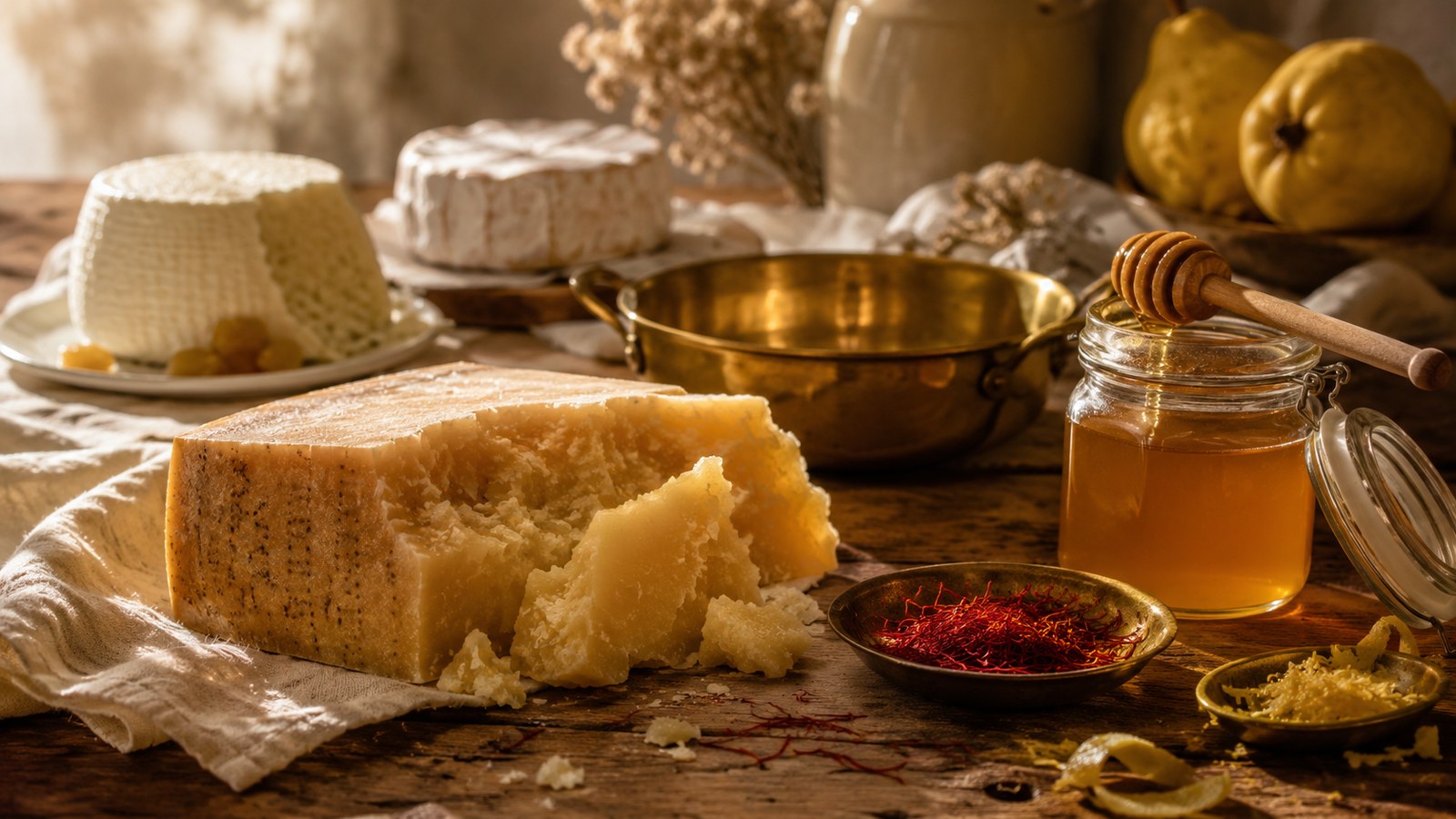
Parmesan Has a Pineapple Note, and the Copper Vat Is Responsible
Smell a good parmesan closely, with your eyes shut, and pay attention to what arrives after the salt. There's something sweet and faintly tropical in there that makes no sense at all in a cheese.
You're not imagining it. It's the vat.
Parmesan and the Swiss alpine cheeses are made in copper vessels. The copper damages some of the milk fat, and the fatty acids that come loose are rebuilt into esters and lactones: precisely the molecule families responsible for pineapple and coconut aromas.
The container became an ingredient. I find that delightful.
The variable that governs everything is water
If you keep one thing from this, keep this.
The difference between a fresh cheese and a two-year-old parmesan isn't mainly the milk. It's how much water stayed inside.
- Fresh cheese: around 80% water. Lasts days.
- Soft cheese: 45% to 55%. Peaks in weeks.
- Semi-hard: 40% to 45%. Months.
- Hard: 30% to 40%. A year, often much more.
Texture, melting point, lifespan, all of it follows from that. When you build a board and it feels like something's missing, what's usually missing is a spread of moisture levels rather than a spread of flavours.
How that water comes out
In ascending order of force: letting it drain through gravity in the mould, over hours. Cutting the curd into pieces, which multiplies the surface. Cooking the curd in its own whey, reaching around 55°C for the big hard cheeses. And pressing.
Cooking does three things at once, which is why it changes a cheese so much: it drives out whey, it alters the bacteria and enzymes, and it sets off flavour reactions among the milk's components.
Salt is structure, not seasoning
Salt in cheese isn't only there to taste salty. It holds off spoilage microbes, pulls out more moisture, firms up the protein structure, slows the ripening microbes and changes how the enzymes behave.
Most cheeses land between 1.5% and 2% salt. Emmental is among the least salty there is, around 0.7%. Feta, Roquefort and pecorino can approach 5%.
If one cheese strikes you as bland and another as aggressive, a good part of that is this range.
Free
Take the Christmas table checklist
It arrives straight away. After that, my newsletter — leave whenever you like.
Ripening has a name, and it comes from alchemy
The word is affinage, from the Latin finus, the end point, the ultimate point. It was a medieval alchemical term about refining impure material. For at least two hundred years it has meant bringing a cheese to its peak.
And there are people who do only this: affineurs buy immature cheese and finish the ripening themselves, controlling temperature and humidity.
Every cheese has an arc. Bland when young, a peak in the middle, then a decline into harshness. Camembert peaks in weeks. Comté or parmesan keep improving past a year.
Industrial cheese is typically part-ripened and then refrigerated to halt the process, which buys stability and shelf life. That's a legitimate choice. It just isn't the same thing.
Those crunchy crystals aren't a flaw
This is the fact I most wish I'd had earlier.
Those white specks that crack between your teeth in an aged Gouda, a parmesan or a mature Cheddar are a sign of age done properly.
In the rind of Roquefort and Camembert they're calcium phosphate: the mould lowers the acidity and the calcium salts turn less soluble. In mature Cheddar it's calcium lactate. In parmesan, Gruyère and old Gouda it's calcium lactate or tyrosine, an amino acid left over from protein breakdown that won't dissolve well when there's little water about.
Crunch is a CV.
Why some melt and some refuse
Melting happens in two stages. First the milk fat melts, around 32°C, and the cheese turns supple and starts to glisten. Then the protein network gives way: near 55°C in soft cheeses, 65°C in Cheddar and the Swiss types, 82°C in parmesan and pecorino.
And some cheeses simply won't melt: paneer, queso blanco, ricotta, most fresh goat cheeses. They're set with acid rather than rennet. The acid dissolves the calcium gluing the proteins together and neutralises their charge, so they clump hard onto each other. Heating just drives off water. Which is why paneer goes into a frying pan whole, and ricotta stays in soft heaps on a pizza instead of turning into a puddle.
As for the stretch, that long string off a slice: it happens when the protein is still largely intact and cross-linked by calcium. Mozzarella, Emmental and Cheddar are the champions. Old parmesan won't string at all, because the protein is already broken into pieces too small to hold.
There's a dish from the Auvergne called aligot, fresh Cantal beaten into hot potato until it forms a cord. It stretches two to three metres.
What to do in your own kitchen
Seven practical things:
Buy it cut to order. Pre-cut portions can be weeks old, and the exposed face going soft against plastic and fridge light spoils the fat within days.
Skip the pre-grated. Enormous surface area, aroma gone.
Cool, not cold. Cheese's ideal conditions are humid, between 12°C and 15°C. Warmer than your fridge.
Never serve it straight from the fridge. Cold milk fat is as hard as cold butter, the protein is stiff and the aroma stays locked in. Take it out half an hour ahead and the same cheese becomes a different one.
Wrap it loosely. Waxed or greaseproof paper, not tight. Cling film traps moisture, holds in ammonia and the cheese reabsorbs its own worst smell.
Turn them over and stand them on a rack, so the underside doesn't go soggy.
Build the board by moisture, not by flavour: one fresh, one soft, one hard. The variety then arrives on its own.
A medieval rule for choosing
A late-medieval French household manual gives a test for good cheese that I think is unbeatable: "not at all white like Helen, nor weeping, like Magdalene."
Not too pale, not leaking.
It works well, and it fails beautifully on young goat cheese, Roquefort, Emmental and Camembert. Even the medieval rule had exceptions.
What's the cheese you always buy? I want to get out of my usual three and I have no idea where to start.
Free
Take the Christmas table checklist
Everything that matters on a Christmas table, on a single sheet. Print it, or fill it in on your computer.
It arrives straight away. After that, my newsletter — leave whenever you like.