
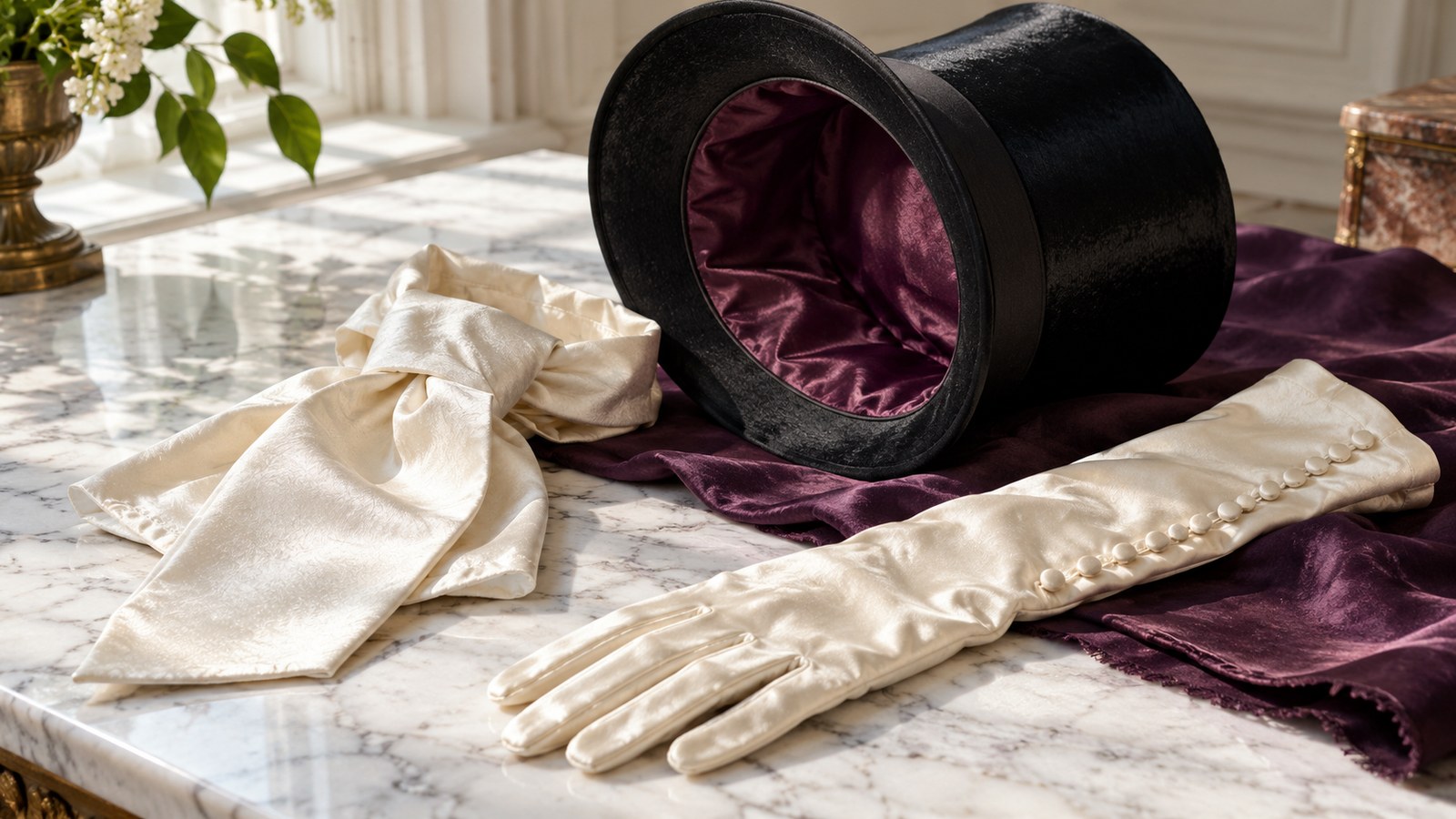
Formal dress is day wear that stopped moving
Every December somebody asks what "formal dress" actually means, and nobody can answer properly.
I went looking, and the answer turns out to be historical rather than aesthetic. And it's slightly deflating, in the best way.
The mechanism, in two sentences
In the middle of the nineteenth century, stylish items of men's daytime clothing — the top hat, the cravat, pantaloons — were progressively reserved for formal occasions.
And their place in everyday dress was taken by other things: the bowler hat and the tie.
Read that again and see what happened. Nobody designed formal dress. Ordinary life moved forward and left the older clothes standing still in a room labelled "formal".
That's why ceremonial clothing looks old: it is old. It's the ordinary clothing of one specific day in the past, frozen at the moment it stopped being ordinary.
And once you see that, "what counts as formal dress" gets easier. Formal dress is a working Tuesday from 1890 that nobody has updated.
What else was going on, for context
The rest of the section gives the background, and it's more technical than I expected.
The three-piece suit emerged in the 1860s, and still took years to become the uniform of business respectability. So even the suit wasn't born formal — it became formal.
Fibres were all still natural, but machinery now allowed more intricate weaves and colour combinations. The sewing machine pushed the ready-made trade forward, and tailors' manuals with patterns for different coats multiplied. In other words: good clothing was becoming possible without a private tailor.
And there's one construction change I loved for being so concrete: fall-front trousers gave way to fly fronts. A piece of engineering nobody ever thinks about.
What surprised me was the colour. Men's formal dress got more sombre in shape and tone — but leisurewear got fun: colour combinations and contrasts, embroidered accessories, a glimpse of a luxurious lining, striped, checked or plaid trousers.
Sobriety wasn't the taste of the era. It was the uniform of a situation.
Free
Take the Christmas table checklist
It arrives straight away. After that, my newsletter — leave whenever you like.
The dress that requires another person
On the women's side, the next section covers the Edwardian era, 1901 to 1910, and contains a detail that rearranges the subject.
The description first: for evening, women bared the décolletage and the upper arms, while simultaneously encasing the lower arms in long evening gloves. Silk satin, damask and chiffon, usually in light, soft colours, with lace, rhinestones and spangles, often placed to draw attention to one part of the body or to the face.
And now the sentence that matters: the many layers made these gowns difficult, if not impossible, to put on without help.
Without help. Which is to say: the dress presupposes another person.
That isn't a dressmaking detail, it's a social fact built into the garment. A dress you can't fasten alone only works if somebody is available to fasten it — a maid, a sister, somebody. The piece carries the structure of the household inside it.
There's more: the materials damaged easily, so evening wear required careful deportment. You didn't move as you liked. The clothing decided your posture for the entire evening.
I've written here about when the law dictated who could wear what, and why it never worked. This is the same idea with no law involved: you don't need a statute when the garment itself does the selecting.
The tea gown, and why I'm not going to romanticise it
Now the part I wanted to be good news.
There's a garment called the tea gown, which emerged in the 1880s and remained a popular choice for receiving guests in the afternoon.
A dress invented specifically for a woman receiving people at home. That is my entire subject area.
I was about to write the lovely paragraph — here is the grandmother of "dressed but comfortable" — when I read the book's own description: made of many layers of soft, light fabrics, flattering and utterly impractical.
Impractical. The book says so outright.
So, no. The tea gown is not the ancestor of comfort. It's a third kind of effort: less structured than evening dress, equally laborious, and dedicated to looking relaxed.
Which is, honestly, an extremely contemporary thing. Clothing that takes work in order to look like it didn't.
One honesty about what I won't claim: there's a widely repeated idea that the tea gown was worn without a corset. That may well be true — but this book doesn't say it, and I didn't find the claim anywhere in the chapter. So I'm not going to write as though it did. If I find the source, I'll come back to it.
What I take into December
Three things, and all three take pressure off.
One: stop looking for the logic of formal dress. There isn't a logic behind it, there's a date. Formal clothing is a frozen portrait of an ordinary day a century ago. Knowing that disarms half the anxiety of "am I dressed right?".
Two: if a garment needs another person, that's information. It applies to a zip up the back, to complicated fastenings, to anything requiring somebody. It isn't a flaw — but it's worth deciding on purpose, rather than discovering at seven in the evening with a full house.
Three, the one I use most: if clothing obliges you to behave — not to lean over, not to carry anything, not to sit down casually — it's charging you all evening. For a host, who spends that evening on her feet with both hands full, that's expensive. I've written about this in the dress you receive people in, and this chapter only gave me the historical examples.
The Edwardians had no choice. You do.
If you'd like the rest of what we're putting together for the season, I've gathered it all on one page, with a table checklist to download.
And for the table that outfit will be sitting at: The Art of Napkin Folding has the classic folds step by step. R$47.00, lifetime access.
Tell me: do you own something that only works with somebody helping you fasten it? I own one, and it only comes out when I remember to ask before I start my makeup.
Free
Take the Christmas table checklist
Everything that matters on a Christmas table, on a single sheet. Print it, or fill it in on your computer.
It arrives straight away. After that, my newsletter — leave whenever you like.