
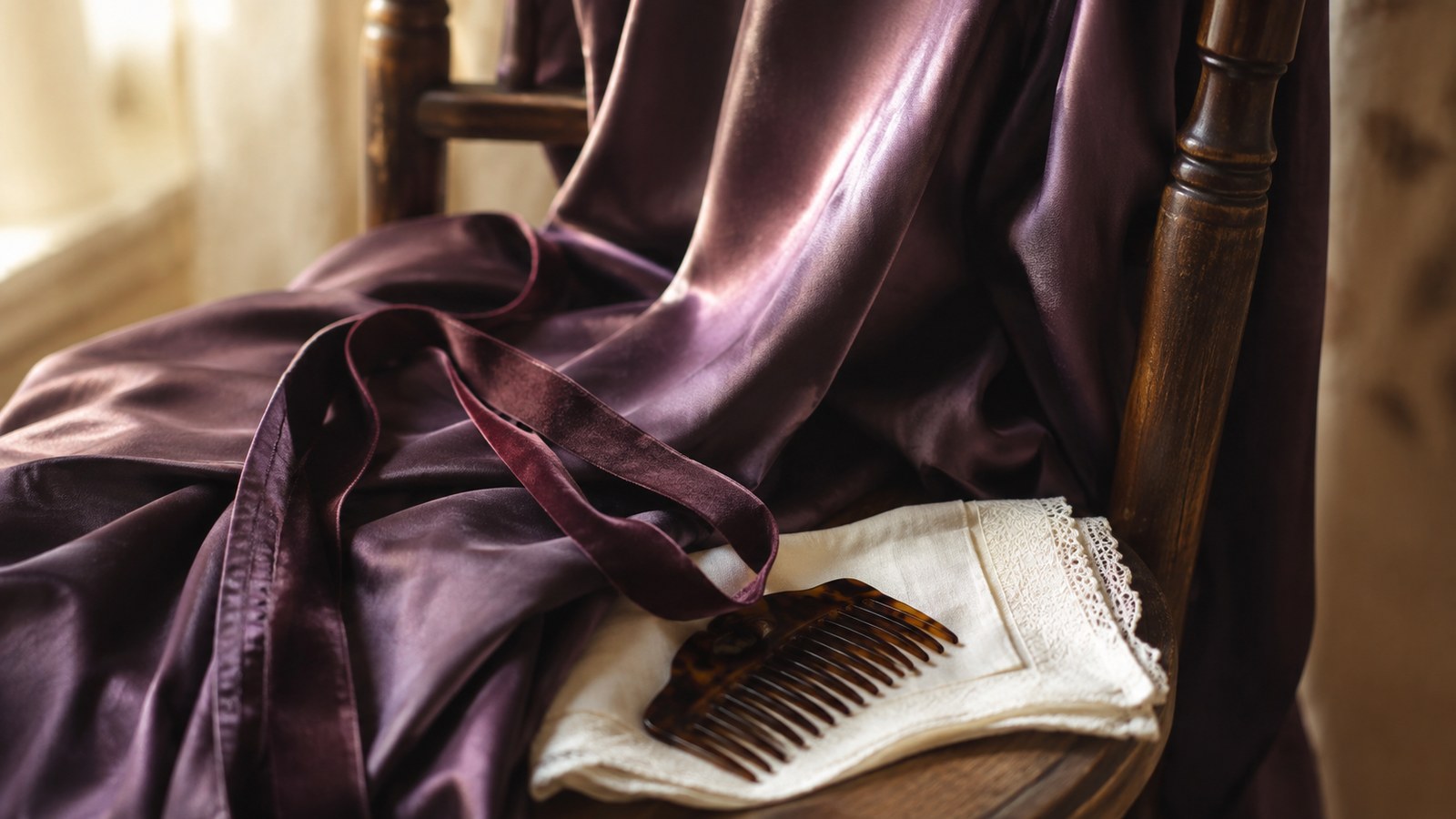
There Was Once a Dress Made Only for Having People Over. It Had No Corset.
Every year, in the run-up to the holidays, I hit the same deadlock in front of the wardrobe.
Dress up properly and I look absurd carrying a serving dish. Don't dress up and I spend the whole evening looking caught mid-task. And I'll be in and out of the kitchen forty times.
It turns out this problem is nearly a hundred and fifty years old and once had its own solution, with a name.
The teagown
From 1877 to 1940 the fashion dictionaries list a garment called the teagown, and the definition is short: "a loose dress worn without corsets and at first by married women only."
Hold on to "without corsets". In 1877 that isn't a comfort detail, it's an entire separate category.
The origin is recorded in a source from the period: "the teagown arose from the habit of ladies having tea in the hostess's boudoir and donning smart dressing-gowns."
So it was born, literally, from women changing into something comfortable inside their own houses in order to receive other women.
And then the men came into the room
The second half of that sentence is the better half, and it reads almost like a comment on the internet.
Once men were admitted to the occasion, the same 1877 source says, "peignoirs have developed into elegant toilettes of satin, silk, etc."
Translated: the comfortable clothing, made for a room with no audience, acquired an audience — and immediately turned to satin.
From 1889 the teagown took a high-waisted Empire line, long hanging sleeves, "yards of lace" as trimming, and came with a lace and muslin cap. Through the 1880s the closer-fitting version became permissible for young unmarried women too.
For anyone wanting less commitment there was the tea jacket, from 1887: close-fitting behind, loose in front, tight sleeves, trimmed profusely with lace. It replaced the tailored bodice at teatime. The low-effort version of the same idea, and it has existed since 1887.
Free
Take the Christmas table checklist
It arrives straight away. After that, my newsletter — leave whenever you like.
A whole family of indoor clothes
Once I started looking, it wasn't one garment. It was a category with grades.
House dress, from 1877: a plain princess robe, sometimes trained and with a Watteau back, worn without corsets, informally, at breakfast and indoors during the morning. By 1890 it had become a close-fitting teagown.
House coat, early twentieth century: defined as "a superior type of dressing gown worn at home in the evening, or for breakfasting."
Half dress, late eighteenth to nineteenth century: "a term denoting the costume worn at day functions and at informal evening ones." A named middle register between full dress and being at ease.
And on the French side, between 1778 and 1789, what a woman wore at home while getting ready or receiving visitors was called undress — which, despite looking elaborate to us now, simply meant "relatively informal".
Notice what that list means. There was vocabulary for this. People needed to distinguish between "dressed to go out" and "dressed at home" often enough to invent half a dozen words.
The contrast, at the same moment in history
To see why the teagown was a relief, look at what it was standing against.
The Edwardian evening gown, 1900 to 1914, was silk satin, damask and chiffon, decorated with lace, rhinestones and spangles. The books record two things about it:
"The gowns' many layers made them difficult, if not impossible, to put on without help."
And that they required "decorous deportment" from the wearer.
The teagown, in the same period, had a modest neckline and remained a popular choice for receiving guests in the afternoon.
One garment you couldn't get into without another person. The other you put on to have people in your sitting room. Both counted as good clothes.
When all of it ended
There's a date for the end of this machinery, and it's the Second World War.
Early in the twentieth century there was still "the need to change two or three times" a day. After the war, one daytime outfit "might suffice".
And the driest line in the dictionaries on the subject: "only after World War II did etiquette about clothing diminish, but vestiges of it are found on invitations which require 'black tie' or 'lounge suit'."
Every dress code left today is the residue of a system that used to be very much larger.
One outlier deserves a mention. In 1918 there was an attempt at a "standard dress", a single silk dress meant to serve as outdoor wear, housegown, rest gown, teagown, dinner gown, evening dress and nightgown. It was sold as a paper pattern in three variants for home dressmakers.
Seven functions in one dress. It didn't catch on, but the ambition is moving.
What I took from it
Three things, none of which requires buying anything.
"Dressed up at home" is a legitimate category, not an embarrassed halfway house. It had a name for sixty-three years.
The receiving garment was designed to be comfortable first. The satin came later, and it came because of the audience. If you have to choose between the two, history is on comfort's side.
The fabric does the "occasion" work, not the cut. Satin is a silk weave whose glossy face and dull back come from the weaving itself. Velvet is medieval, imported from Spain, Italy and France, and only stopped being silk in the twentieth century. The sequin dates from the 1880s and takes its name from the zecchino, an Italian gold coin. One detail of a light-catching fabric on an otherwise cool garment solves the same problem layers used to solve, without the heat.
What I'll be wearing
Something loose, in a fabric that catches a bit of light, that I can put on by myself and carry a dish in.
Which is, a hundred and fifty years late, exactly a teagown.
If you want the rest of what we're writing for the season, it's all collected here. And if clothing that pretends to be effortless interests you, the copy about "French style" hasn't changed since 1959 and I wrote about that.
Tell me: do you have an outfit that's only for having people over? I have two, and both have pockets.
Free
Take the Christmas table checklist
Everything that matters on a Christmas table, on a single sheet. Print it, or fill it in on your computer.
It arrives straight away. After that, my newsletter — leave whenever you like.