
The Copy About "French Style" Hasn't Changed Since 1959
In 1959 Simone de Beauvoir wrote an essay about Brigitte Bardot for an American magazine. She described a woman who went about barefoot, indifferent to jewellery, perfume, makeup, artifice. Someone entirely without calculation.
Now pick up any article from the last five years about a stylish Frenchwoman. The words are the same. Not similar: the same. She isn't trying, isn't calculating, woke up like this.
Sixty-odd years, and the advertising copy hasn't moved a line.
What's being sold
The archetype comes with a manual. How to wash your hair, how to tie a scarf, how to eat breakfast, how to have people over. There is a hairbrush on the market sold specifically as the French-girl hairbrush.
And the promise is always the same word. Effortless. Makeup that looks like the absence of makeup. Hair styled to look unstyled. An outfit arranged to look thrown on.
Notice what that promise does to you. If the good result has to look accidental, then all of your effort becomes a failure. You can't be seen trying. And since you are trying, you feel caught out.
Two women who weren't French
One detail I found telling.
Jane Birkin was English. Anna Karina was Danish. Both entered the global imagination as emblems of French style and both are still cited that way.
So not even the nationality of the myth's muses is French. What's being sold isn't a country. It's an aesthetic, and it has a marketing department.
What people actually wear there
Here's the part that made me laugh.
The journalist who wrote about this lived in Paris as a foreign student at an art school. She expected colour, boldness, short skirts, people experimenting.
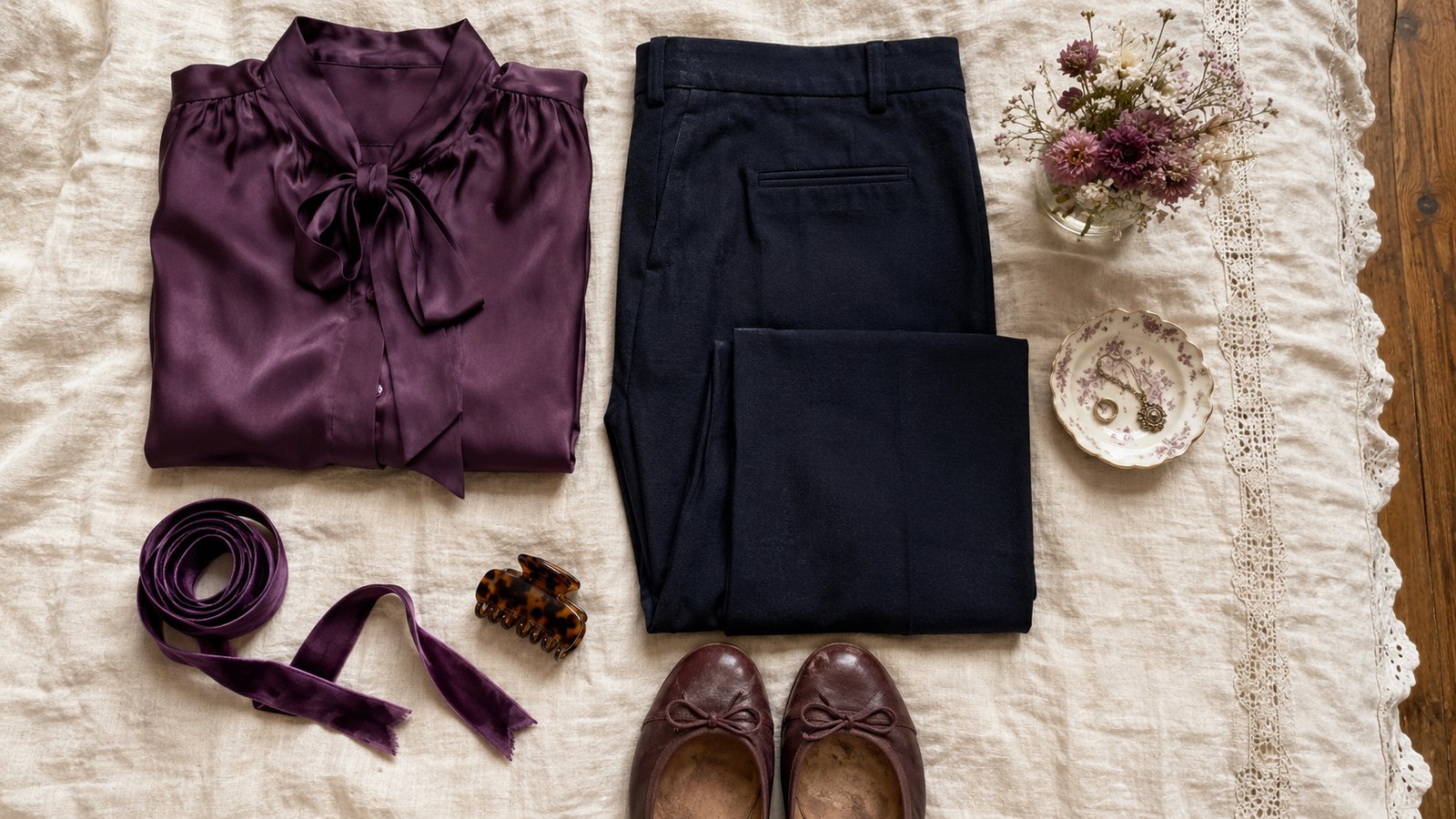
She found black and navy. Near-uniform. Colour and print read as tacky. Showing skin was still shocking. Drawing attention to yourself through clothing was effectively off limits.
At an art school.
The code even has a name and an acronym: BCBG, bon chic, bon genre. Discreet, classic, well made, in-group. There's a guidebook to it, in the same way there's a handbook of American preppy style.
So the "effortless" being sold to us is, at source, a rigid set of rules. Not an absence of effort. Effort trained until it went automatic, inside a group that learned the rules as children.
Free
Take the Christmas table checklist
It arrives straight away. After that, my newsletter — leave whenever you like.
And the archetype changes country
This was the part that gave me some peace.
After the Frenchwoman came the Dane, with hygge: candles, cashmere socks, a blanket, and an entire shelf of books teaching cosiness.
Then came the Korean, with the twelve-step routine, the essence, the sheet mask, the glass skin.
And there's a lovely detail about that last one. A Korean writer published a piece pointing out that in the Korea of the 1980s and 90s none of it existed. Not the products, not the twelve steps. People who cared about beauty used French, American and Japanese things. The ancient-tradition framing was assembled afterwards, to sell.
It's the same mechanism every time. Choose a country, build a symbolic woman, publish the manual, sell the shelf.
And France does exactly the same thing with Brooklyn
This part put me in a very good mood.
While the rest of the world buys the myth of the Parisienne, Paris buys the myth of Brooklyn with equal inaccuracy. There are businesses in Paris called Brooklyn Café, The Brooklyn Pizzeria, Le Brooklyn. A French streetwear label called BWGH, for "Brooklyn We Go Hard", made a sweatshirt reading BROOKLYN PARLE FRANÇAIS. And one of the city's grandest department stores ran an entire season called "Brooklyn Rive Gauche", selling beanies and mason jars.
Each country is selling the other an edited version of itself, and buying back an edited version of the other.
That took the weight off entirely. There is no place on earth where women wake up finished. There is a place that got photographed a certain way and sold to you.
What I kept
Four things, none of which requires a passport.
"Effortless" is an output, not a method. When someone says she just threw it on, treat that as a claim to check rather than a standard to reach. Behind it there is nearly always editing, repetition and money.
What actually travels is the principle, not the label. Simple, well made, classic, repeatable. That works anywhere and needs no French name on it. Brands charging for the connotation are charging for the connotation.
A uniform beats novelty. Those Paris students wore variations of one outfit. Every woman who "always looks put together" has, underneath, a small set of pieces that reliably work together. It isn't a gift. It's a narrowed repertoire.
Watch for the archetype changing countries. It will. Recognising the cycle is the cheapest way to buy less.
One opinion, no hedging
The effortless myth is the least generous thing fashion ever invented, because it makes you hide the enjoyable part.
Choosing what to wear is good. Trying three combinations in the mirror is good. Spending half an hour on a table, a hairstyle, a set of nails is good. That's the pleasure, not the flaw.
I try. I like trying. And I would take a woman who has visibly thought about what she put on over one who has to pretend she didn't, a hundred times out of a hundred.
De Beauvoir summed Bardot up in four words: "she goes about barefooted."
Lovely. But someone chose that photograph, that framing and that sentence. Barefoot is a decision too.
Tell me: what's your uniform, the outfit you repeat that always works? Mine is three pieces and I'm slightly embarrassed to say how many times a week.
Free
Take the Christmas table checklist
Everything that matters on a Christmas table, on a single sheet. Print it, or fill it in on your computer.
It arrives straight away. After that, my newsletter — leave whenever you like.