
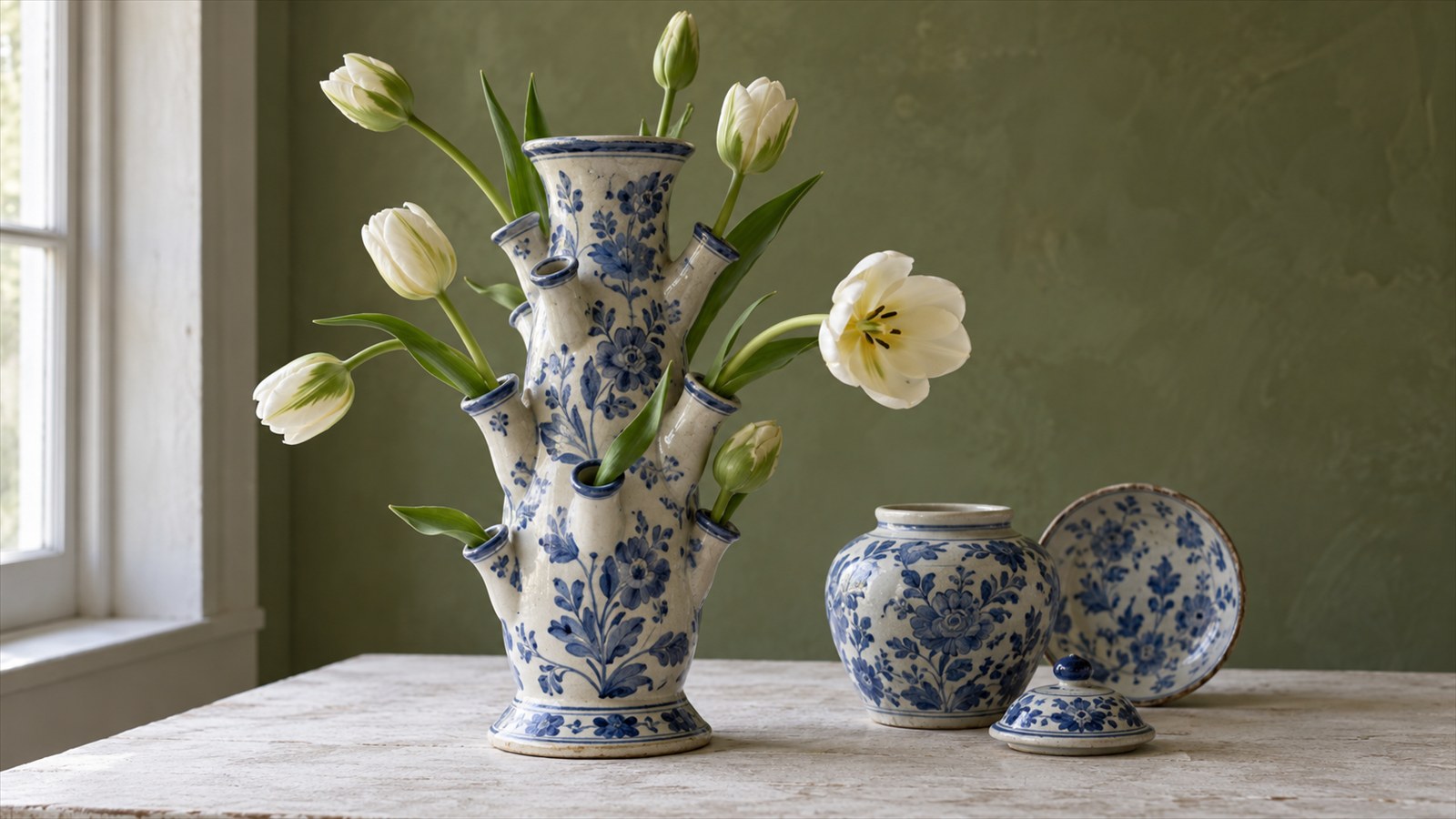
Whoever painted your blue and white was painting in black
I learned something this week that I can't now unsee.
The painter making that blue design on a piece of delftware is not looking at blue while they work.
The motif goes onto the piece in a black glaze whose main ingredient is cobalt oxide. The blue only appears after the second firing. Which means somebody draws the entire thing in a colour that isn't the final colour, and has to know the kiln well enough to predict what will come out.
Think about the nerve that takes. You paint a whole piece, hand it to the fire, and find out hours later whether you were right.
And the whole ware was already a copy
That's the second part, and it rearranges the object.
At the end of the sixteenth century one of the first Dutch East India Company ships arrived in Holland from China carrying blue-and-white porcelain. China had been producing in that style for over a thousand years.
The effect on Europe was delirious. It became an obsession of royalty. Topkapi Palace in Istanbul accumulated a stunning holding for the Ottoman sultans. Augustus II of Poland displayed more than twenty thousand pieces of Chinese and Japanese porcelain in his Japanese Palace in Dresden.
Twenty thousand. Of one thing.
The problem is that real porcelain needs kaolin clay, and Europe at that moment had no access to it. So the potters of Delft did the only thing available: an imitation.
Tin-glazed earthenware — milky and opaque — painted to resemble Chinese porcelain as precisely as they could manage.
Delftware is not porcelain. It never was. It's the answer a market gave itself when it wanted something it couldn't buy.
And it only had room to grow because Chinese exports fell away, through political unrest and trade disruption around the collapse of the Ming period. A gap opened, and Delft walked into it.
It's a completely different blue from that other one
Worth comparing, because I've written here about the blue that cost more than gold — the Venetian painters' ultramarine, ground from lapis lazuli, a stone imported from a long way off at enormous cost, which was already blue before anyone touched it.
Cobalt is the opposite in almost every respect. It's a mineral oxide that doesn't look blue until the kiln transforms it. Cheap enough to supply a whole industry. And what it produced wasn't an altarpiece — it was tableware for people who were getting rich.
One blue is rarity, bought. The other is chemistry, becoming a colour.
Free
Take the Christmas table checklist
It arrives straight away. After that, my newsletter — leave whenever you like.
The queen who brought flowers indoors
This part I didn't know, and it changed how I look at a vase.
Before the seventeenth century, cut flowers barely lived inside houses. They were church garlands, religious offerings, and occasionally banquet decoration. The idea of having flowers in your living room because they're lovely is newer than it sounds.
The person who pushed it was Mary Stuart — Mary II. She was born in England in 1662, married her cousin William III at fifteen, in 1677, and moved to the Netherlands shortly after. The marriage was a political manoeuvre to patch up relations between the two countries after the Anglo-Dutch war.
And William, trying to please her, asked the head gardener of his country estate to bring into bloom everything he could get hold of, in every season, so that he could make her two or three bouquets a week.
It escalated exactly as you'd expect. Botanists at their court were sent out on East India ships to collect rare specimens. Hampton Court accumulated around four hundred rare plants that had never been seen in Europe.
And here's the part that closes the circle: to hold all of it, the Delft potters introduced vases with spouts — vessels designed to take one rare flower at a time, each stem in its own opening.
The shape of the vase was designed around what the flower was worth. When the flower was precious, the vase held them one by one.
The scale of it, and the end of it
By the eighteenth century there were thirty-four potteries in and around Delft. The industry had replaced the textile factories and the beer breweries to become the backbone of the town's economy.
Each piece took as long as two weeks and passed through many specialised hands. Someone trod the clay with their feet to make it workable again after it had been dried and cut. Someone threw it, someone fired the kiln, someone painted.
From about 1800 it fell away, run over by English ceramics — cheaper, more durable, mass-produced. One single pottery was left in Delft, which from 1851 was the last one standing and eventually led the revival at the end of the nineteenth century.
Thirty-four to one. In a hundred years.
The practical things, which are more useful than they sound
If you have blue and white at home, or are thinking of buying:
Earthenware is porous. It's fired at a lower temperature than porcelain, and the clay particles only partly fuse. Direct consequence: it stains, because liquid gets in through the pores. And glazes and gilding fired at low temperature wear away under repeated cleaning. Lukewarm water, mild soap only if needed, dry thoroughly.
Not every earthenware vase holds water. The author describes watching water come through the glaze of a new piece in her collection, and another leaving a mark on a table because its base was porous. The fix is simple and I've adopted it: put a glass vase inside the piece and fill the glass, not the piece.
Large jars full of water get extremely heavy. Before filling a ginger jar on top of a piece of furniture, think about the weight.
The collector's test: according to a specialist quoted in the book, a genuinely old piece tends to feel light and brittle in the hand, like an empty milk carton. And it's worth turning it over to look for the maker's mark on the base. Hand-painted beats stencilled; cracks and chips bring the price down.
This is thrifting territory, which I've argued beats buying new. The author finds her best pieces at the flea market near her house, not in the specialist shops in Amsterdam, where rent sets the price.
One rule of proportion I'm going to use
From the chapter on arranging, just one, and it's the most applicable thing in it:
Choose the vase first. Not the flowers.
And the rule of thumb: the vase takes up about a third of the whole, the flowers the other two thirds. The author admits she sometimes gets carried away and ends up with a vase that's a quarter of the arrangement — so it's a guide, not a law.
But the order matters. Vase first changes what you buy at the stall.
What stays with me
I started the week thinking blue-and-white was a traditional, old, slightly serious sort of thing.
It's an imitation of an imported product, made in a material inferior to the original, by a town that spotted a gap in the market, painted by people working without being able to see the final colour.
And it's beautiful. Four hundred years on, it's still the thing that goes with any flower you put in it.
I like that better than the noble version. Almost nothing on your shelf was designed to be beautiful. It became beautiful solving some other problem.
If you'd like the rest of what we're putting together for the season, I've gathered it all on one page, with a table checklist to download.
And for the table that vase is going on: The Art of Napkin Folding has the classic folds step by step. R$47.00, lifetime access.
Tell me: do you have a blue-and-white piece at home? Mine came from a market stall and I have no idea who made it.
Free
Take the Christmas table checklist
Everything that matters on a Christmas table, on a single sheet. Print it, or fill it in on your computer.
It arrives straight away. After that, my newsletter — leave whenever you like.