
Tinsel Was a Fabric Before It Was a Decoration: in the 1500s, Silk Woven With Real Gold
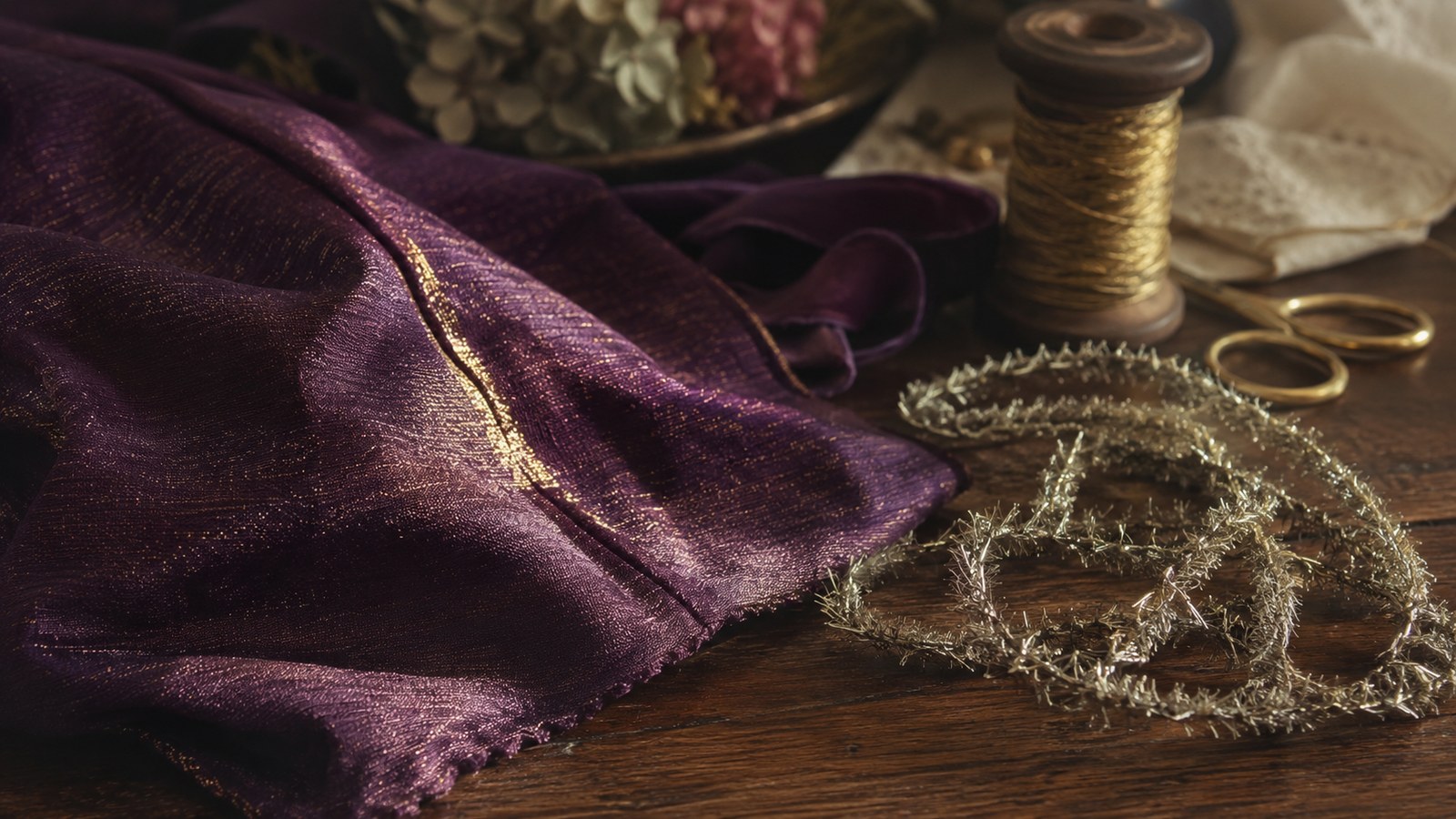
In the sixteenth century, tinsel was a fabric: "a rich silk fabric which could be plain or patterned interwoven with a weft with gold or silver threads or strips."
Today it's the metallic plastic strand you wind round a tree.
The same word. It went from silk with gold in it to the cheapest thing in the box, and the route between the two is documented.
The descent
The first step down is recorded in the entry itself: the term came to be applied to a sparkling net, and to cheaper imitations using copper threads, popular for theatrical costume.
Real gold, then copper, then the stage. The book doesn't say what year that swap happened, and I'm not going to invent the date.
But in 1748 tinsel was still in people's hair. A description of a pompon that year lists the possible forms: "butterflies, feathers, tinsel, cockscomb, lace, etc."
And in 1883, by which point the tree version was nearly invented, you could still buy dress fabric made with it: Bulgarian cloth, "a cream-coloured cotton fabric, plain or striped, worked in tinsel and coloured silk."
And in the next decade it went on the tree
On the other side, in the history of decoration, the chronology is just as dated.
1878: the first "icicles" are produced in Nuremberg, Germany.
1890s: Germany begins producing rope garlands of tinsel for trees. Metal hooks for ornaments arrive in 1892.
1895: Grover Cleveland's White House tree, the first to sport electric lights, is described as carrying gold angels, gold and silver sleds, toy tops and tinsel.
An honest note, because it matters. These come from two different books: the textile definition from a fashion dictionary, the tree chronology from a Christmas encyclopedia. Neither source connects them causally. I'm laying the two timelines side by side because they touch in the 1880s and 90s, not because anyone has proved the crossing.
Free
Take the Christmas table checklist
It arrives straight away. After that, my newsletter — leave whenever you like.
The most expensive cloth in the medieval wardrobe
While we're on metal thread, it's worth knowing the top of the list.
It was called tissue, and the definition is: "the most costly form of cloth of gold or silver, woven with raised loops of metal thread" over a ground of brocatelle, lampas or velvet.
Raised loops. The metal wasn't just crossing the cloth, it was standing off it.
From a royal trousseau of 1612–13, one line of inventory: "eight yerde of sea greene tyssue for double slevis for ridinge gownes." Somebody wrote that on a shopping list.
And the word decayed the same way: from the eighteenth century onward, tissue came to mean merely "sparkling but lightweight fabrics". Today it's the paper your new clothes are wrapped in.
The dress engineered for candlelight
Here's the part that ties this to the whole month.
A court mantua of 1753 was woven from silk threads and strips of flattened silver metal. And the description of what it does is explicit: "at least 14 different colors and four types of silver thread were used, reflecting the light in different ways and sparkling beautifully in candlelight."
Four kinds of silver thread, chosen because they throw light back four different ways.
That isn't vanity. It's optical engineering for a room lit by flame, done by people who knew exactly what the evening's light source would be.
Another mantua, worn at the court of George II, was embroidered with over 11 pounds — five kilos — of silver metal thread. Five kilos of metal sewn into a garment.
And dresses that wide, on the side hoops introduced as court dress in the 1740s, had a domestic consequence I love: the women wearing them were obliged to slide sideways through doors.
The same reasoning shows up a century earlier. Between 1625 and 1635, dresses used "light-colored silk satins that shimmered in the candlelight."
The same trick, with no metal at all
And the one that interests me most, because it costs nothing.
On an early sixteenth-century Saxony doublet, the big pomegranate pattern is made by contrasting the matte and sheen of two directions of weaving that catch the light differently. It was more expensive than a plain weave.
Which means you can make a surface answer light without adding a single shiny particle. Just the same thread, turned two ways.
It's exactly what damask does on a tablecloth, and it's what stops a plain garment looking dead in a photograph taken at night.
Sequins are older than they look
A quick line of chronology, because it surprised me.
Spangles, the old ones, are dated fifteenth to nineteenth century: small decorative pieces of glittering material, usually metallic, originally lozenge-shaped and later circular, sewn onto garments.
Centuries of sewing small pieces of metal onto clothes before plastic existed.
And the words that survived still carry the metal that left: lamé, from the 1920s, comes from the French for "metal strip". Lurex, from the 1940s, is an American company's trademark for its metallic fibre yarn.
The word goes on saying metal long after the metal has gone.
What I do with this in practice
Three things, none of which requires buying expensive fabric:
A surface that answers light beats a surface that's shiny. Plain satin, a raised embroidery, a cloth with two directions of weave. Cheap-and-glittery throws everything back at once and reads as flash; the other gives it back slowly.
Choose for the light source of the evening, not of the shop. The 1753 mantua was built for flame. If your dinner is by candlelight, try the thing on near a candle, not under the white strip light of a fitting room.
One metallic detail beats a metallic outfit. Five kilos of silver was a royal-court decision. A button, a thread at the cuff, an earring solves the same problem in a country at 33 degrees.
And underneath it all, the thing I can't let go of: the strand on your tree and a sixteenth-century court dress are the same word. The tree is wearing an old outfit nobody wears any more.
If you want the rest of what we're writing for the season, I've gathered it on one page — the table, the house, the meal. And on clothes made for receiving people at home, there was once a dress for exactly that, and it had no corset.
Tell me: do you have something shiny that only leaves the wardrobe in December? Here it's a scarf of my mother's that used to be a dress.
Free
Take the Christmas table checklist
Everything that matters on a Christmas table, on a single sheet. Print it, or fill it in on your computer.
It arrives straight away. After that, my newsletter — leave whenever you like.