
In the Early 1800s, Tourists at Plymouth Rock Were Handed a Hammer
In the early 1800s, tourists visiting Plymouth Rock were provided a hammer so that they could take a piece of the rock as a souvenir.
By 1880, what was left of the rock was fenced off within a memorial.
The museum holding one of those fragments, with a painted inscription, dates it to 1830. People dismantled a monument, one chip at a time, to carry home proof they had been there.
I laughed, and then I looked at my own shelves.
There is a classification for this
The historian Beverly Gordon, in her 1986 book The Souvenir: Messenger of the Extraordinary, divided the travel keepsake into five types. I found it useful enough to reproduce whole.
Piece-of-the-rock. Natural elements, such as rocks or dried flowers, or actual pieces of something historical. That's the Plymouth category, and the book I read calls these objects "oft-ill-begotten spoils."
Pictorial. Any ephemera, postcards or posters, that feature images of the destination.
Symbolic. A representation of a local icon, like a miniature Roman Colosseum.
Markers. An object that could have been made anywhere, like a T-shirt or a mug, printed with the name or slogan of a place.
Local product. Food, clothing or handicrafts indigenous to, and ideally made in, a specific region.
Walk through your house with that list. I did, and the distribution surprised me: nearly everything I own is a marker, and nearly everything I love is a local product.
And souvenir-hunting is ancient
Not an invention of modern tourism: "curious travelers have been souvenir-hunting since ancient times, originally for religious objects."
The impulse is the same as the hammer. Bring home material proof that something happened to you.
Why that object outlives all the others
Here's the sentence that made this post exist.
Sentimental objects "represent stories and not styles, emotions and not aesthetics", and therefore, the book says, "they will always be the most timeless objects you own."
Notice the mechanism, which is simple. Style has an expiry date and a story doesn't.
The book even gives a rough figure for the expiry: they say your taste in food changes every seven years, and your taste in interiors, by its estimate, every three to eight.
Three to eight years. About how long it takes for a wall colour you loved to start irritating you. An object that came with a story doesn't obey that clock, because it was never competing on it.
And the definition of a sentimental object is good: they are "physical stand-ins for our memories", kept "not because they look good or make us look good, but because we find them moving."
Free
Take the Christmas table checklist
It arrives straight away. After that, my newsletter — leave whenever you like.
It starts early
A fact I wasn't expecting: "as babies, we start to exhibit signs of object attachment."
Infant attachment is "fairly indiscriminate": anything will do. With age it becomes less about simple possessiveness than about sentiment.
Which means the person keeping a grandmother's chipped jug is doing, with more precision, exactly what she was doing at two with a scrap of blanket.
The part I envied: collect a category
This is the most applicable idea in the book for anyone in a small flat.
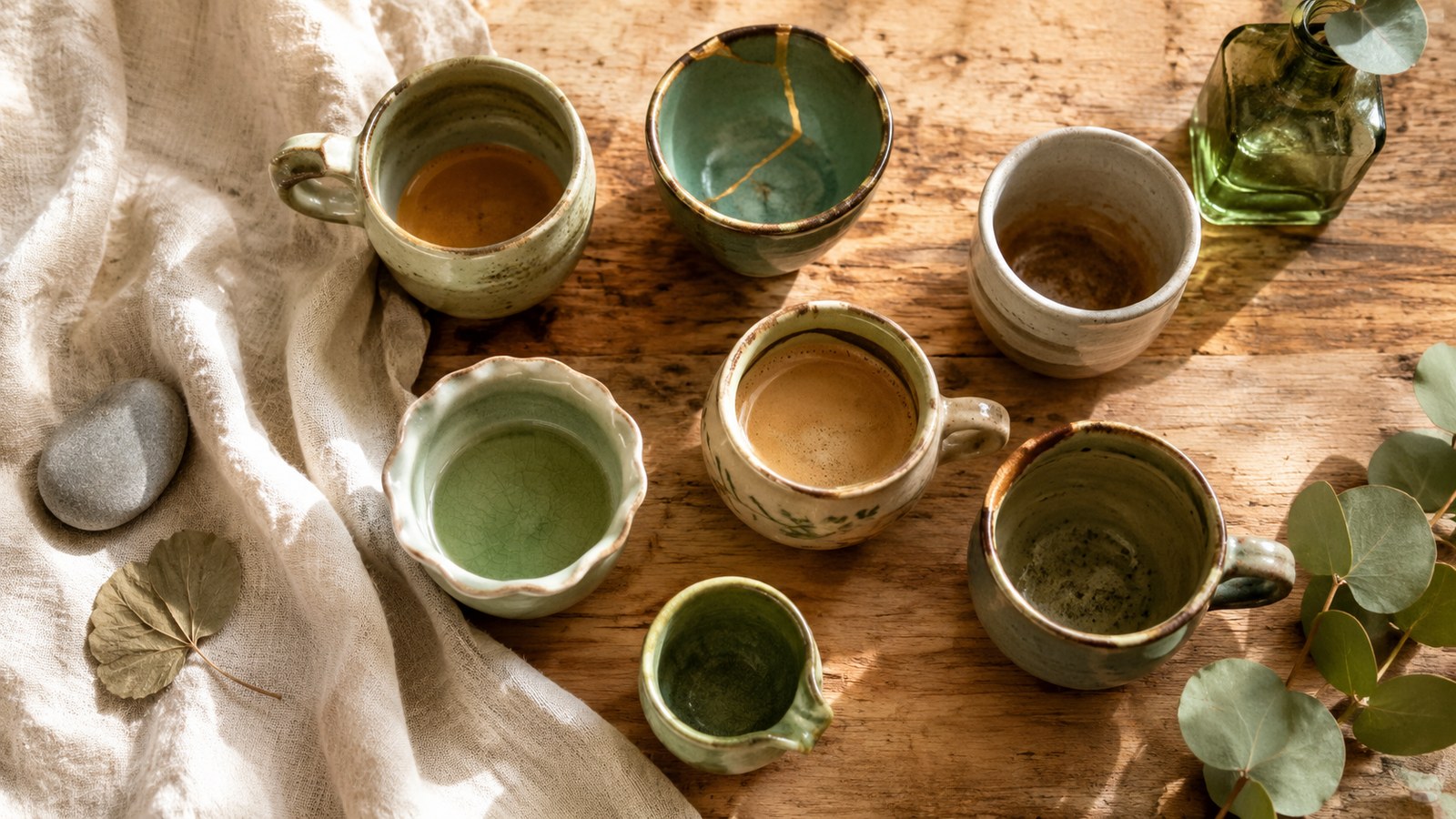
One collector picked a single category and stuck to it: small cups, water glasses and espresso cups, hundreds of them, bought while travelling.
The reasoning is purely practical, and the book gives it: they are "usually affordable, and small enough to tuck into a carry-on" — and they vary enormously from place to place.
Think about what that solves. You stop buying a random thing in every city and start buying the same thing in every city. The result isn't clutter, it's a collection. And it fits in a cupboard.
On a holiday table that's gold: twelve different cups, each from somewhere, is a table telling twelve stories with nothing bought as decoration.
The honesty about bought souvenirs
The book isn't romantic about this and I liked it for that.
At the Grand Bazaar in Istanbul, "many of the trinkets… have been manufactured in other parts of Asia." And on one souvenir street in Marseille, the author counts "at least five stores selling the same exact woven bags and speckled ceramics."
Five shops, one object. The marker and the symbolic are collapsing: they promise a place and deliver a catalogue.
What holds up is the genuine local product, and the piece-of-the-rock you picked up yourself. A shell. A stone. A pressed leaf. Things nobody manufactured for you to buy.
And the gift, which is the strongest category
A line I'll be using: "on the scale of positive energy levels that objects can radiate into a room, the gift is among the highest."
And the advice that comes with it is worth the whole season: buy or make gifts in the moment you find the right thing, rather than waiting for a special occasion.
That's the reverse of how most of us do December. We decide to give a gift and then go looking for what. The other order — find first, keep it, hand it over when the date arrives — produces a better gift and a calmer month.
There's a variation I loved too: two friends who always give each other within one fixed running category, one of them "rocks that look like food", the other "things shaped like clams". Each knows what to look for all year. Buying stops being a December emergency and becomes a radar that's always on.
And a defence of the gift that suits nothing you own: keep it, because it makes your home a little less like a theme.
Two things the book doesn't say
Recorded for honesty.
It does not say who handed out the hammers at Plymouth, whether it was sanctioned, or how much of the rock was lost. Only that an inscribed 1830 fragment sits in a museum collection.
And it says nothing about Christmas, Thanksgiving or a holiday table. The application is mine.
What I'm doing
I'm going to stop treating the object-with-a-story as shelf material and bring three of them to the table. The jug, a cup that came from a trip, and a candlestick I was given.
And I'm going to pick a category to collect, because a shopping list that runs all year sounds infinitely better than one that runs from the fifteenth to the twenty-fourth of December.
If you want the rest of what we're writing for the season, it's gathered on one page, with a table checklist to download. And on why a secondhand piece is usually the better buy, there's a whole post about that.
And if you want to add something to the table that takes up no space at all, the napkin folds are in the course. R$ 47.00, lifetime access.
Tell me the ugliest thing you keep because of its story. Here it's a glass ashtray nobody has ever smoked in.
Free
Take the Christmas table checklist
Everything that matters on a Christmas table, on a single sheet. Print it, or fill it in on your computer.
It arrives straight away. After that, my newsletter — leave whenever you like.