
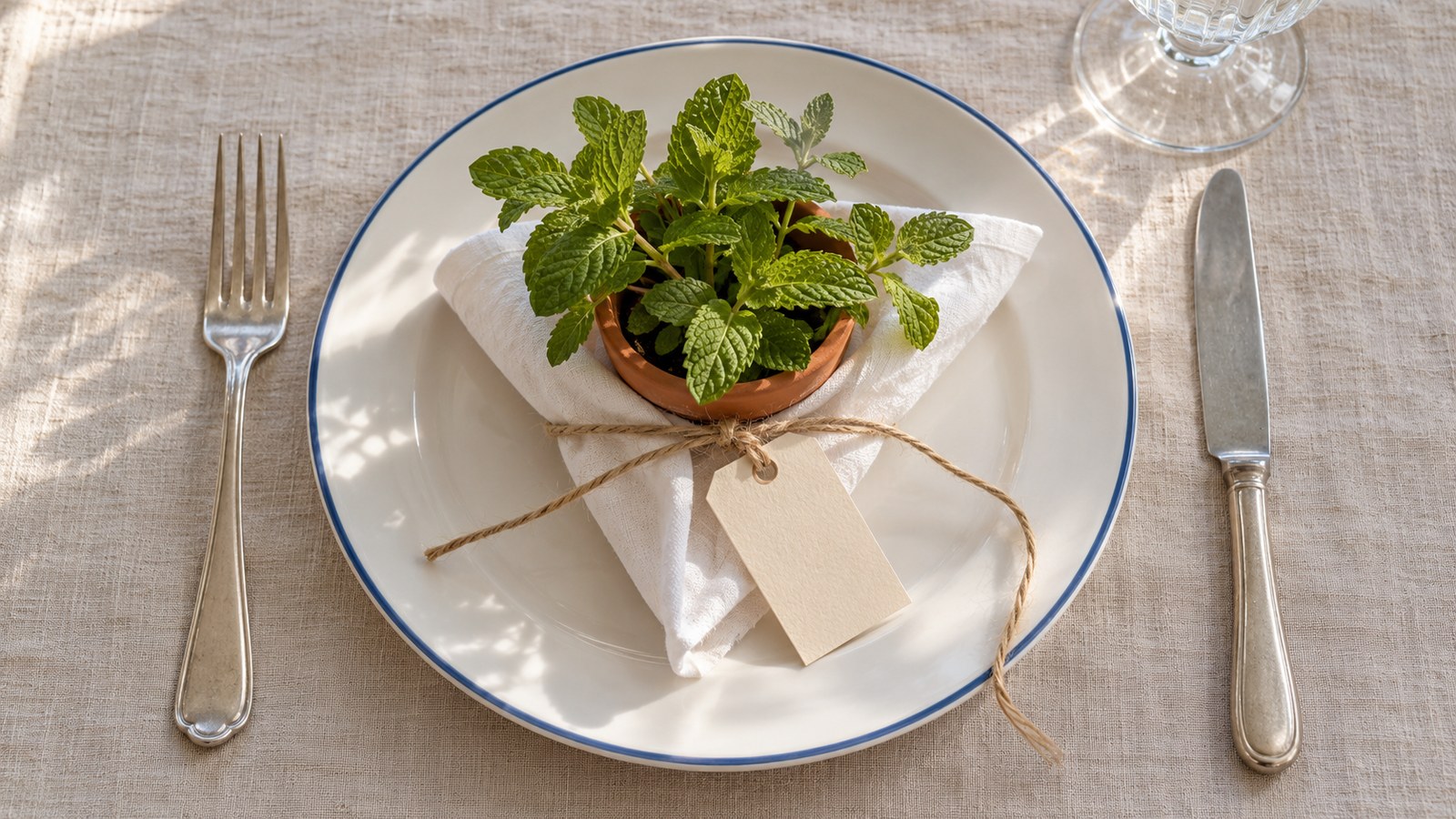
A small pot of mint at each place isn't decoration. It's for your hands.
I opened a book about napkins expecting folds, and its best idea wasn't a fold.
It's this: fold the napkin into a triangle, tie it around a small pot of herbs with a contrasting ribbon or cord, and put one at each place.
The guest unties the napkin to use it. And the little pot stays in front of them all evening.
It looks like it's only pretty. It isn't only pretty.
Three jobs, one object
This is where the idea stops being decoration.
One: it dresses the place. A living object at every seat, with nothing to buy as a favour and nothing to wrap.
Two: it seasons. If the herb is basil or thyme, it works as a garnish. The guest pinches a bit and puts it on their own food. Same as a scatter of fresh herbs on the plate, except they do it themselves.
Three, and this is the one I hadn't thought of: it's for your hands. The book specifically recommends mint or lemon verbena for this — the guest rubs a leaf between their fingers to clean and scent their hands after eating with them.
Picture a Brazilian Christmas table. There's farofa, there's pork someone will pick up with a hand, there's crackling, there are snacks before anyone sits, there are children. Here in December, eating with your hands isn't the exception.
And the alternative we currently use is a plastic-wrapped wet wipe, or getting up and going to the sink mid-dinner.
A mint leaf has solved this for centuries, and it goes back to solving it for almost nothing.
The rest comes from the garden, the market or the beach
The book has a list of natural decorations by season, and it's aggressively cheap:
- a small sprig of roses or foliage cut from the garden
- vine leaves, a little cluster of grapes
- small fruits, nuts, hazelnuts
- fresh herbs from the shop, if there's no garden
- shells, sea-smoothed pebbles, a piece of driftwood
- a daisy chain made by hand
If you have no garden, the book is explicit: small fruit and supermarket herbs do the same work. This isn't advice for people with grounds.
For flowers in a small pot it suggests small-headed ones — lavender, pansies, daisies, pinks, violets, patio roses. Which makes sense: a small head fits the place without invading the plate's space.
And there's a variation I thought was elegant and not at all obvious: instead of flowers, wild grasses and sculptural seedheads. More architectural, lasts far longer, and doesn't wilt in the heat — which matters here in December.
Free
Take the Christmas table checklist
It arrives straight away. After that, my newsletter — leave whenever you like.
The place card, and how to attach it
The place-card section is short and practical.
The main rule: the card has to agree with the rest of the table. If the table is neutral and garden-ish, the card is plain paper with twine. If the table is colourful, the card follows.
You can buy ready-made cards or make them with a stamp or a stencil. And here's the attachment method I'm going to copy: punch a hole in one corner and tie the card to the napkin itself, with garden twine or string.
That way the card isn't lying flat on the plate or propped against a glass, where it disappears.
And the most useful detail in the whole section, which is pure usability: write the name high on the card. High enough to be read standing up, from a distance, by someone looking for their seat with a plate in their hand. A name in the middle of the card vanishes behind the rim of the plate.
The book also has a fold designed specifically to hold a place card upright — and it's worth knowing in advance that it needs a large, heavily starched napkin, because it depends on two tight rolls that only hold with starch. A soft napkin won't make it, and that isn't clumsiness — it's a lack of starch.
The one-colour rule, which rescues a mismatched set
This one helps almost everybody, because almost nobody owns twelve matching napkins.
The book suggests a set of napkins in different tones and textures of a single colour. Not identical — varied, within one family.
And it gives a reason for which colour: blue is ideal because the spectrum is so enormous, from near-white to navy with everything in between. You can put six different blues together and the table reads as deliberate.
That's permission disguised as technique. Six napkins that are similar but not identical isn't a failure to own a full set — it's a scheme. And it works at a big party and on an ordinary Tuesday.
The alternative, if your napkins are genuinely patterned: match the decoration to the pattern. Real flowers with a floral print; cord with a stripe; and so on. The decoration finishes the sentence the pattern started.
Two small things about the table itself
Outside the napkin subject, two ideas from the chapter I've kept:
Rough texture against smooth metal. The book sets polished cutlery against raw stone, and it's a pairing I'd never built. It works because a laid table is almost entirely smooth — china, glass, metal, pressed linen. One rough thing in the middle wakes all of it up.
Runners laid across the table. Instead of a whole cloth or a lengthwise runner, the book shows linen runners crossing the table from side to side, one per pair of places. It gives the effect of placemats without placemats, and it solves a long table when you don't own a cloth the right size.
What the book doesn't solve, and where I'm sending you
One honesty: this is a napkin book. It's very strong on folds and on dressing a place, and it says essentially nothing about height.
And height is what ruins a table. If you put a pot of herbs at every place and an arrangement in the centre as well, you can end up with a wall between people without noticing. I wrote last week about why the centrepiece is the only decoration that can ruin the evening, and the two-minute test that prevents it — worth running that test with the little pots already in position.
The good news is that a pot of herbs is naturally low. It dresses the place without competing with the centre.
And if you're wondering why napkins ended up the size they are, that's another story: the fork shrank the napkin, and the change can be dated.
What I'm going to do
A tray of small mint pots from the market, one per place, napkin tied around each with twine, and everyone's name on a little card tied into the same twine.
It costs less than one good candle, it works as a seasoning, and at the end of the night each person takes their herb home.
If you'd like the rest of what we're putting together for the season, I've gathered it all on one page, with a table checklist to download.
And if what's missing is the fold — including the one that holds a card upright — The Art of Napkin Folding has the classics step by step, with the starch detail that decides whether a fold stands up or slumps. R$47.00, lifetime access.
Tell me: have you ever put something living at each place, or has it always been something bought? Here it was always bought, and I think that's over.
Free
Take the Christmas table checklist
Everything that matters on a Christmas table, on a single sheet. Print it, or fill it in on your computer.
It arrives straight away. After that, my newsletter — leave whenever you like.