
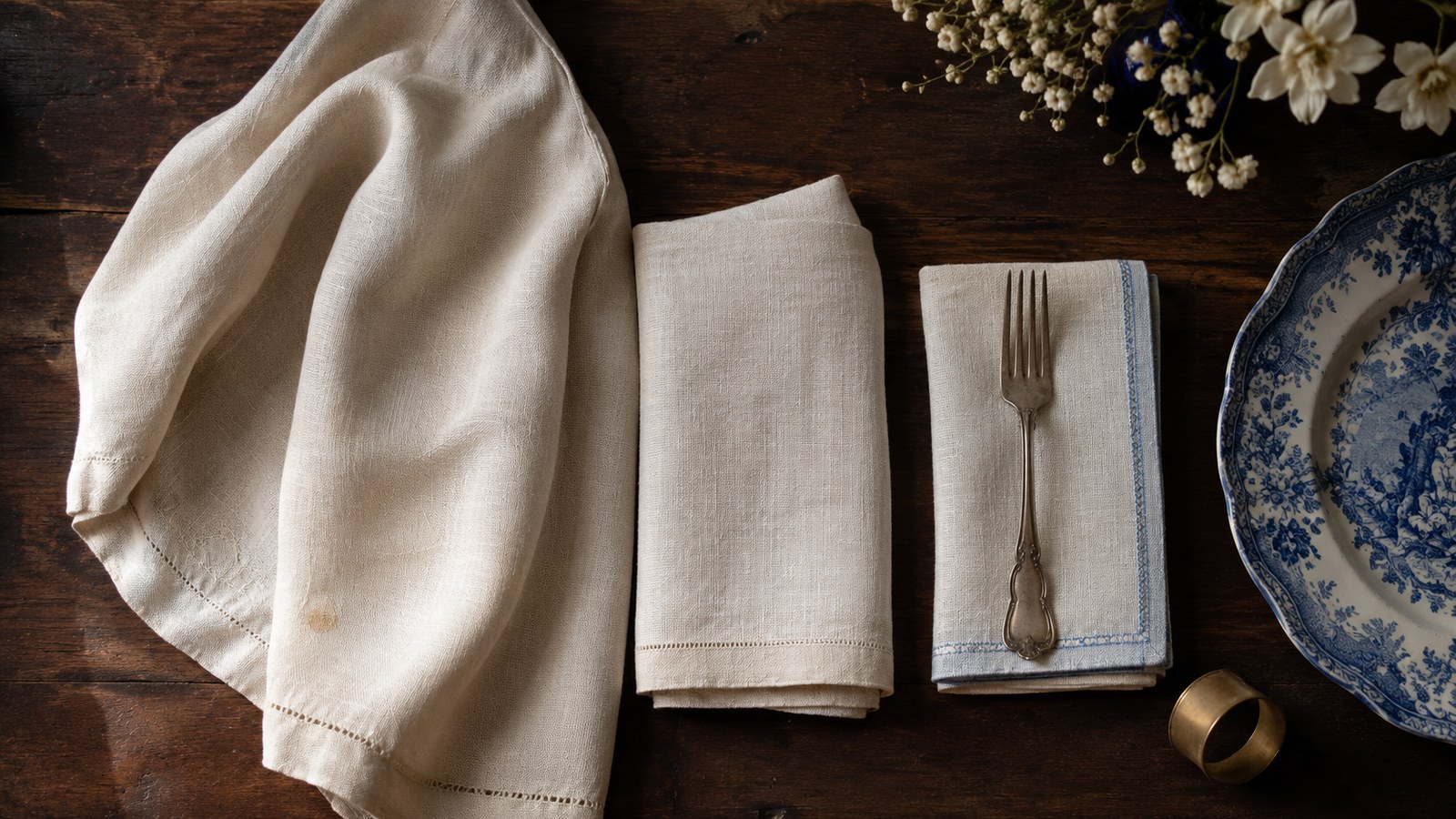
In the 1600s a Dinner Napkin Was 35 by 45 Inches. Bigger Than a Bath Towel.
In the seventeenth century, the standard dinner napkin was about 35 inches wide by 45 inches long. Roughly 89 by 114 centimetres, by my arithmetic — the book gives inches only.
That is bigger than a bath towel.
And the reason is beautifully practical: it was "a capacious size that accommodated people who ate with their fingers."
The rule nobody wrote down, but which decides everything
Napkin size was never a question of taste. It was always an answer to a technical question: what does this meal do to the hands of the person eating it?
Whole hand in the food wants a big cloth. A fork wants a small one. That's it, and the entire history obeys.
The timeline is short and every step has a cause.
The first napkin was edible
Not a figure of speech.
The first napkin was a lump of dough the Spartans called apomagdalie. You kneaded it at the table and wiped your hands on it. The book gives no date.
And from that came a custom that survived for centuries: using a slice of bread to wipe the hands.
Rome had two, and one of them invented the doggy bag
Romans ate reclining, so they carried two cloths with different jobs.
The sudarium was pocket-sized, carried "to blot the brow during meals taken in the warm Mediterranean climate."
Hold on to that one. A cloth specifically for sweat, because it was hot. We host in heat and assume we invented the problem.
The mappa was larger, "spread over the edge of the couch as protection from food taken in a reclining position."
And here's my favourite fact from the whole search: each guest brought his own mappa from home. On departure, the mappae were filled with the delicacies left over from the feast — and the book says outright that this is the custom that continues today in restaurant doggy bags.
The container of leftovers you carry home from a family dinner is two thousand years old and has a Latin name.
Free
Take the Christmas table checklist
It arrives straight away. After that, my newsletter — leave whenever you like.
Then it disappeared
In the early Middle Ages the napkin simply vanished.
"Hands and mouths were wiped on whatever was available, the back of the hand, clothing, or a piece of bread."
When it came back, in the late Middle Ages, it had already shrunk to "about the size of our average bath towel."
The 1500s: two sizes, two situations
Here the vocabulary turns useful, because it's exactly the problem of a modern holiday meal.
The serviette was the large table napkin.
The serviette de collation was "a smaller napkin used while standing to eat, similar to the way a cocktail napkin is used today."
So the sixteenth century had already worked out that seated people and standing people need different cloths. If half your family eats at the table and half eats standing in the kitchen, you aren't improvising. You're applying a five-hundred-year-old distinction.
From the same century comes the word diaper, from the Greek diaspron: a white cotton or linen fabric woven with a small repeating diamond pattern.
And then the fork arrived
The seventeenth century. The fork is accepted by royalty, and the effect on the napkin is immediate and documented: "when the fork was accepted by royalty in the seventeenth century, the napkin fell from use among the aristocracy."
Ben Jonson wrote that forks arrived in England from Italy "to the saving of napkins."
To save on napkins. That's the sentence.
And when the fork reached everyone else, in the eighteenth century, the cloth shrank again: "the acceptance of the fork in the eighteenth century by all classes of society brought neatness to dining and reduced the size of the napkin to approximately 30 inches by 36 inches." About 76 by 91 centimetres, my conversion again.
Two new tools, two shrinkages. The object got smaller in exact proportion to the mess disappearing.
Two loose dates I loved
From the seventeenth century, a proportion rule I've started using: the napkin was about one third the breadth of the tablecloth.
And from around 1740 comes the invention of the matching set. Before that, cloth and napkins didn't match as a matter of principle. Savary des Bruslons recorded it: "Twelve napkins, a large tablecloth and a small one, comprise what is called these days a 'table service'."
The table linen you inherit from a grandmother is an eighteenth-century idea with a name and a date.
Why napkin rings existed
This is the one that made me laugh at myself, because I always assumed a napkin ring was decoration.
It wasn't. It was laundry logistics.
Before the washing machine, fabric napkins were washed by hand. To save time and energy, at family meals each napkin was kept in a personalised ring — an accessory that identified whose napkin it was, so it could be used again.
The ring wasn't decorating the table. It was saying this one is yours, you used it yesterday, use it again today.
And the book is blunt about the ending: paper napkins, after the Second World War, made the ring almost obsolete.
What I took from it
Three things, and the first overturns a rule I'd been following without thinking.
Choose the size by the food, not by the occasion. That's the two-thousand-year lesson. Roast on the bone, shellfish, fruit, anything with hands in it? Big cloth. All knife and fork? Small is fine. The question isn't "is this formal?", it's "what will people do with their hands?"
Eighteen inches is the size that folds best. About 46 centimetres. The book calls it "the easiest size to fold into a decorative shape." If you keep one size at home and you like folding, that's the one.
Fold it, don't crumple it. The book is direct: a folded napkin lies smoother on the lap than a creased one. And before folding, lightly starch and iron out the creases.
One note on placement, which settles an argument I've had at home: in the United States today the napkin goes to the left of the setting. In Europe it's often laid to the right of the spoon. There is no universally correct side. There are two continents disagreeing politely for a century.
And the part I'm not repeating
The table books of that era are full of correction, and I'll record this only as a curiosity, not as advice.
A manual of 1729 ruled that the person of highest rank in the company should unfold their napkin first, and everybody else should wait.
I read that and thought: what a miserable dinner. Nobody eats until the most important person gives permission.
My rule is the opposite and fits on one line: the napkin is there to be dirtied. If it comes back clean, somebody was afraid to eat.
If you want the rest of what we're writing for the season, it's gathered on one page, with a table checklist to download. And if you'd rather start with the folds themselves, the three easiest ones are explained here.
And if you want to go past the basics after that, I made a course purely on napkin folding, with the classic folds step by step. R$ 47.00, lifetime access.
Tell me: do you have cloth napkins put away waiting for an occasion? I did. For two years now they've come out for Tuesday lunch and not one of them has been ruined.
Free
Take the Christmas table checklist
Everything that matters on a Christmas table, on a single sheet. Print it, or fill it in on your computer.
It arrives straight away. After that, my newsletter — leave whenever you like.