
How to Fold Napkins: 3 Easy Folds to Start With
There's a version of my table that lives in my head: the napkin standing upright on the plate, the small detail that looks like somebody spent the whole evening on it.
And there's the version that actually happens: the napkin folded in a panic, two minutes before everyone sits down, because I remembered it last.
The good news is that both are the same fold. The genuinely beautiful ones are almost never the complicated ones.
This used to be a job
Something I love knowing: in the seventeenth century, particularly in France, napkin folding was a profession.
Wealthy households hired a napkin folder, who arrived the day before a banquet purely to build the display. Napkins became animals, fruit, birds, butterflies — elaborate shapes, made to land as a small shock when the doors opened.
Which means the wish for your table to do something to people as they walk in isn't a modern affectation. It's about four hundred years old.
There's a better story still. In the Middle Ages, the size of napkin a guest brought signalled his standing — the larger the napkin, the wealthier the man. Of someone who turned up with a small one, it was said he could only just make ends meet. That is literally where the phrase comes from, and we still use it for the last week of the month.
Even the restaurant "cover charge" traces back here: it was the band of linen, the cover, laid along the table's edge.
Then came the rules — and then they left
By the early twentieth century it had all stiffened up. Emily Post, high priestess of American etiquette, ruled that "very fancy foldings are not in good taste", and households dutifully obeyed.
You can picture the mood at dinner: everyone watching everyone else to check the form was being observed.
None of that survives — and that's the best part. The only rule that made it through is a simple one: whatever the fold, a napkin should look and feel freshly laundered. That's it.
Beautiful is whatever makes a guest feel somebody prepared this with them in mind.
Free
Take the checklist with you
It arrives straight away. After that, my newsletter — leave whenever you like.
The right size (nobody mentions this)
Before the fold, one practical thing that solves half the problem: napkins have sizes, and the wrong size is usually why your fold won't stand up.
- Dinner: 50–75 cm (20–30 in). The only size where structured folds — the ones that stand on their own — really work.
- Lunch: a little smaller, and usually more decorated.
- Afternoon tea: 20–30 cm (8–12 in).
- Cocktail: 15 cm (6 in) and down.
And the fabric matters more than the technique. Linen beats cotton for folding: it holds a crease, survives sunlight and washing, and doesn't crumple in that defeated way. If your fold collapses, it often isn't you — it's a napkin that's too small or too soft.
Three folds to start with
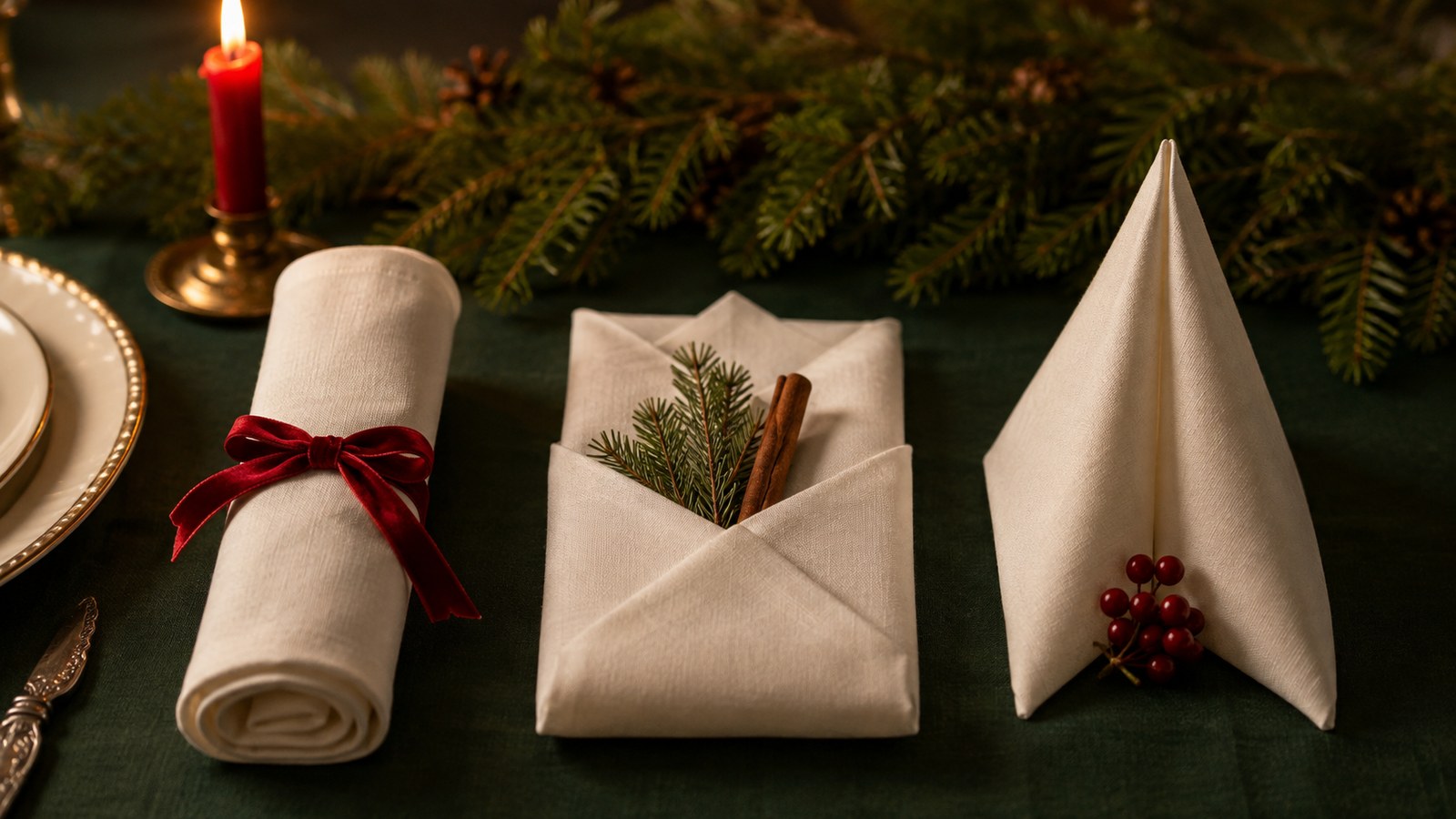
1. The roll
The fastest of all, and the one I use most on an ordinary day.
Fold the napkin in half, then in half again, into a smaller square. Roll from one corner to the other, firmly but without forcing it. Lay the roll on the plate with the seam underneath, and set a sprig of something green or a length of ribbon across it.
Forty seconds, and it carries any lunch.
2. The envelope
This is the one that looks like it took effort and didn't.
Fold into four, with the loose corners facing you. Lift the first layer and fold it up to just below the top edge, making a band. Then take the sides around to the back and cross one over the other. You're left with an envelope — and inside it fits a name card, a sprig of rosemary, a stick of cinnamon.
Best compliment-per-minute ratio of any fold I know.
3. The pyramid
For when you want height on the plate without a centrepiece.
Fold in half diagonally into a triangle. Bring both bottom points up to the top, making a diamond. Turn the whole thing over, fold it in half backwards, and stand it up — it holds itself.
Size really rules here: with a 50 cm napkin or larger it stands firm. With a tea napkin it won't.
The real version
Now the honest agreement.
Iron the top layer only. Nobody unfolds a napkin to inspect the rest, and the crease that matters is the one on show.
Paper napkins count. Structured folds often work better in paper, which is stiffer. There's no second-class table.
If you have six people and no time, do the same fold six times. Six identical napkins look decided. Six different ones look like indecision.
And if it all goes wrong: napkin folded in three, laid beside the plate. That is a set table. It always was.
Start from where you are
Once three folds become automatic, that's when it gets fun — because you start wanting more of them.
If you reach that point, I've put together 13 folds on video, easiest to hardest, each one filmed close up with the occasion it suits. It's The Art of Napkin Folding — made for exactly the person who has the roll down and now wants the flower.
But start with the roll. It rescues more dinners than any complicated fold ever will.
Tell me — do you fold napkins on an ordinary day, or only when people are coming? 🤎
Read next
- The Foundation of a Beautiful Table: The Part Nobody Compliments — The layer under the napkin, and the one that decides everything.
- A Simple Christmas Table: Beautiful Without the Fuss — Where these three folds get an occasion.
Free
Take the checklist with you
Everything that matters on a Christmas table, on a single sheet. Print it, or fill it in on your computer.
It arrives straight away. After that, my newsletter — leave whenever you like.