
The Foundation of a Beautiful Table: The Part Nobody Compliments
It took me a long time to understand something about setting a table: the most important part is the one nobody ever compliments. No one walks into your home and says "what a beautiful tablecloth." They say "what a beautiful table" — and what they're seeing, without having a word for it, is the foundation.
My tables are aesthetic 🌸 and real life, not so much. But I've noticed this: on the rushed days, when I get the foundation right, the table rescues itself. And on the days I skip that part and go straight to the pretty bits, nothing quite lands — no matter how many flowers I put in the middle.
Why the foundation decides everything else
A well-made table has layers you can actually name: the foundation, the height and placement of the pieces, the centrepiece, the shapes and textures, the atmosphere (food, music, light), and the sparkle — those little points of light that make everything feel alive.
Of all of those, the foundation is the only one that constrains the rest. It's made of four things: the theme, the colour scheme, the space you actually have, and the first layer that goes onto the table. Get those four settled and everything after flows. Leave them unsettled and no centrepiece will fix it — you'll spend the evening nudging things around, feeling like something's missing and unable to say what.
It's the same logic as a house. Nobody compliments the foundation. It's the reason everything else stands up.
1. The theme — simpler than it sounds
"Theme" sounds intimidating because it's a big word. But a theme is just a direction, something to help you decide. Without one, every single choice becomes an open question.
To find yours, answer quickly:
- What's the occasion? A birthday, a holiday, a family lunch, or simply because you felt like it.
- What season is it? Which colours do you associate with it? What fruit and flowers are actually around right now?
- Where's the inspiration from? A place you love, a film, an era, a colour, the passion of someone who'll be sitting there.
- What adjective do you want to hear? Cosy, luxe, playful, calm, laid-back.
And here's what makes the real difference: put a small piece of yourself into the foundation. The most beautiful tables I've seen had something in them that only made sense to the person who set them — the cup that belonged to a grandmother, the colour of a place where someone was happy, an object hunted down over months. That isn't decoration. That's your signature.
Free
Take the Christmas table checklist
It arrives straight away. After that, my newsletter — leave whenever you like.
2. Colour — and why matching everything makes a table dull
This is the part that changed my tables most.
Mix shades of the same colour. If everything is exactly identical, the eye gets bored fast and the table looks flat. Three shades of pink in conversation beat ten identical pieces.
Don't be afraid of mixing metals. Silver with gold is fine. Silver with gold and copper is also fine. Contrary to what most of us were taught, mixing metals elevates a table rather than muddling it.
Patterns can meet. Floral with check, stripe with polka dot. Sometimes they fight; sometimes they become the most interesting thing on the table. You only find out by trying.
Contrast is balance too. If the room runs cool, pull warmth onto the table with wood, terracotta, a burnt orange.
And the most freeing part: nothing has to match. That complete, identical set, bought all at once, is not a prerequisite for anything. A table that looks gathered slowly, with pieces from different places, is almost always the more beautiful one — because it looks like it belongs to somebody.
3. The space — the part almost everyone skips
Before buying or gathering a single thing, look at the actual table.
Measure it. Round or rectangular? Large or small? Skip this and the runner arrives too short, or the placemats don't fit. It's the silliest and most common frustration there is.
Mind the height. Nothing on the table should block the face of the person across from you. If people have to lean around your centrepiece to talk, the decoration is getting in the way of the party instead of serving it.
Think about how many people. That decides whether the table goes intimate or generous. And mind the gaps between them: not so far apart that they raise their voices, not so close they've no room for their elbows.
Think about the path. Where do people come in? What do they see first? Where will they gather? If you've ever had every guest stuck in the kitchen all evening, you know exactly what I mean.
And the most useful trick of all: sit in the guest's chair. Really. Set the table, sit down, and look. Can you see the face opposite? Is anything in the way? Did the view out of the window disappear? Thirty seconds sitting down solves problems you'd never spot standing up.
4. The first layer
Now the physical part.
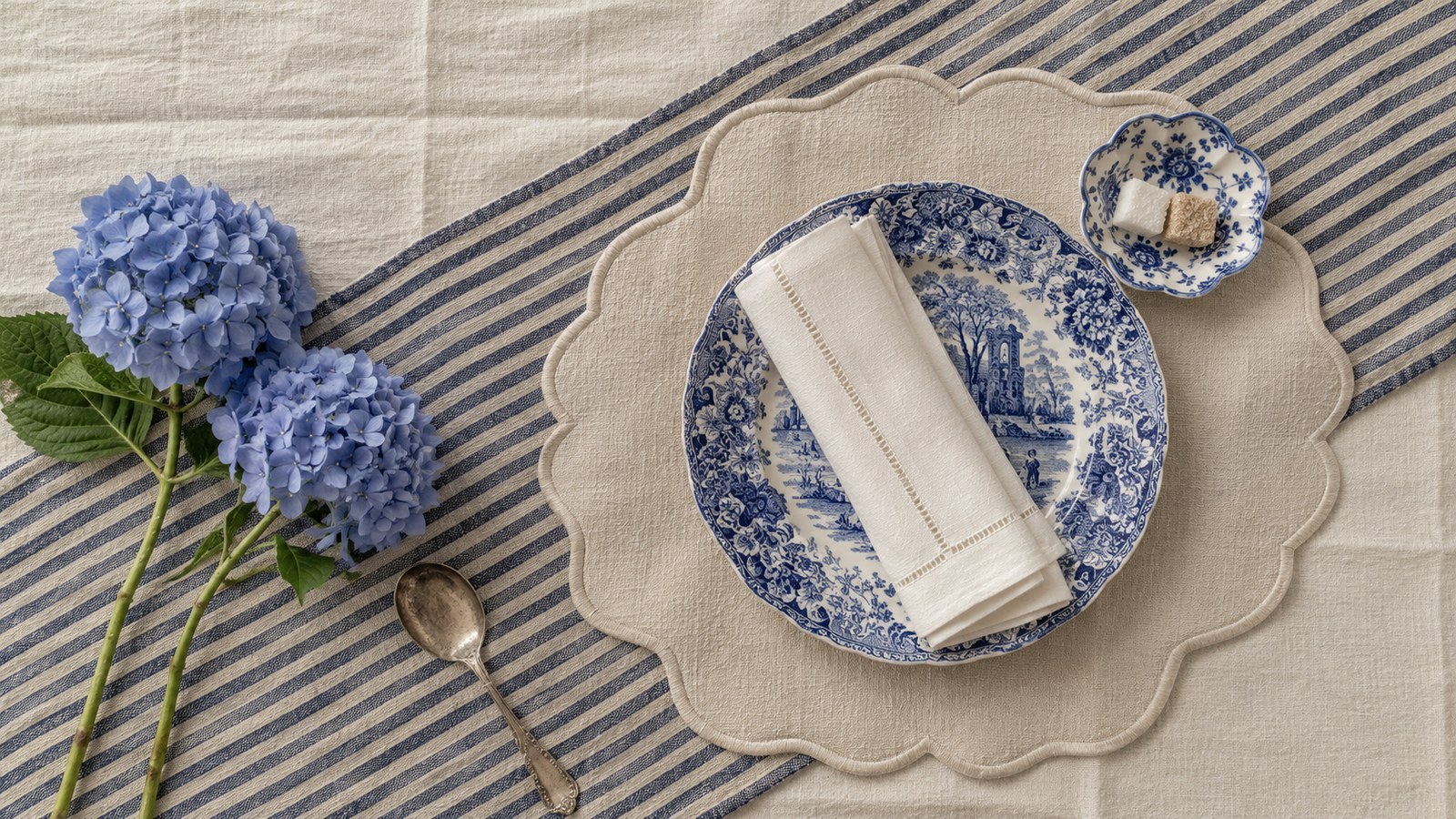
The first layer is whatever goes down before anything else: tablecloth, runner, or placemats. And there's an important permission here — if your table is beautiful wood or stone, you're allowed to put nothing down at all. That texture is already your foundation.
If you do want a layer, you have far more options than a tablecloth:
- Overlapping placemats
- Burlap or hessian
- Butcher paper — with pencils on the table, if children are staying
- Tulle
- Overlapping lace or crocheted doilies
- One long runner, or several short ones laid diagonally across
- Newspaper stained with a tea bag, for an aged look
- Netting — yes, fishing net, if it says something true about you
Notice that nearly everything on that list costs little or nothing. The first layer is where creativity goes furthest and money matters least.
When real life turns up
Because it always does.
Some days you have twenty minutes, the plates aren't from the same set, and the tablecloth is in the wash. On those days I do three things, in this order:
- Pick one colour and repeat it three times on the table. That alone makes it read as deliberate.
- Improvise the first layer with whatever's there — two placemats laid crosswise, a nice piece of fabric that isn't a tablecloth, the butcher paper.
- Light a candle. Atmosphere covers a great deal that decoration didn't.
It isn't the table from the photograph. It's a good table. And a good table on a Tuesday is worth more than a perfect one that never happened.
A quick check before you decorate
Before moving on to the centrepiece and the details, ask:
- Does my first layer speak to the theme? (Organic? Festive? Elegant? Casual?)
- Which colours have I already spent on the foundation — and which am I saving for the rest?
- Does everyone fit comfortably? Am I assigning seats?
- Is the food coming to the table on platters or already plated? (If it's platters, they count as space — place the platters first.)
Answer those four and you can decorate with a clear head. The hard part is behind you.
So tell me: what's the small piece of yourself you'd put into the foundation of your table? I'd really love to know.
Read next
- How to Fold Napkins: 3 Easy Folds to Start With — The next layer up, once the base is settled.
- A Simple Christmas Table: Beautiful Without the Fuss — The same logic applied to the hardest table of the year.
Free
Take the Christmas table checklist
Everything that matters on a Christmas table, on a single sheet. Print it, or fill it in on your computer.
It arrives straight away. After that, my newsletter — leave whenever you like.