
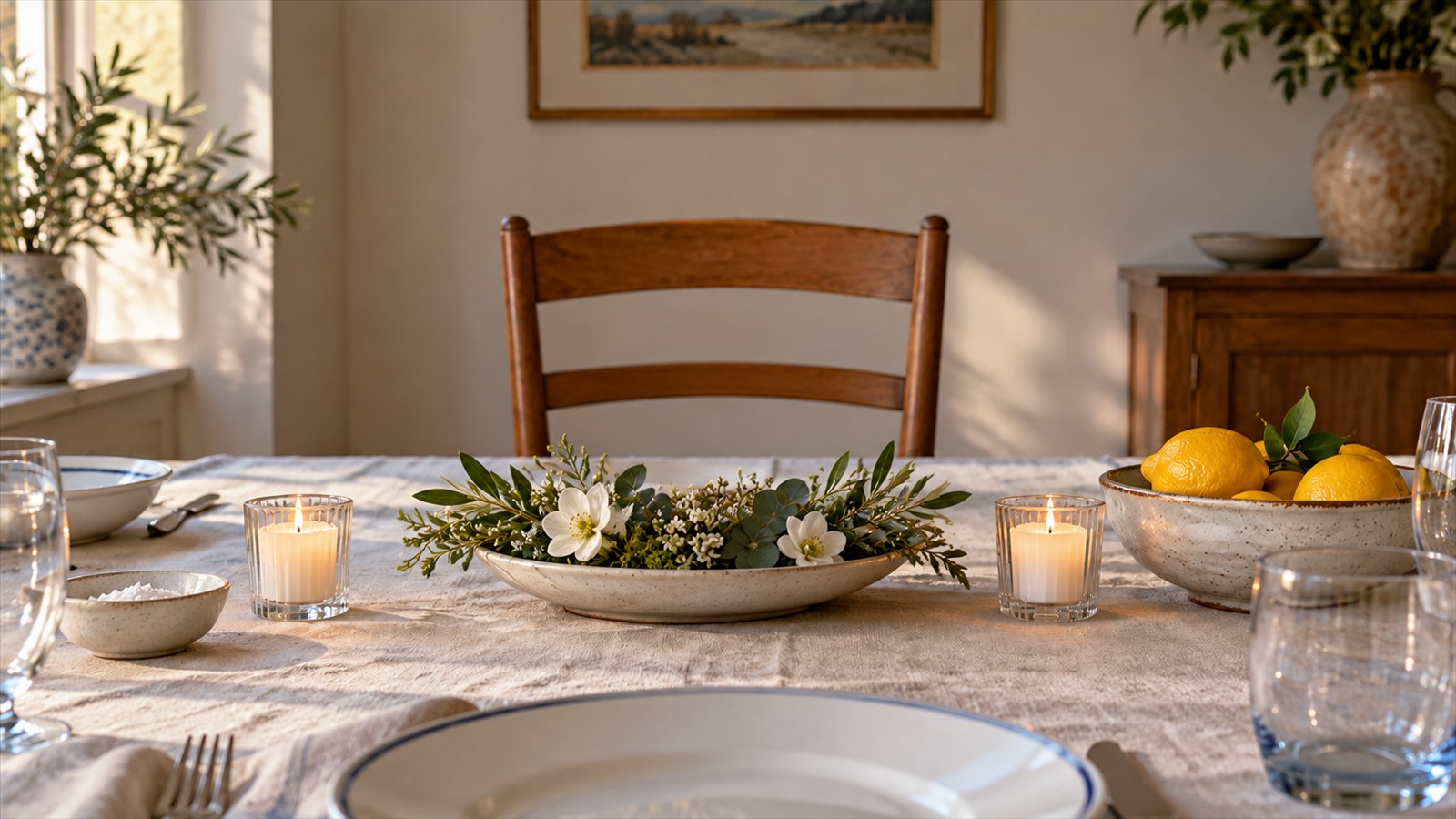
The centrepiece is the only decoration that can ruin the evening
Yesterday I finished by saying to choose the vase before the flowers. Today is the part that decides whether the vase was the right one.
And the best way to explain it is the story I read in a table-styling book, told by the author herself, who clearly still winces at it a little.
The table on the yacht
She was hired to build a table on a yacht. She gathered flowers, gathered small pieces, gathered details, and worked on it for a long time. When she finished she stepped back and admired it. She was proud of it. She couldn't wait for the guests to see it.
The guests sat down.
And they couldn't see each other.
All that beauty came off the table then and there, in front of everyone.
Since that day her number one rule has been one thing: make sure you can see the person sitting opposite you.
I love that story because it isn't about bad taste. The arrangement was beautiful. The problem is that it solved the wrong problem: it was built to be looked at standing up, by people walking past, and a table is used sitting down, by people who stay.
The test that costs two minutes
This is the most practical piece of advice in the whole book, and it's free:
Sit in every seat at the table and look straight ahead.
Not one seat. Every one. Because the table isn't symmetrical for the people at it — someone at the head sees one thing, someone in the middle of a side sees another, and an arrangement that's perfect from one chair can be sitting directly in front of somebody else's face.
It takes two minutes. You do it before anyone arrives, with the table already laid, and you find the problem while there's still time.
The object that has a back
I'd never thought about this one, and I found it very fair.
If your centrepiece is sculptural — a figure, an object with a defined front, anything with a correct side to look at — then half the table has won and half has lost.
The person facing it spends the evening looking at the beautiful thing. The guests on the other side spend the evening looking at its back.
A table is seen from every side at once, all the time. It's the only decorated surface in the house with that property. A picture has one side. A shelf has one side. A table has six people around it and each of them has a different angle.
So either the object works from every angle, or it isn't a centrepiece — it's a sideboard piece.
Free
Take the Christmas table checklist
It arrives straight away. After that, my newsletter — leave whenever you like.
Height: you can't go up without going down
The author is a maximalist, and even so this rule of hers is about restraint.
You can't go high without going low. If there's a tall point on the table, there has to be something interesting down low as well, or the high point floats and the table goes off balance.
And one freedom I enjoyed: the centrepiece doesn't have to be the tallest thing. We treat that as compulsory, but the high point can live somewhere else, and the centre can be low and wide.
To gain height without buying anything: a cake stand. It lifts what you already own off the table, creates a second level, and costs nothing if you have one. It's the cheapest trick in the book.
Placement: the method is trial and error, and that's fine
The author compares building a table to arranging a vase of flowers — you put something in, step back, look, move it again. There's a great deal of placing and replacing, and that's the process working, not you being indecisive.
What she recommends:
- Scatter first, adjust second. Distribute things across the table and only then fix the spacing, so there are no gaping holes and no clusters.
- Walk around the table while you place things. Don't arrange it all from one spot. This is literally the same point as the object with a back.
- Similar shapes at different angles. Two identical objects lined up the same way sit there inert; turned, they talk to each other.
- Explore the edges. How far out can the table go? We tend to pile everything into the centre and leave the perimeter empty.
- If you want something to stand out, give it space. Two or three pieces that mean something to you, centrally placed, and everything else pointing at them. Prominence is empty space around a thing, not its size.
And the last lap, which is the most honest bit: walk around the finished table and ask whether you overdid it. The author says she sometimes removes things at the last minute, because too much décor makes the décor compete with itself.
"Talking points"
This is the most entertaining idea in the book and the easiest to pull off in December.
She argues for putting slightly odd objects on the table on purpose. A ceramic animal, a silly souvenir, anything that makes somebody pick it up and ask what on earth it is.
The function isn't decorative. The function is to supply a subject. And it works hardest at exactly the family table where people see each other once a year and don't quite know what to talk about.
She hunts for these in thrift shops. I suspect most Brazilian houses already have a shelf full of them — it's just a matter of bringing them down.
This book's limits, said plainly
It's a professional stylist's book, and a good share of the examples are big events, with a budget and a theme. There's a Gatsby table, a tropical table, a champagne bottle turned into a candelabra.
That isn't Christmas dinner at your house, and I'm not going to pretend it is.
What transfers directly is the geometry and behaviour: sight lines, the object with a back, high needs low, space creates prominence, take a lap at the end. All of that works identically on a table for eight with the china you already own.
What doesn't transfer is the long list of centrepiece ideas, which is portfolio inspiration.
The December summary
The Christmas table has one property no other table has all year: people stay sitting at it for a long time. Two, three hours. With people they want to hear.
Anything that gets in the way of that charges a high price, and charges it all evening.
- Sit in every chair beforehand
- Low in the middle, tall at the ends or out of the eye line
- If it has a front and a back, it doesn't go in the centre
- At the end, one lap around the table, and take one thing off
And when the toast comes — the one moment where everybody needs to see everybody at once — you'll be glad. I've written here about where the clink of glasses came from and what the rules of toasting actually say, and none of it works with an arrangement in the way.
If you want a ready-made starting point, I built a whole Christmas table with the absolute minimum, and it was designed on exactly this low-sight-line logic.
And if you'd like the rest of what we're putting together for the season, I've gathered it all on one page, with a table checklist to download.
For the part of the table that's at the right height by definition: The Art of Napkin Folding has the classic folds step by step. R$47.00, lifetime access.
Tell me: what goes in the middle of your Christmas table? Ours is always the same thing, and I'd never once stopped to measure how tall it is.
Free
Take the Christmas table checklist
Everything that matters on a Christmas table, on a single sheet. Print it, or fill it in on your computer.
It arrives straight away. After that, my newsletter — leave whenever you like.