
The portrait on the wall has a job, and it was never decoration
Last week I wrote that the family photo doesn't record your family — it declares what you want shown. This week I found the other side of that coin, and it's stranger.
A portrait was almost never kept because it was good.
The bishop and the four hundred faces
Paolo Giovio was a sixteenth-century Bishop of Nocera, and he had an obsession.
In a letter dated 28 August 1521, he wrote that he wanted to bring together true portraits of men of letters, because the sight of those faces would stimulate men to virtue.
Not to remember them by. To have an effect on whoever looked.
By the late 1530s he had nearly four hundred portraits of famous men, displayed at his villa on Lake Como. And they weren't hung at random: they were divided into categories — nobility of spirit, saintly actions, military valour, writing, art, leadership.
A wall organised by moral quality.
The collection was exclusively of men, and that's worth saying plainly, because who qualifies for wall space is part of the story.
And then the Medici copied the lot
This is the part I read twice.
In 1553, Cosimo de' Medici decided to start his own portrait collection. What he did was not commission new portraits. He hired a painter, Cristofano dell'Altissimo, to copy Giovio's entire collection.
Copies. Of portraits of people the copyist had never seen, made by another painter, of people already dead.
And that collection of copies grew. In the seventeenth century, Cardinal Leopoldo de' Medici expanded it into what became the Uffizi collection of artists' self-portraits — which today runs to nearly fifteen hundred works, and isn't readily accessible to the public.
The historian telling this draws a dry and correct conclusion: artistic authenticity was not a major concern. What mattered was who was in the picture.
A portrait of a man dead for over a century
If any doubt remained that likeness was secondary, there's this.
Between 1630 and 1637, the painter Philippe de Champaigne produced a portrait of Gaston de Foix for Cardinal Richelieu's gallery. The series was conceived as a single entity: 25 painted portraits and 38 marble busts.
Gaston de Foix was a general who died in 1512.
More than a hundred years earlier. Champaigne never saw him, and nobody alive had. The portrait was built either from earlier portraits or from the painter's own imagination.
And the book is clear about why: in a series like that, the presence of the figure within a coherent whole matters more than individual likeness.
Most of that gallery was destroyed later.
The same holds at domestic scale in the eighteenth-century European country house, where whole ancestral portrait series were painted by an artist or group of artists who had never laid eyes on many of the ancestors they were painting.
Free
Take the Christmas table checklist
It arrives straight away. After that, my newsletter — leave whenever you like.
Why this isn't a curiosity but the normal operation
The chapter has a line that rearranges the whole subject: aesthetic value — the quality of a portrait as a skilful, inventive or beautiful work — has only rarely been the primary motivation for commissioning, displaying or receiving one.
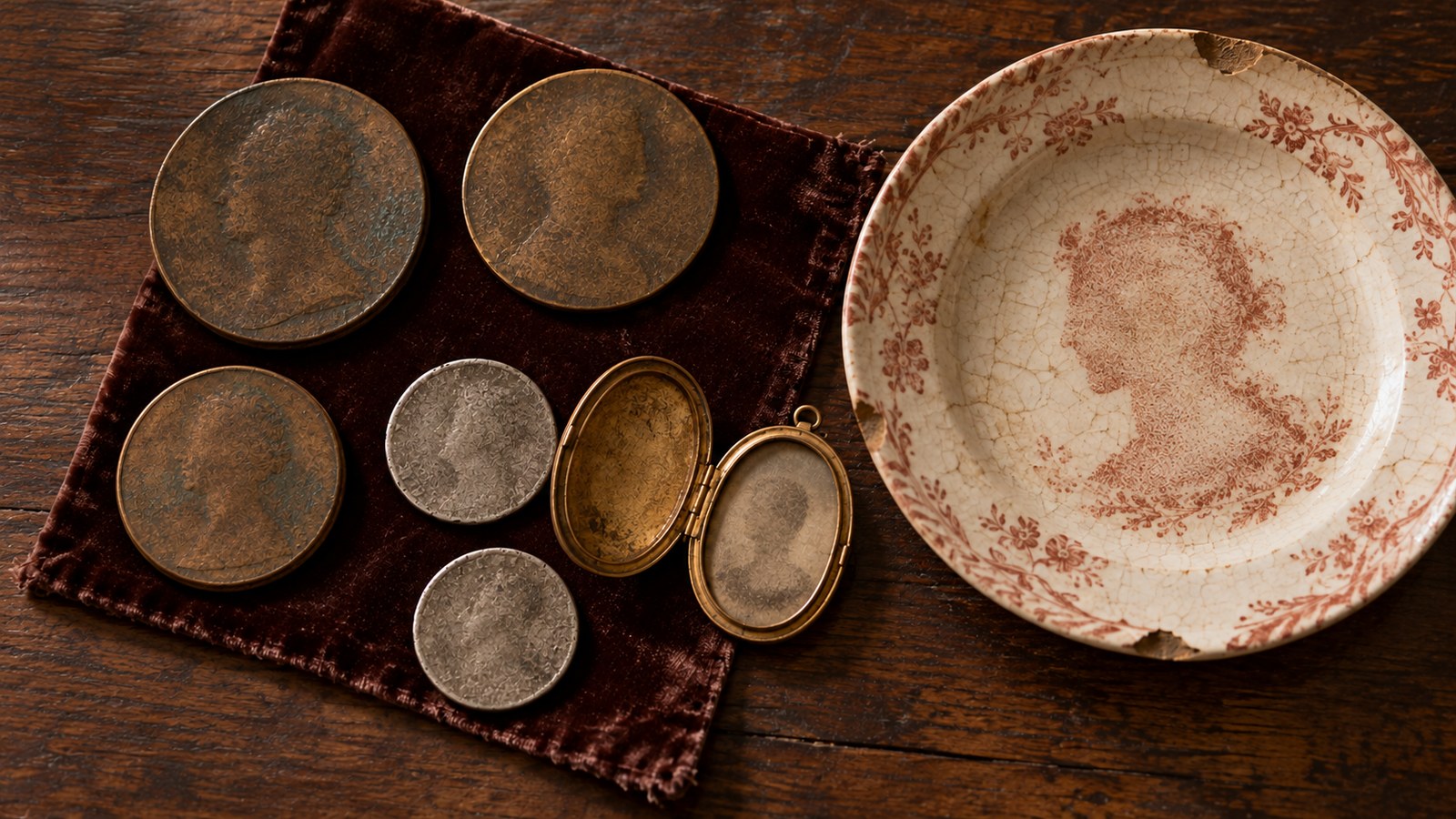
Look at where portraits actually turn up: coins, banknotes, stamps, commemorative medals, plates, mugs. Also fans and handkerchiefs, which wear out and get thrown away. And even mosaic and stained glass, which are terrible materials for studying a likeness closely.
None of those places is a gallery. All of them are places where a face is working.
And one point I hadn't considered: even the apparently private portrait — the miniature, the family picture — is made in the expectation that a group will see it, not one person. A portrait is born knowing it's headed for some kind of public domain.
Which is different from a self-portrait, the one situation where painter and sitter negotiate alone — and even there, the Uffizi turned the gesture into an institutional collection.
The national gallery that nearly wasn't an art gallery
The last piece is from 1856, and it's a documented argument.
When a national portrait gallery was being discussed in England, there were two camps. One held that only portraits of high artistic quality should be admitted. The other held that what mattered was the historical importance of the people portrayed.
The second camp won.
On 4 March 1856, in a speech to the House of Lords, the man behind the idea said the gallery should include those most honourably commemorated in British history — as warriors, as statesmen, or in the arts, letters and sciences.
The institution was founded that year. It had no permanent home until 1896, forty years later.
The result, which the book names and I think is honest: a gallery built on an ideal of national celebration, where the choice and arrangement of what hangs carries inevitable biases. Curators still wrestle with bringing marginalised figures into that pantheon, precisely because portraits of those people are far rarer than portraits of their noble, powerful or famous contemporaries.
Whoever wasn't painted doesn't get in. And whoever wasn't painted wasn't painted for a reason.
The tension that makes a portrait work
There's an idea in the chapter I'm taking with me.
A portrait points at the fleeting moment of its making — that person, that day, those clothes. And at the same time it freezes time and artificially extends the life of the person in it.
A record of an instant and an evocation of something permanent, both in one object. The book argues that the power of portraiture sits exactly in that tension.
It's why a photograph from a December ten years ago hurts in a way a landscape doesn't.
What I'm doing with this at home
Two practical things, and they changed what I think a wall is for.
First: ask what the portrait is doing to whoever looks at it, not only who is in it. That was Giovio's question, and it's the useful one. A photograph of your grandparents on the kitchen wall acts on whoever drinks coffee there every morning. It isn't decoration — it's company, or pressure, depending on how you hung it.
Second: print them. This is the tedious point and I'm going to insist on it. Almost all our photography lives on a server, and we have invented an entire generation of portraits with no physical support. Giovio had four hundred. The Medici copied his. We have four thousand and none on the wall.
December is when the whole family is in one room once a year. I've written here about why the family photo is a declaration rather than a record. This week I'd add: once you've declared, get it off the phone and onto a wall, because the object is what does the work.
If you'd like the rest of what we're putting together for the season, I've gathered it all on one page, with a table checklist to download.
And for the table that'll be in the photo: The Art of Napkin Folding has the classic folds step by step. R$47.00, lifetime access.
Tell me: are there portraits of actual people on your walls, or only landscapes and nice pictures? I counted at home and found zero, which felt strange after reading this chapter.
Free
Take the Christmas table checklist
Everything that matters on a Christmas table, on a single sheet. Print it, or fill it in on your computer.
It arrives straight away. After that, my newsletter — leave whenever you like.