
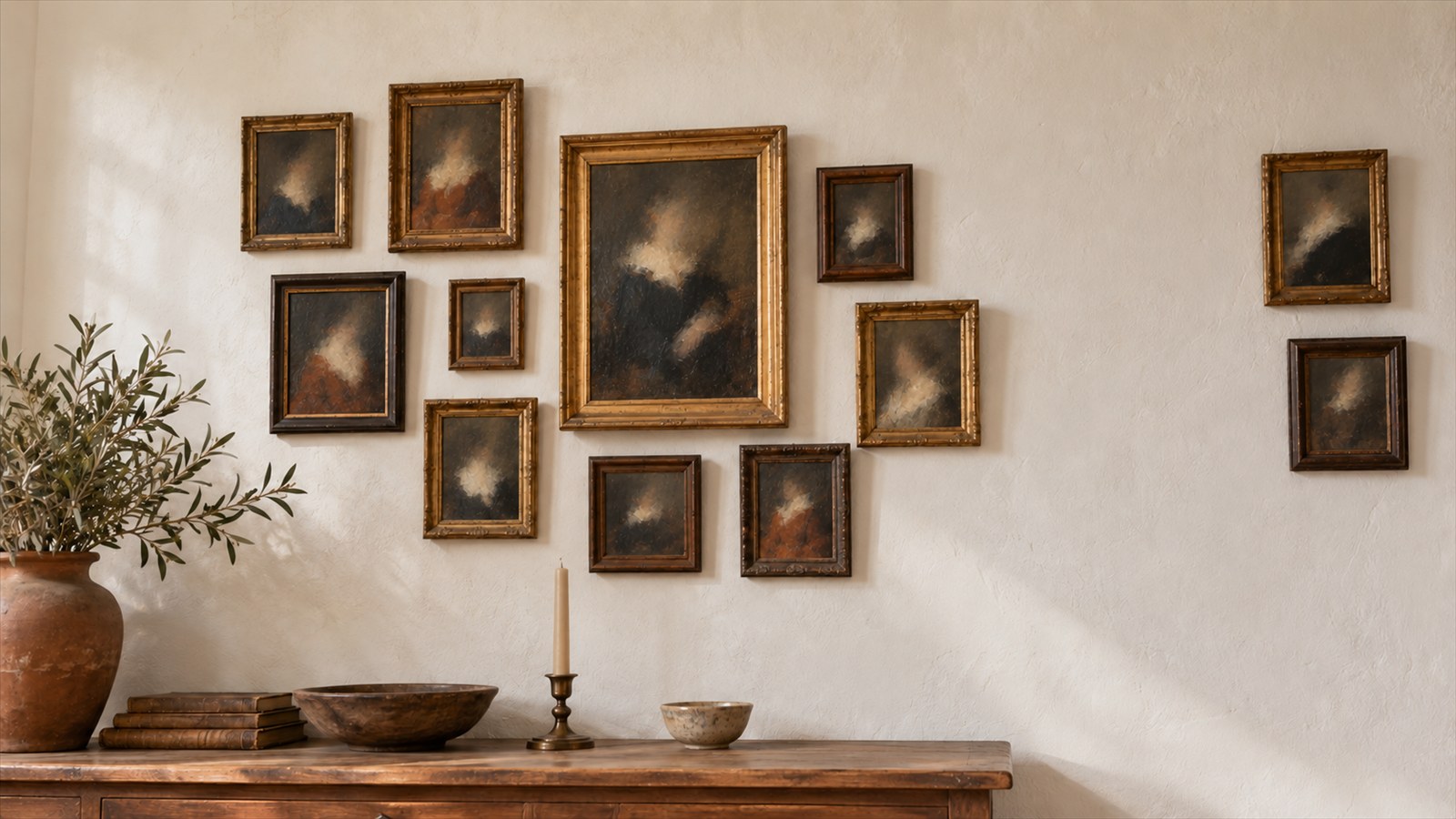
The family photo doesn't record your family. It declares what you want shown.
Every December has the photo moment.
Someone announces it's happening now, everyone piles up near the tree, one person ends up half hidden at the back, somebody blinks, and for the next year that picture is the official memory of Christmas.
I always found that moment awkward and slightly false. Then I read a chapter on group portraiture in an art history book, and discovered it is false — and that this was never the flaw.
First thing: in a group, the relationship is stated by space
A portrait of one person carries likeness, personality and status. The moment a second person enters, a variable appears that wasn't there before: interaction.
And in formal portraits that relationship is almost never carried by expression. It's carried by position.
In periods of patriarchal dominance, the father of the family gets the most prominent place. When the sitter is a club, a militia or a guild, the president or the leader takes up more of the canvas than everyone else.
It isn't subtle once you know to look. The hierarchy isn't written anywhere. It's in centimetres.
The portrait that is a family quarrel in progress
The example that got me most is Titian's, from 1546: Pope Paul III with two of his grandsons, Alessandro and Ottavio Farnese.
The story behind it is the good part.
Paul III had promoted both grandsons early in his papacy — a dukedom for one line, a cardinal's position for the other. In 1545 he summoned the Council of Trent to reform the Church. And then the reform started haunting him: he grew anxious about being accused of nepotism, and moved to strip Ottavio of the Duchy of Parma and Piacenza.
The grandsons went and negotiated secretly with Emperor Charles V to hold on to it. The pope read that as betrayal, and never recovered from it.
The painting was made in the early stages of that crisis.
And the result is extraordinary: the pope appears aged, wizened and irritable. The postures of the two grandsons have been read, by different people, as obsequious, conspiratorial, or simply courtly.
Three opposing readings, of the same bodies, on the same canvas. None of them demonstrable.
That's what a group portrait does: it records an arrangement of people in space and leaves the meaning permanently open.
The portrait that was edited afterwards, by other hands
The other case is Holbein's, from 1528: Thomas More and his family.
The original painting was destroyed in 1752. What survives is preparatory drawings and copies made by other people.
And the copies don't agree with each other. In the earlier versions the family appears in shared devotion; later copyists removed religious objects from the scene, rosaries among them.
So what we call "the More family portrait" is in practice a portrait that passed through several hands, each deciding what about that family should stay visible.
The drawing, incidentally, was a gift: More sent it to Erasmus, as a gesture of friendship and shared values.
A family picture turned into a present. Five hundred years and that hasn't shifted at all.
Free
Take the Christmas table checklist
It arrives straight away. After that, my newsletter — leave whenever you like.
The arc: from lineage to affection
The book traces a slow change I found genuinely lovely.
Early on, portraits of parents with children were about continuing the line. Child mortality was enormous, children were precious and fragile, and the portrait's job was to say the house had a successor. Dynastic, not affectionate.
By the seventeenth century the dynastic emphasis holds, but personal connection between generations starts to show. Van Dyck's 1635 portrait of the Earl of Arundel with his grandson is the case: the grandfather is in formal military dress, politically at work trying to re-establish a dukedom for the family — and at the same time his hand rests on the boy's shoulder, in a way that has nothing political about it at all.
By the end of the eighteenth century informality arrives. Children playing with dolls, misbehaving, teasing their parents. William Hoare's portrait of Christopher Anstey with his daughter, around 1779, has the girl mid-mischief, and the whole scene escapes the hierarchical convention of the century before.
Marriage portraits travel the same road: formal at first, softened in the seventeenth century by a new idea of marriage as companionship, and by the eighteenth century husband and wife appear in a single unified composition instead of two separate pictures hung side by side.
And now the warning, which is the most important part of the chapter
This is where I nearly wrote something foolish, and the book caught me.
It's tempting to read that arc as: families became more affectionate, and painting followed.
The book says explicitly that this doesn't hold. These are conventions of representation, not records of behaviour. A portrait sits between social expectation and lived experience, and the image it projects has as much to do with how people wished to see themselves as with what they felt.
Anstey's daughter mid-mischief might be real warmth. It might equally be a device to make the picture stand out at a public exhibition. It might be an echo of Rousseau's ideas about the importance of childhood, which were in the air at the time.
There's no way to know. And the book draws a conclusion I find stronger still: portraiture changed the public image of family life — how the family was represented, discussed and understood — rather than reflecting a change in what went on inside houses.
Painting didn't document the affection. Painting helped invent the expectation of it.
The detail that made me like the whole chapter
There's one kind of group portrait that escapes all of this: the corporate one.
Guilds, militias, confraternities, charities. These groups had internal hierarchies, but they talked about themselves in the language of equality — and the painter had to respect that. So unlike family portraits, many civic group portraits are deliberately democratic rather than hierarchical.
And even so, every member had to stay recognisable. You had to stitch a collective together without erasing anyone in it.
The practice goes back to the late fifteenth century, to the Venetian confraternities — lay groups devoted to a saint, grown wealthy on subscriptions and endowments, competing with each other over who honoured their patron best. Gentile Bellini painted a procession in St Mark's Square in 1496 for one of them, and at the front of the scene are the living members, in white robes, walking in the procession.
They put themselves inside the story they were telling. Which is exactly what we do with the Christmas photo.
This talks directly to something I wrote from the same book — that a portrait marks the hinges of a life, and that a series beats one perfect picture.
What I'm doing with this in December
Two things, and both took weight off me.
First: stop wanting the photo to be true. It isn't, it never was, and nobody ever expected it to be. It's a statement of what the family wants on the record. That's permission to arrange, to position, to take it again.
Second: look at who is where, on purpose. If position is what states the relationship, then it's worth deciding the position instead of letting chance decide it. Who ended up behind everyone? Who's cropped at the edge? Is someone alone in a corner while the rest lean into each other?
It's the same question I ask about the chair that stays empty at the table, and it deserves the same care. Nobody is going to say they minded being half hidden. But the photo stays.
If you'd like the rest of what we're putting together for the season, I've gathered it all on one page, with a table checklist to download.
And for the table that'll be in the photo: The Art of Napkin Folding has the classic folds step by step. R$47.00, lifetime access.
Tell me something: who organises the photo in your family? Because there's always one person, and it's almost never the one who comes out well.
Free
Take the Christmas table checklist
Everything that matters on a Christmas table, on a single sheet. Print it, or fill it in on your computer.
It arrives straight away. After that, my newsletter — leave whenever you like.