
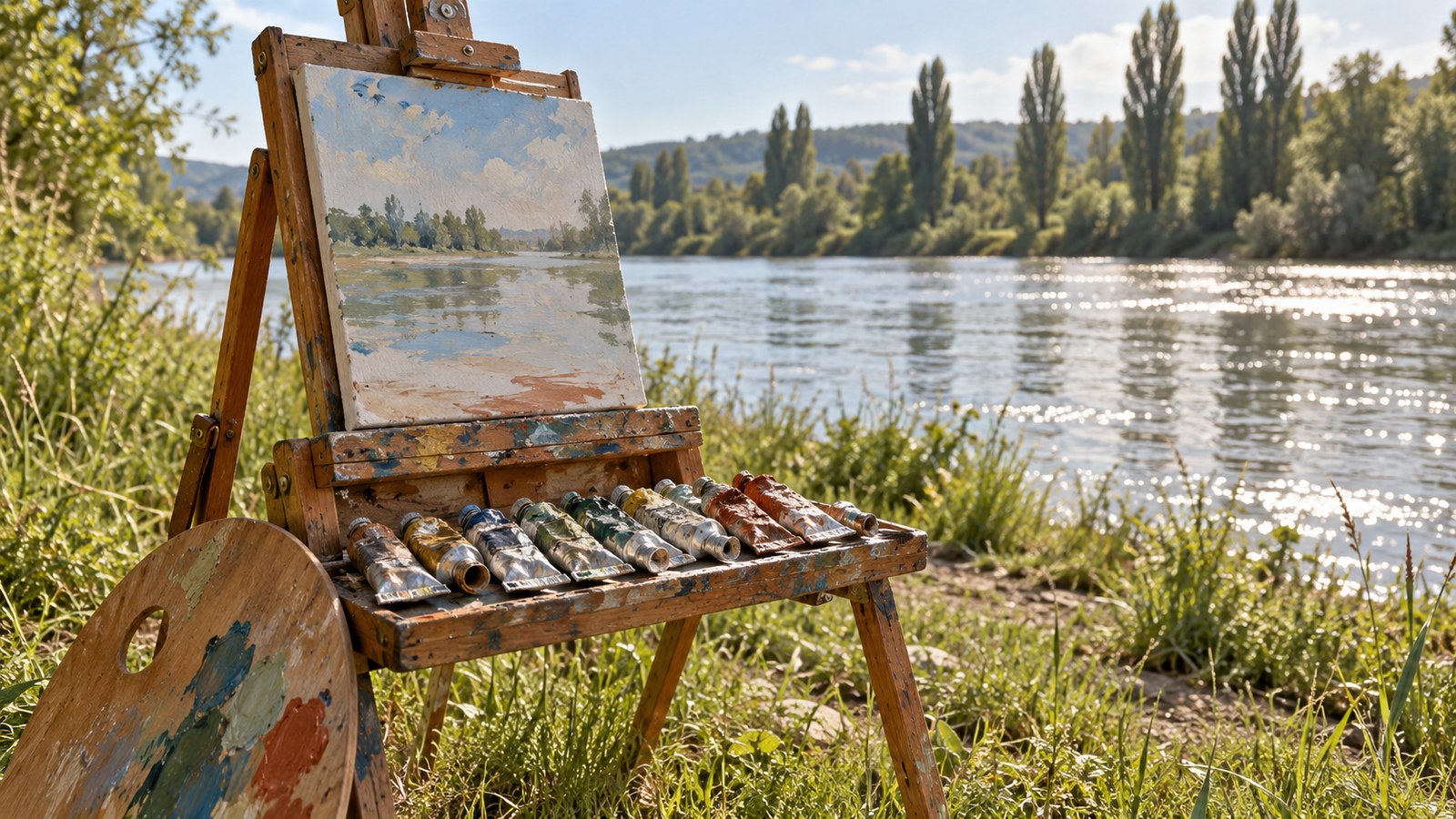
What got the painter out of the house was a container
I went to read about Impressionism expecting the story of some artists and found the story of a container.
Until the middle of the 19th century, oil paint was kept in a pig's bladder. You pierced the bladder with a tack, squeezed, and paint came out. Then you tried to plug the hole again. The paint dried, it leaked, and you couldn't take it anywhere.
Then the book says the sentence I kept rereading: among the mid-19th-century inventions that helped painters work outdoors were the collapsible easel and ready-mixed paint stored in metal tubes, rather than in pigs' bladders. Plus new pigments, which widened the available palette.
That's it. What got the painter out of the studio wasn't an idea. It was a container that closes.
First the subject moves house
Painting outdoors wasn't an Impressionist invention. The Barbizon painters were already working in the Forest of Fontainebleau before them, and the book has a detail I loved: Daubigny had a studio boat, and Monet later painted from a boat too.
But once the materials become portable, the change stops being about method and becomes about content.
The Impressionists dropped the earthy palette of the previous generation and went for pure, intense colour, with smaller fragmented brushstrokes made to record the momentary effect of light. It isn't only that they left the house. It's that outdoors, the light changes while you paint — which forces you to paint fast, and painting fast changes what the picture looks like.
The entire technique is a consequence of logistics.
Boudin, who taught Monet to paint on a beach, said it in 1888 in one short line: "Everything painted on the spot has a strength, a power, a vividness."
Then the train does the rest
This is where it gets better, because the city was changing at the same time.
Paris was being rebuilt by Baron Haussmann: the crooked medieval streets were cut open into wide boulevards with room for pavement cafés. Newly installed gas lanterns lit the city at night, and nightlife grew with them — theatre, opera, dance halls.
And new railway lines radiated out of Paris in every direction, putting the suburbs and the countryside one afternoon away. The book is explicit about the consequence: the Gare Saint-Lazare became a subject for painting precisely because that's where they themselves caught the train to the suburbs and to Normandy.
Pissarro moved to Pontoise in 1866 because living there was cheaper and rural subjects were to hand. Holidaymakers began filling the new seaside resorts of Trouville and Deauville — and became pictures too, the reds and whites of the bathers' clothes breaking up the blue and brown of sand and sea.
In 1888 Eastman launched the Kodak No. 1 and amateur photography became a craze. The book notes that many artists used photographs as a basis for composition without admitting it, and that you can see it in the abrupt crops and odd framings.
Free
Take the Christmas table checklist
It arrives straight away. After that, my newsletter — leave whenever you like.
The name was an insult
The first exhibition was in 1874, at the Paris studio of the photographer Nadar. Thirty artists. It was greeted with derision by the critics and lost money.
That's where the critic Louis Leroy took the title of a Monet painting, Impression, Sunrise, painted in 1872 at Le Havre, and used "Impressionist" as an insult. He named the movement by accident.
There were eight exhibitions, up to 1886. Pissarro is the only one who was in all eight. Berthe Morisot was the first woman to show with the group, in 1874, with The Cradle — her sister watching her daughter sleep.
I like that part because it dismantles the idea of an organised movement. It was a group of people with different styles, held together less by an aesthetic than by three practical things: wanting out of the academy's rules, wanting to exhibit outside the official Salon, and wanting to paint life as it was now.
The part that's useful at home
This is the one I actually wanted to tell you.
What these pictures did was promote the ordinary subject to the size of the important one. Courbet had already done it before them, painting labourers on canvases of the scale previously reserved for history and religion. The Impressionists carried it forward: a Sunday afternoon at a dance garden, friends at lunch on a balcony, people standing in the shallows at the beach, your sister watching her daughter sleep.
And today they're the most reproduced paintings on earth. The image hanging above more sofas than any other is somebody's ordinary afternoon.
There's a piece of homework in there, and it's literal: the same corner, at different hours, is a different corner. Monet showed twenty canvases of the façade of Rouen Cathedral in different light conditions, and worked on several at once, switching canvases as the light moved. Of the pond in his garden at Giverny he painted twelve canvases from the same vantage point in one year — and went to look at that water at least three times a day.
If an obsessive painter needed twelve canvases to deal with one pond, you aren't exaggerating when you find your living room lovely at five in the afternoon and strange at eight at night. It's the same observation. I wrote about this from the decorating side — decorating the room for the hour you actually use it, and it's the advice that changed my house most this year.
What I couldn't confirm
Two bits of honesty.
The book gives no name and no date for the invention of the tube. It says the metal tube existed and that it changed everything, and stops there. The patent for the collapsible metal tube is from 1841, by an American painter called John Goffe Rand, and that came from outside this book — I haven't checked it against a primary source, so I'm telling you where it comes from.
And there's a famous line I'm not going to use. Every article about paint tubes carries a quotation attributed to Renoir saying that without paint in tubes there would have been no Impressionism. It may well be real, but it isn't in the book I read and I couldn't find its origin. So it stays out.
What I'm going to do
Look at the living room wall at three different hours of the same day before deciding where anything gets hung. And stop treating an Impressionist print as generic decoration for a beige wall, because it isn't — it's a deliberate record of an afternoon that had nothing special about it.
If colour is what interests you in this story, blue once cost more than gold, and the order can be dated.
If you'd like the rest of what we're putting together for the season, I've gathered it all on one page, with a table checklist to download.
And if your December project is the table rather than the wall, The Art of Napkin Folding has the classic folds step by step, with the starch detail that decides whether a fold stands up. R$47.00, lifetime access.
Tell me: are the pictures in your house ones you chose, or did they arrive by inheritance and stay? Here half of them arrived and stayed.
Free
Take the Christmas table checklist
Everything that matters on a Christmas table, on a single sheet. Print it, or fill it in on your computer.
It arrives straight away. After that, my newsletter — leave whenever you like.