
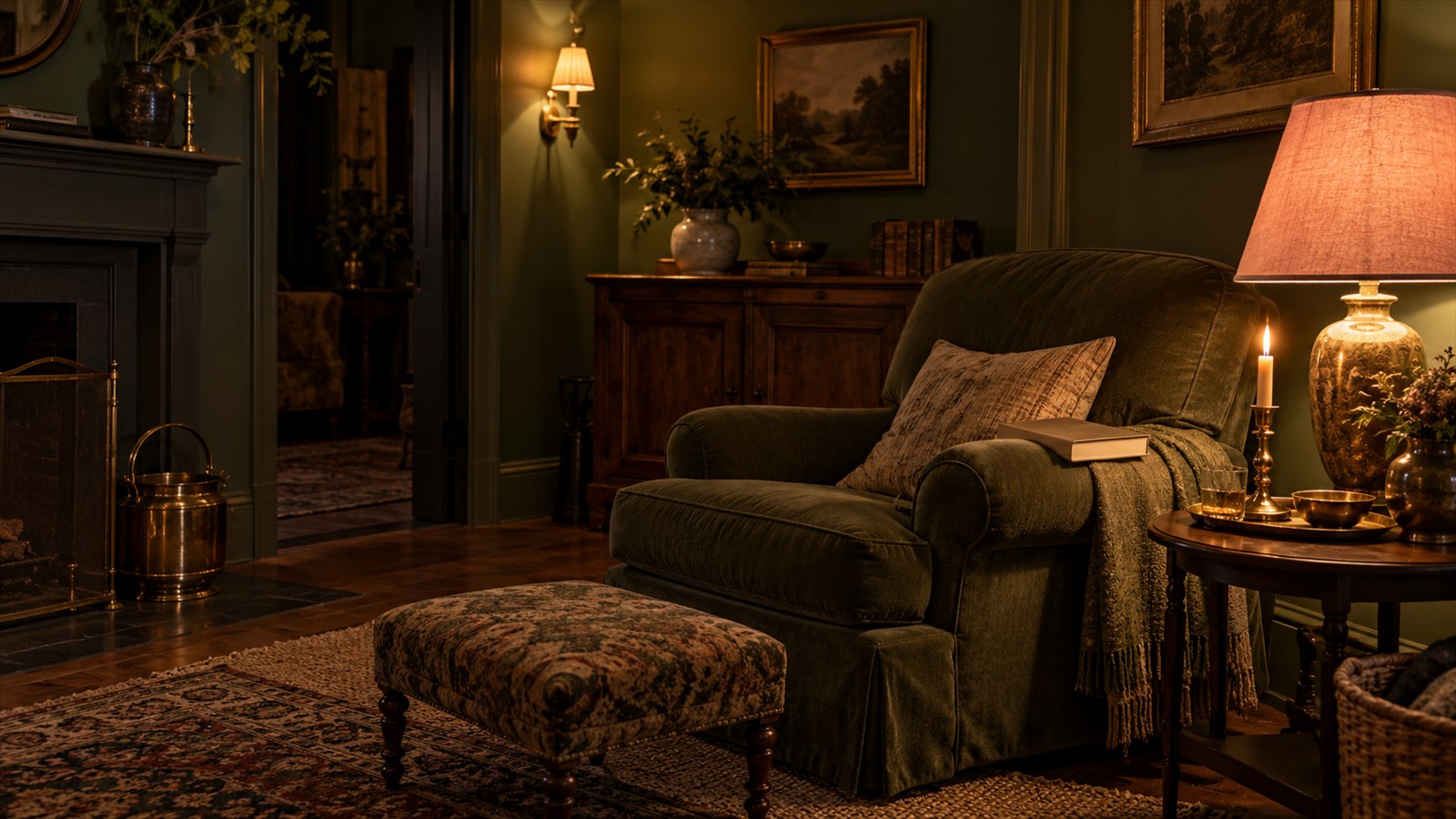
Your living room was decorated for daylight, and you only live in it after six
Try this with me. Think about the last time you sat in your living room without being in a hurry.
What time was it?
If the answer is after six, which it is for me and probably for you, there's an odd question hiding in that: why do we choose paint, fabric and lamps from a catalogue in flat midday light, for a room we almost only ever see at night?
I found a phrase for this in a decorating book, and I'd never come across it before: an evening room. A room settled by the hour it actually gets used.
What changes when the decision is a nocturnal one
The first change is colour, and it runs against most of what we're told.
The book recommends dark, cosy colours for this room: brown, blue, red, even green, in deep shades. Not to look larger. Not to look brighter. To wrap around you.
But there's a technical detail that makes all the difference, and I didn't know it:
The finish has to be satin or gloss, never flat. The reason is excellent. Flat paint on a dark wall sucks the light out of the room, and the book says it sucks the life out with it. A finish with some sheen reflects what little light there is and hands it back as a warm glow.
So: the same colour, in the same room, in two different finishes, gives you opposite results at night. Dark and flat is a hole. Dark and satin is a nest.
And if you're brave, she raises black. She points out that Cecil Beaton's London drawing room had walls covered in black velvet with gold and silver embroidery, catching glints of light. Black with something shining inside it isn't darkness, it's depth.
The line about overhead lighting I'll be repeating forever
On lighting at night the book is blunt: give up the overhead light.
The reason, in her words, is that it gives off an antiseptic glare about as inviting as a hospital ward.
Easy to laugh at, but look at what it describes. You flip the ceiling light on and the room goes correct and lifeless, the way a doctor's waiting room is correct.
It's the same idea I ran into on the Christmas tree, where fairy lights work as a spotlight rather than an ornament: light is for pointing at things, not for covering everything evenly.
What she proposes instead: a combination of table lamps, floor lamps and sconces, which bathe the space in warm, flattering light.
And two practical things I'd never considered:
Pink incandescent bulbs, or lampshades lined with pink fabric. They improve the room and, the book says, give the face of anyone in it a rosy glow. It's makeup applied by a lamp.
Brass, gilt and chrome work as light amplifiers. Not ornament: a reflective surface hands light back to the room. A scattering of metal gets you shine you never had to plug in.
That sits right alongside what I'd already learned about candles, which are the warmest light in any house. The candle settles the temperature. The metal settles the distribution.
Free
Take the Christmas table checklist
It arrives straight away. After that, my newsletter — leave whenever you like.
And the fabric, which is where the book is at its best
Here comes the part I found bravest for a decorating book.
No hard-backed chairs, no stiff little antique settees. An evening room wants roomy upholstered sofas and armchairs, tufted stools and ottomans for tired feet.
And the fabric: brushed cotton, velvet, corduroy, certain wools. Soft to the touch and durable.
Then she disposes of silk with a sentence I'd love to have written. Silk is stand-offish, and doesn't do well with people eating and drinking on it, something that really should be encouraged in an evening room.
Encouraged. In a book about classic decorating, the author says eating and drinking on the sofa is to be actively invited, and picks the fabric accordingly.
It's the closest thing to my own opinion I've read all month.
The lamp invented for a card game
And then, twenty letters earlier in the same book, there's the object that proves the whole principle.
It's called a bouillotte lamp, named after an eighteenth-century French card game. It was conceived to light the table during a hand.
The build: two or three candle holders on a metal shaft, with a dish-shaped base designed to hold the players' chips. Most are wired for electricity now, but the design survived.
And here's the good part.
At the top of the shaft is a metal shade that moves up and down on a screw key. What for? Because candles burn. As the wax dropped, the player wound the shade down with it, and it went on covering the flames and shielding the players' eyes from harsh light.
Someone looked at a candle and realised the problem wasn't the light. It was that the height of the light changes over the course of an evening. And solved it with a screw thread.
The designer Mark Hampton wrote of it that it is safe to say it "will never be out of favor", and the author agrees.
Two practical notes of hers that apply to any lamp:
This is the exception to the rule about pairs. Lamps generally look best in twos; the bouillotte doesn't, because the design is already ornate enough. One will do.
The traditional shade is metal painted black, and there's no reason not to have it painted whatever colour your room asks for.
One thing about this book
It's a book of taste, not of history.
The author writes in the first person, gives opinions, jokes, tells you her favourite chair and the name of her dog. It has dates where it has dates, and where it doesn't she doesn't pretend. On the bouillotte, for instance, she says the card game is eighteenth-century and stops there: she doesn't give a year for the lamp, and I'm not going to invent one.
I like that kind of book precisely because it isn't disguised as an encyclopedia.
What I'm doing before the hosting season
Turning off the ceiling.
Just that, to start. A full week of not switching on the central light after six, using only lamps and sconces, to see whether the difference is as large as the book promises.
And leaving two metal things out near where the light sits, which is the cheapest trick on the entire list.
The satin wall can wait for next year. Start from where you are.
If you want the rest of what we're putting together for the season, it's all on one page, with a table checklist to download.
And if your evening is going to involve people eating and drinking in the living room, which the author of this book would approve of: The Art of Napkin Folding has the classic folds step by step. Lifetime access.
Tell me: do you switch on the overhead light in your living room at night? I do, and I'm going to stop.
Free
Take the Christmas table checklist
Everything that matters on a Christmas table, on a single sheet. Print it, or fill it in on your computer.
It arrives straight away. After that, my newsletter — leave whenever you like.