
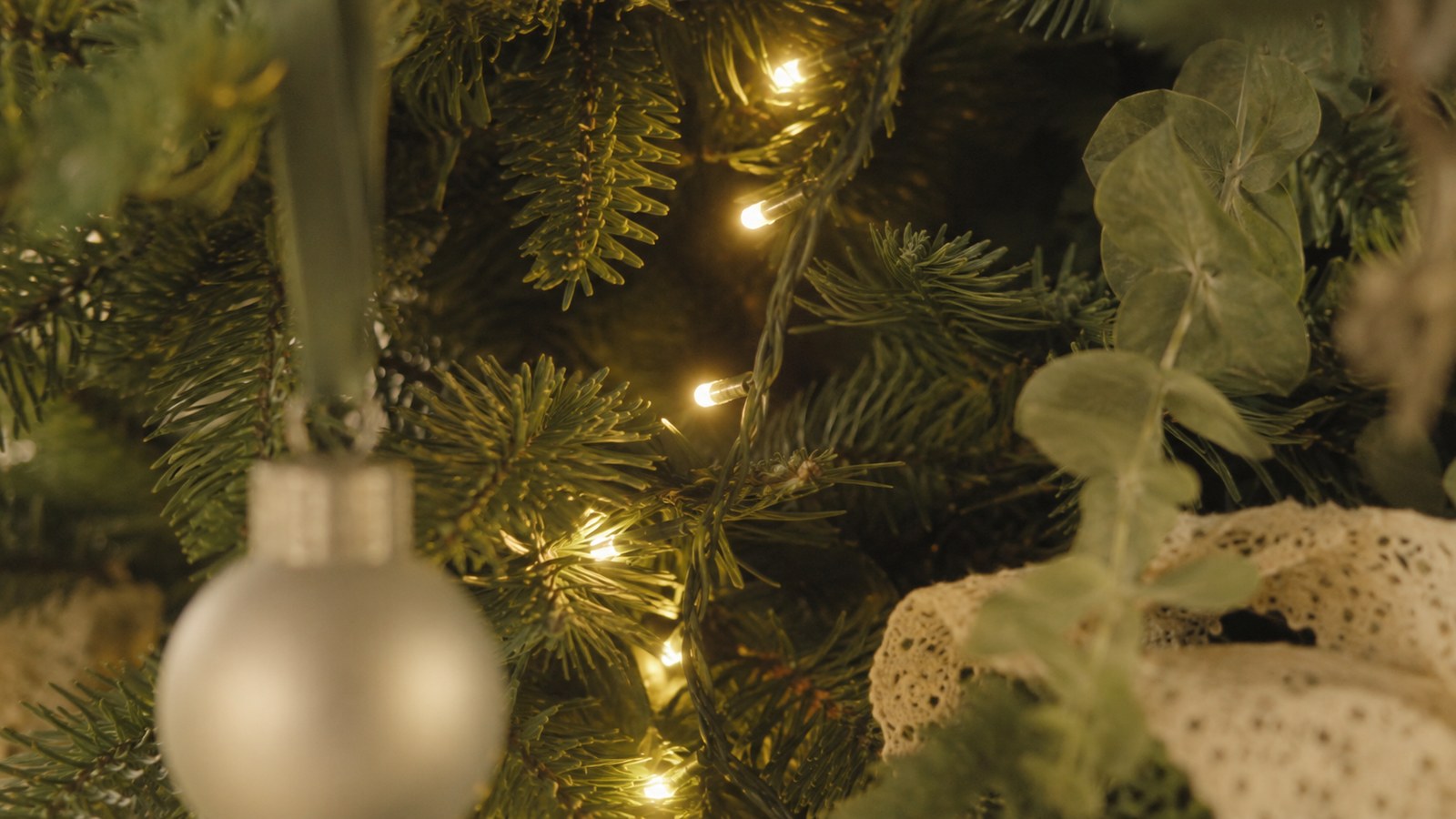
Fairy Lights Aren't Decoration. They're Spotlights, Which Is Why They Go On Vertically.
Before anything else, a sentence from a decorating book that I did not expect to find in a decorating book:
"Marketing and movies have taught us that decorating a Christmas tree is a joy-filled, fun and glorious event, spent laughing with loved ones, delicately placing ornaments while wearing Fair Isle. The reality involves suppressed screams of frustration, blown bulbs and tension."
Good. Now we can talk about method.
The line that reorganised my tree
"When it comes to using fairy lights well, you need to think of them less as decorations and more as gorgeous spotlights. Use them to light up the darker pockets of the tree rather than as an added decoration."
Spotlights. Not decorations.
And the practical consequence follows immediately, and it's the most applicable thing I've read about a Christmas tree:
"Don't hang lights horizontally along branches. This can waste a lot of yardage and a lot of bulbs can go unseen, as they literally sit on the branches. Instead, go vertical. That way you have bulbs in between branches as well as on them."
Think about what happens horizontally. The bulb lies down on the branch. Half of it is hidden by foliage, and the light that escapes goes sideways rather than inward.
Vertically, the wire travels up and down through the layers, and the bulbs drop into the gaps. The tree lights from inside.
And there's a bonus for anyone whose tree stands against a wall: "If your tree is not seen from all angles, it will also give you double the coverage as you don't have to light up the back that is never seen."
Three more things about the light
Lights go back, ornaments go forward. Same logic as a spotlight: the light does the lighting, the ornament does the showing.
Test before you hang. "You don't want to wait until they are all beautifully hung to realize they need to be repaired." Obvious, and still.
Choose solar or battery, because "they are safer". If it has to be plug-in, choose low-energy, "as these don't get as hot."
The hanging order, which is also technique
She has a system here, and it solves the lopsided-tree problem.
First, take everything out. Every piece, before you start. "There is no point going box by box."
Sort by size. "Before you hang anything, lay out your decorations in order of size. When we do this, it allows us to hang in a more balanced way."
Within each size, split into plains and specials. That lets you "prioritize special or sentimental decorations at the front, with the less ornate further back."
The large plain baubles go first, close to the spine. "This will give a sense of fullness. As they are simpler, they don't need to be centre stage."
The special ones go at eye level.
The smallest go on the branch tips, which is where the branch carries least weight.
And keep standing back, "to see where you are getting too heavy or too light."
None of that costs anything. It's just order.
Free
Take the Christmas table checklist
It arrives straight away. After that, my newsletter — leave whenever you like.
And she says something I wasn't expecting
"I personally think that you don't have to have a Christmas tree. GASP. Said it, won't regret it. They are absolutely glorious but not everyone has the space or will be spending enough time in their home around Christmas to make it worth it."
If you're not having a tree, her alternative is a foliage arrangement on any flat surface. With a warning: "Make sure it is not too precious in case you get a water mark."
The arrangement method comes with numbers:
- Jars and containers in mixed sizes, so you get different heights, filled three-quarters with water.
- Chicken wire over the mouth of each jar, held with twine, to hold the stems.
- Largest at the back, smaller to the front and sides, for a tiered shape.
- Largest stems first, to set the silhouette. Then filler. Flowers and the expensive foliage last.
- Cut stems at an angle ("more surface area for drinking") and strip any leaves that would sit below the waterline.
- Spritz daily and change the water every three days.
And the economy of it: buy one bunch of your hero foliage and ask at the market what works as filler, because "there is so much foliage that works well with eucalyptus for around a third of the price". The expensive stuff goes at the front and on top. The cheap stuff makes the bulk.
The smell, with a temperature and a time
This is the part I've already tested.
Dried oranges and cinnamon sticks, she says, "are one stunning way to add visual appeal as well as scent realness to your December set-up. They can suit wreaths, garlands, trees and almost all other décor. They are also gorgeous in a sugar bowl on a hall table."
The method, in full:
"Slice and pop the oranges in the oven for around 45 mins to an hour, turning halfway. I set my fan oven to around 120ºC and keep a wee eye on them while they dry out."
That's about 250°F, by my conversion. Cinnamon needs nothing at all: "the cinnamon can be used as she comes."
And the against-the-grain opinion, which is the best part: "I know the done thing is to hang these in full view, but I live for the slices tucked in among the greenery."
Hidden. You smell it and can't see where it's coming from.
One thing about this book
It contains no dates. Not one, in the entire chapter.
I usually open these pieces with a year, a decree, a name. I've written, for instance, about the tree that stood on a table because of a 1531 ordinance. This chapter is a different animal: pure technique, with numbers and mechanisms, and no origins anywhere. Better to say so than to invent a history.
And the end, which nobody writes about
The most useful part of the chapter is the last one, and it's about putting things away.
Her rule is not to buy plastic boxes. "We are living in a world where we are told that lots of plastic boxes make an organized home. Shudder."
What she uses instead, and the whole list is worth having:
- Egg cartons and cereal, pasta or teabag boxes. They take up almost nothing and stack inside larger boxes.
- Wrapping-paper or kitchen-roll tubes taped together, to wind the lights around, then slid into a postal tube. "This means they are safe from harm during storage and you won't have to spend time unknotting next year."
- Wrapping paper and tissue saved on the day, to wrap baubles and line the bottom of boxes. The tissue "will be able to absorb any moisture in the box during storage."
- Wine-delivery box inserts, ideal for stacking baubles, with sheets of cardboard between the layers.
- Chocolate boxes and biscuit tins, for anything delicate. The small tins for hangers and tape.
And the space trick I'm going to use: "Storage in the home is usually bottom heavy, with the top part of storage cupboards frequently unused. As Christmas décor can be so light, tension poles are ideal here to keep the boxes up off the floor and out of harm's way."
It closes with the cheapest advice in the chapter: photograph or sketch the arrangement that worked, and note what foliage you bought and how much you used. Next year you don't start from nothing.
If you want the rest of what we're building for the season — as useful for a Thanksgiving table on 26 November as for December — it's on one page, with a table checklist to download.
And if you want the detail that takes up no room on the table at all: The Art of Napkin Folding has the classic folds step by step. R$ 47.00, lifetime access.
Tell me: do you string your lights horizontally or vertically? I did horizontal my whole life and I'm switching.
Free
Take the Christmas table checklist
Everything that matters on a Christmas table, on a single sheet. Print it, or fill it in on your computer.
It arrives straight away. After that, my newsletter — leave whenever you like.