
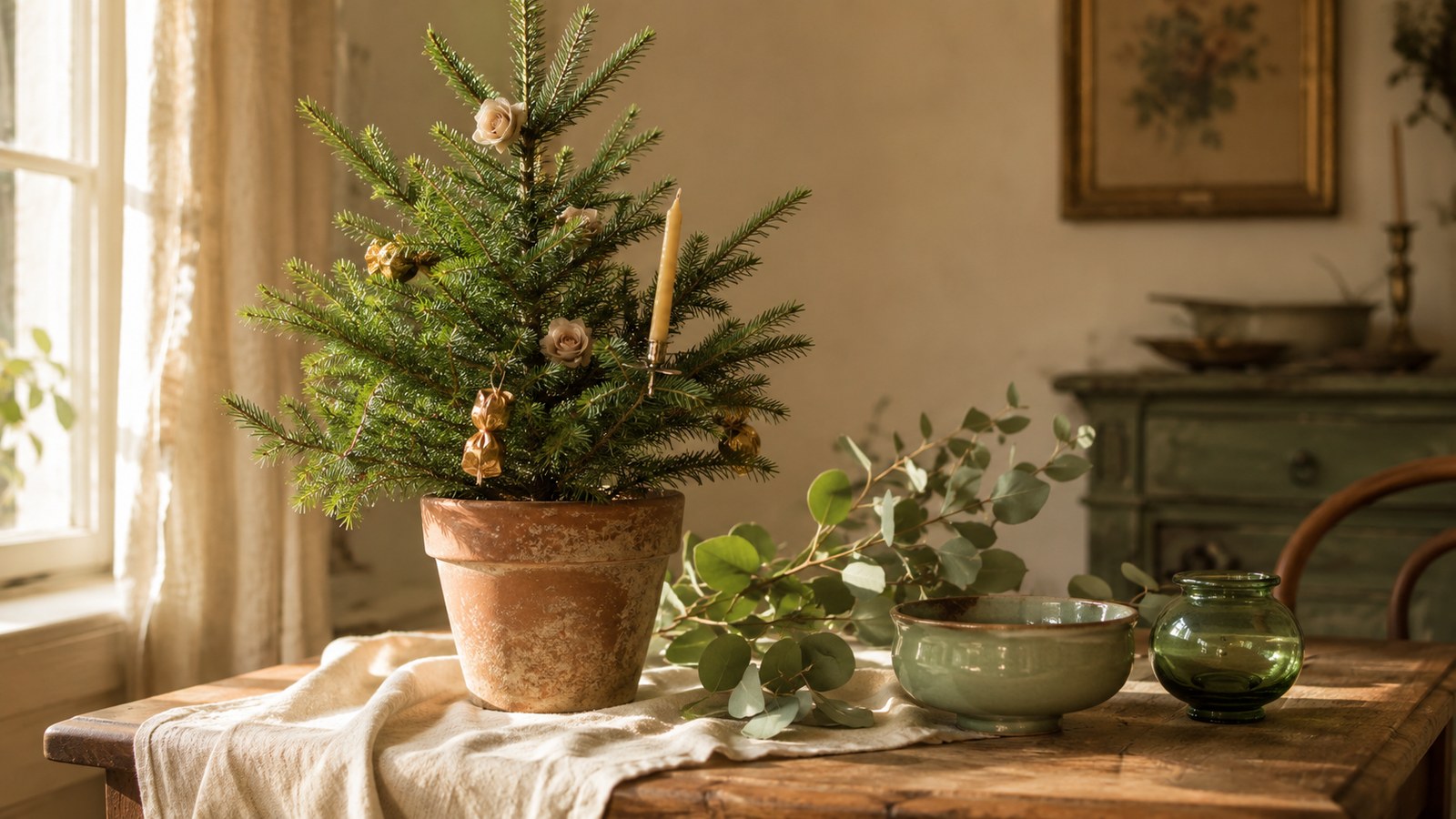
The First Christmas Tree Stood on a Table. Because of a Law.
I spent years with a metre-and-a-half plastic tree and a faint sense of doing the reduced version of something.
Then I read the date and the ordinance that created the tabletop tree, and the feeling turned inside out.
Alsace, 1531
The first reports of German Christmas trees come from 1531, in Alsace. And here is the detail: the trees, still undecorated, were erected on tables, because a local forest ordinance forbade cutting firs more than four feet in height.
Four feet is about 1.2 metres.
So the tree on the table is not the small version of anything. It is the first one. And its height was decided by a forestry official worried about the fir supply, not by taste.
Before that, the oldest evidence of decorated trees comes from Riga in 1510 and Reval in 1514, now Latvia and Estonia. In both cases guild members danced around a fir hung with paper roses on Christmas Eve, and then burned the tree.
What went on it, and for how long
In Strasbourg, 1605, we get the first mention of firs decorated inside houses. They hung paper roses, flat wafers, apples, gilded candies, sugar candy and pretzels.
And the sweets stayed on the tree until Epiphany. On the day it came down, the children ate the tree.
Candles appear on trees in southern Germany around 1660, often sharing a room with a Weihnachtspyramide, a triangular shelved wooden frame wrapped in fir boughs, sometimes hung from the ceiling.
And here is the origin of an object I used without ever thinking about it: the tree skirt began as a plain cloth placed under the fir to protect the table, the table and not the floor, from candle drippings and shed needles.
Free
Take the Christmas table checklist
It arrives straight away. After that, my newsletter — leave whenever you like.
When it grew
The giant tree is recent and it has an address.
By around 1860 American trees had reached ceiling height and stood on the floor rather than a table. The first depiction of that is a short story by Lizzie McIntyre in Godey's Lady's Book.
Even so, at the turn of the twentieth century only one in five American families had a tree at all. It was not until around 1930 that the custom became nearly universal.
The artificial tree was born small too. In 1913 Sears, Roebuck sold the first ones in the United States, and they were tabletop models made of goose feathers dyed green and wound around sticks attached to a central trunk. In the 1930s the Addis Brush Company made the first brush trees using the same machinery that made toilet brushes.
Seventy years separate the table tree from the ceiling tree. We inherited the second one and assumed it was the only one.
The plant they deliberately shrank
There is a second size story here, and it is even more explicit.
The poinsettia is native to Central America and tropical Mexico, and it originally grew to heights of ten feet. From 1923 onward the Paul Ecke family in southern California bred shorter, more branched varieties. In 1963 came the cultivars that grow best as potted plants.
The Christmas plant that fits on your sideboard was shrunk in a nursery over forty years, in order to fit on your sideboard.
And since we are on the subject of a warm December: the Christmas cactus, Schlumbergera, is a true cactus native to Brazil and Central America that blooms in December. It doesn't need snow to know what month it is.
How to put things on a surface that's already full
The practical part, because a lived-in house has no empty surface waiting for decorations.
Height wants company its own size. A 24-inch vase usually looks better beside a 16-inch sculpture than beside a 2-inch paperweight. Small next to large just reads as clutter.
Odd numbers, same material. On a rectangular table, run a small collection of one material down the centre: five or seven different glass vases, say. Odd works better than even. On a round table, cluster them in the middle.
The rule of fifths. For branches in a tall vase: one fifth vase, three fifths branches, one fifth empty air above.
Low, always. A centrepiece tall enough to block the eyes of the person opposite has failed before the meal starts.
Three to five vertical moments in the whole room, not more — sideboard, side table, mantel — so the eye doesn't get stuck in one place.
If it will be within arm's reach, choose what survives being picked up. At a table where dishes are passed, prefer the heavy-bottomed bowl to the tall vase on a narrow foot. Thin glass and porcelain want a high shelf.
Two lines I stole
From a decorator, on accumulating: "if it doesn't have a home, it's not allowed to roam." Anything new needs a designated place before it comes in.
And the editing rule I use most: shelves can be about quantity, surfaces have to be about quality. A bookcase can carry a collection. A table cannot.
What I'm doing
Keeping the 1.2-metre tree on the corner table, with the cloth underneath, and no longer explaining myself.
It isn't a flat-dweller's concession. It's from 1531.
If you want the rest of what we're writing for the season, I've gathered it on one page — the table, the house, the meal. And on why an old piece is usually the better buy, I wrote a whole post about buying secondhand.
Tell me: what's the oldest Christmas decoration in your house, and whose was it before yours?
Free
Take the Christmas table checklist
Everything that matters on a Christmas table, on a single sheet. Print it, or fill it in on your computer.
It arrives straight away. After that, my newsletter — leave whenever you like.