
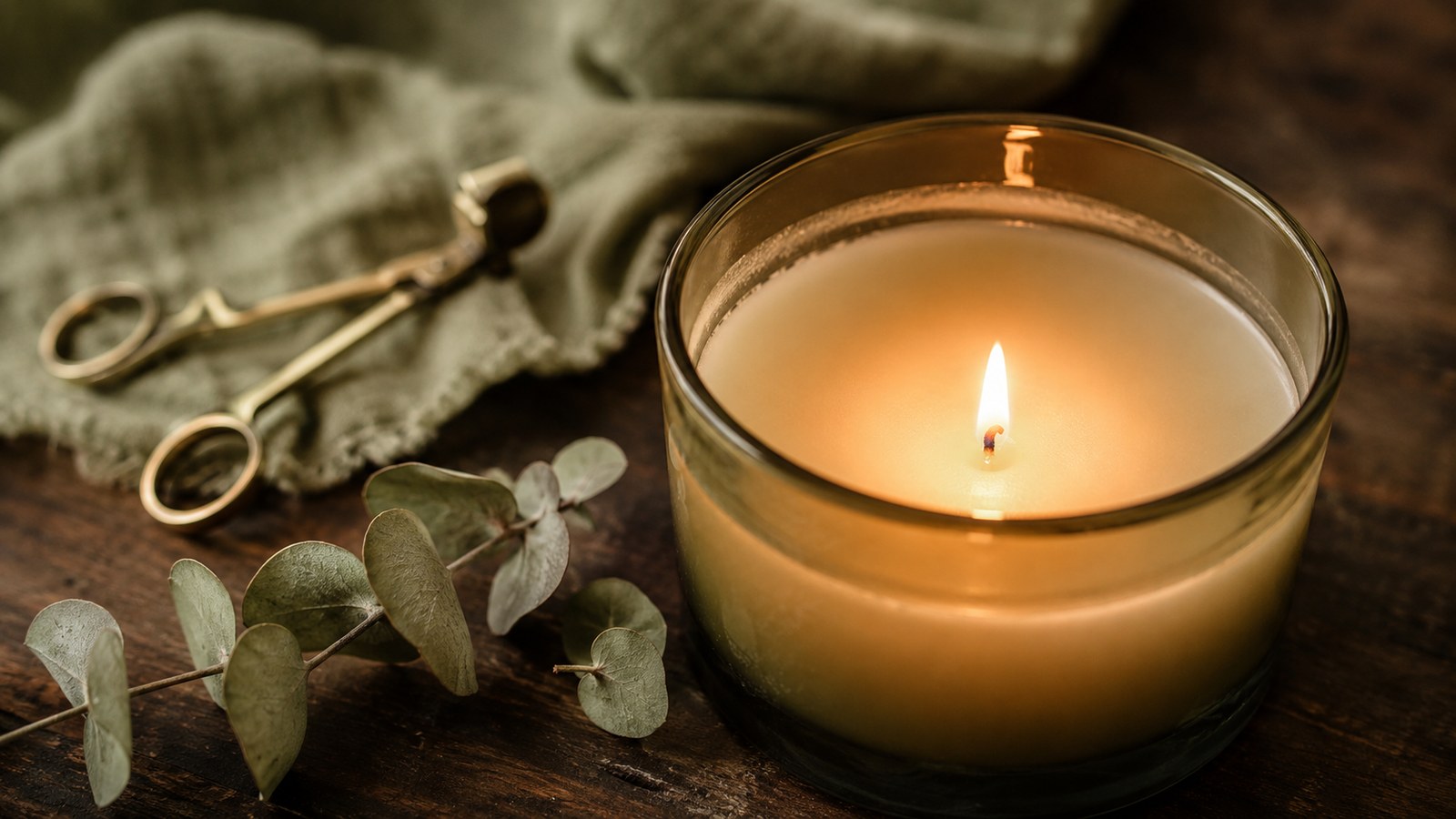
Many Candles Only Have Scent in the Top Layer. It's There So You Smell It in the Shop.
Have you ever bought a candle that smelled wonderful in the shop and smelled of nothing after two evenings?
You didn't imagine it.
"If you ever feel like a cheaper candle has stopped smelling after a couple of burns, this is because many candles will only have scent at the top to lure you in when in store. Higher priced candles are whipped the whole way through."
I read that sentence three times.
And more fragrance isn't a sign of quality
That was the second surprise.
"Better quality scent doesn't necessarily mean more fragrance, as the highest ratio of wax to fragrance is 9:1 before it becomes a hazard."
Nine parts wax to one part fragrance. That's a safety ceiling, not a taste one: above it the candle becomes a hazard. Which means the expensive candle doesn't hold more scent than the cheap one. It holds the same scent spread evenly.
What changes isn't the amount. It's where it is.
And then the part that really got me
The same book, in an entirely different chapter, about having people over for dinner:
"Always opt for an unscented candle for the table, as scented candles while eating can throw people off."
After all those pages on how to choose a good scented candle, the author arrives at the dinner table and says: here, none.
She's right, and the reason is the one I'd already run into from the kitchen side. Smell is the strongest thing in a meal and it doesn't share: a single clove bud is up to 17% pure aroma, and one roast fills a room on its own. Putting a vanilla candle in the middle of that is playing two songs at once.
So the rule turns out to be simple and slightly funny: scented candle for the living room, plain candle for the table.
Free
Take the Christmas table checklist
It arrives straight away. After that, my newsletter — leave whenever you like.
The other four rules for a candle on a table
All from the same chapter, all with a practical reason behind them.
Tall, not short. "Tea lights and low-rise candles can lead to burned wrists or napkins going up in flames, so go for a tall candlestick with a long dinner candle." A low candle sits at exactly the height of the arm reaching across for the dish.
Tapered. "Go for tapered, stunning and less likely to knock."
Two of them. "I like two candlesticks to spread the light." One candlestick lights half a table and leaves the other half in the dark.
Lit at the right moment. "Light them shortly before people sit and then leave to burn until everyone has left the table." Not earlier, because it burns for nobody. Not out halfway, because the table disappears with it.
Something I didn't know about the colour of a flame
A candle has a colour temperature, measured in kelvin, the same as a bulb.
"They will have a kelvin of between 1,500k and 1,700k."
For comparison: the same author recommends a maximum of 3,500K for the reading lamp beside the sofa, and 3,000K or under for every other bulb in the room. In the bedroom, 2,700K to 3,500K.
So a flame sits well below any household bulb she recommends. That's why no "warm white" bulb has ever managed to imitate candlelight. It isn't a question of strength. It's colour.
I have to be precise here, because in another chapter the book slips: kelvin measures the colour of light, not how much of it there is. A 2,700K bulb can be far stronger than a 5,000K one. In practice the two often move together, but they're not the same measurement and I'd rather keep them apart.
The rest is mechanics, and all of it works tonight
The first burn decides every burn after it. "Always allow your candle to melt the wax to the edge before you put it out, especially on the first burn. Wax has memory and so will stop melting at the same point as when it was last burned."
Put it out early on the first night and the candle will sink down a narrow well forever. There's a second cost I hadn't thought about: the flame ends up hidden down in the hole. You lose the light, not only the wax.
Trim the wick to a quarter of an inch before lighting. It cuts the smoking and stops the black mark on the glass. Scissors are fine, as long as the trimmed bit doesn't fall into the wax.
Cotton wick. "It won't smoke or mushroom like others." And it needs to be thick enough to melt the wax right out to the glass; a thin wick wastes wax and scent at the same time.
Don't blow. I got this wrong my whole life. "Blowing out a candle can disperse a lot of smoke." The right way is to dip the wick into the melted wax and stand it back up, with a dipper, or use a pinch snuffer, which she recommends for dinner candles in particular. The lid is not for putting it out — it's for protecting the wax while the candle is stored.
Away from draughts. A candle in a walkway, near a window or a vent flickers, and a flickering flame makes soot.
The soot has a name, and it goes on your walls
The author calls it BSD, "Black Soot Disposition". When combustion is incomplete you get soot, and it "floats through the air and settles in smoky patches on the furniture but mainly on your walls. Usually around the picture frames, windows and other fittings."
If you have a dark halo around a picture frame and never worked out where it came from, look at what burns underneath it.
One thing about this book, to be fair to it
It contains no dates. Not one.
I usually open these pieces with a year, a decree, a name. This is a technique book, not a history: it explains how things work, with numbers and mechanisms, and never says where they came from. Better to tell you that than to invent an origin that isn't in there.
If you want the rest of what we're building for the season — as useful for Thanksgiving on 26 November as for December — it's on one page, with a table checklist to download.
And if your table will have dishes travelling past a live flame, it's worth getting the still things right: The Art of Napkin Folding has the classic folds step by step. R$ 47.00, lifetime access.
Tell me: are you a scented-candle-on-the-table person or a plain one? I was the scented kind and changed sides after reading this.
Free
Take the Christmas table checklist
Everything that matters on a Christmas table, on a single sheet. Print it, or fill it in on your computer.
It arrives straight away. After that, my newsletter — leave whenever you like.