
A Clove Bud Is Up to 17% Pure Aroma. No Other Spice Comes Close.
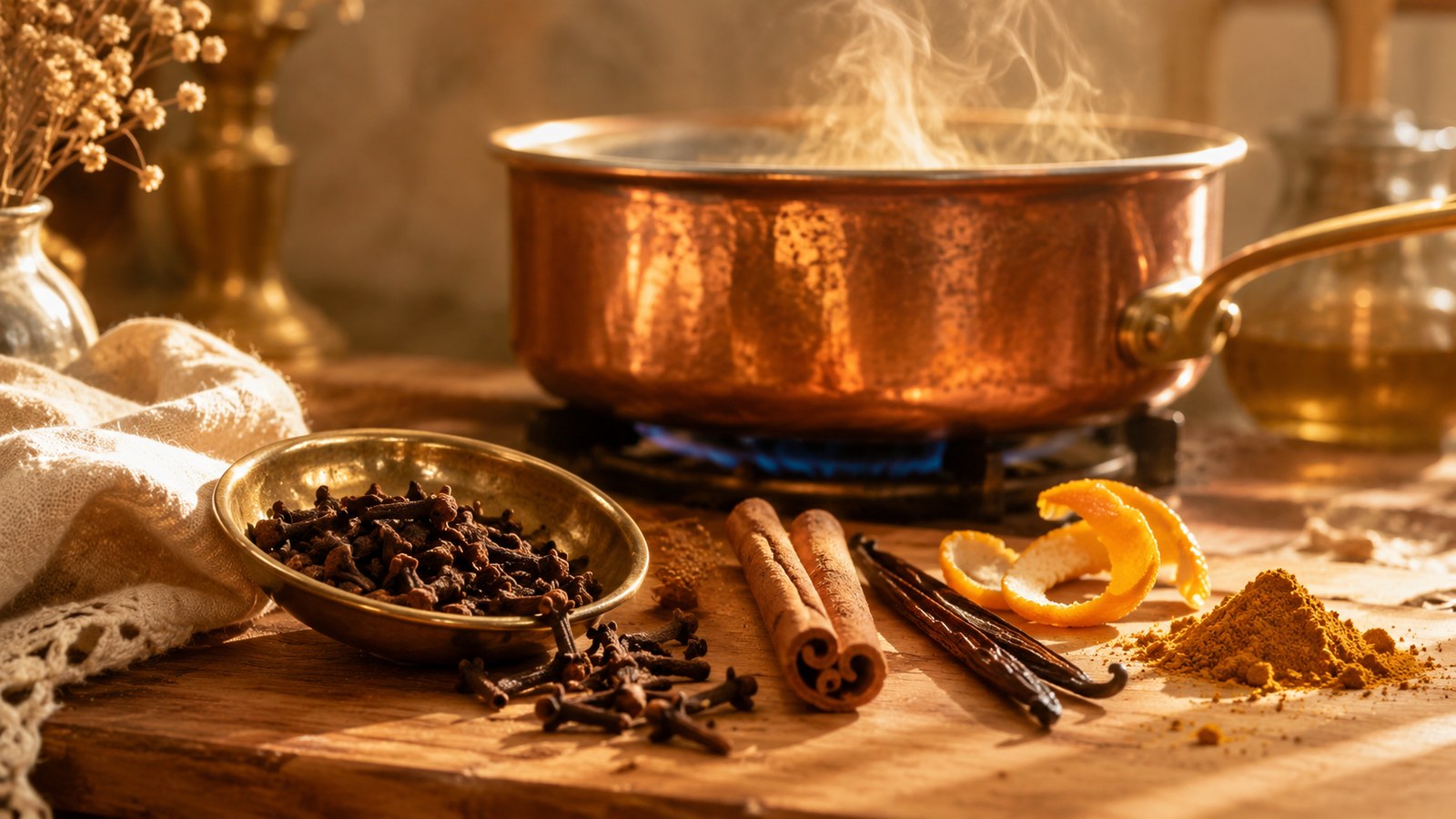
A clove bud is, by weight, up to 17% pure aroma compounds. That is the highest concentration of smell in any spice on earth, and its oil is about 85% eugenol, a single molecule.
I read that number and finally understood why six cloves stuck into a joint of pork can occupy a two-bedroom flat for six hours.
This is a post about the room, not the food. About what happens to the air in a house while somebody is cooking in it.
What a smell technically is
An aroma molecule is one small and light enough to evaporate from its source and fly through the air. That's the whole definition. A smell is food leaving the pan.
And heat accelerates it on purpose: high temperatures make volatile chemicals more volatile, so heating herbs and spices liberates more aroma molecules and fills the air.
Here's the part that struck me as almost unfair. In a finished dish, herbs and spices are 1% or less of the total weight. A whole house smelling of dinner is the work of a few milligrams.
Why some smells cross a room and others don't
There's an explanation, it's about size, and it's the most useful thing I learned.
The pungent molecules in mustard, horseradish and wasabi are a dozen or two atoms. Tiny, they escape into the air easily, and they go straight up your nose.
The pungent molecules in chilli, black pepper and ginger are 40 or 50 atoms. Too heavy to leave the food, so they mostly affect the mouth.
That's why mustard burns in the nose and chilli burns on the tongue. Not temperament. Molecular weight.
And there's a temperature where that changes: chilli and black pepper only become significantly volatile above about 60 °C, which is exactly why toasting peppercorns makes everyone in the kitchen start sneezing.
The smell of "roasted" doesn't exist below a temperature
This is the part that most changed how I think about a holiday meal.
Water boils at 100 °C and goes no higher. Ever. While there's water present, the surface of the food is stuck under that ceiling.
And the reactions that make the smell of roasting start above it: Maillard reactions from around 120 °C, caramelisation from around 165 °C.
Which means nothing you boil or steam will ever smell roasted. It isn't underseasoned. The temperature required doesn't exist inside a pan of water.
The Maillard reactions are named after Louis Camille Maillard, a French physician who described them around 1910, and they produce hundreds of different by-products. It's the same mechanism behind bread crusts, chocolate, roasted coffee beans and roast meat.
One charming detail: they happen below boiling too, just far too slowly to notice. Egg white, which is 90% water, turns tan if you simmer it for twelve hours. Balsamic vinegar goes nearly black over the course of years.
Free
Take the Christmas table checklist
It arrives straight away. After that, my newsletter — leave whenever you like.
A digression about invisible heat
While we're here: in 1800, an English oboist turned astronomer, William Herschel, moved a thermometer across the colours of a prism to see which was hottest.
The highest temperature turned up below the red band, where there was no visible light at all.
Hence infrared, from the Latin infra, below. Your oven runs on something a musician found while looking for something else.
Why smell is nearly all of flavour
We have five tastes: sweet, sour, salty, bitter, umami. And many thousands of odours.
Flavour is the combination of the two, and the second list is thousands of times longer than the first. What you call "the taste of my grandmother's cooking" is almost entirely smell.
Three practical consequences I've since tested:
Fat holds aroma back. Aroma molecules dissolve in fat, not water. That's why herbs are infused in oil. And it's why too much fat in a sauce hangs onto the aroma and makes the dish less fragrant, not more.
Salt and sugar turn the smell up. In a sweet dish, sugar improves how you perceive aroma; in a savoury one, salt does the same. Thickening with flour or starch does the reverse, and a little salt restores part of it.
The fresh notes evaporate first. Terpenes — the pine, citrus and green-leaf notes — are boiled off or altered by even brief cooking. The fix is unglamorous and it works: a second dose of the herb, right at the end.
The things on your table, in numbers
Clove: up to 17% volatiles, oil about 85% eugenol.
Cinnamon: the hot note is essentially one molecule, cinnamaldehyde. And there's a curious geographic split — cassia types carry considerably more of it and are preferred in most of the world, while Latin America prefers Sri Lankan cinnamon.
Anise and fennel: the molecule is trans-anethole, and it isn't only a smell. It is thirteen times sweeter than table sugar, weight for weight. Anyone chewing fennel seed after a meal is literally eating something sweet.
Vanilla: more than 200 different volatile compounds have been found in the beans. Curing takes 35 to 40 days in Madagascar and several months in Mexico, and it takes 3 to 5 pounds of fresh pods to produce 1 pound of cured beans.
Coffee, which is how the night ends: more than 800 aroma compounds identified, one of the most complex flavours in anything we eat. The ideal drinking temperature is around 60 °C, hot enough for the full aroma to come out and cool enough not to scald. And the warning: the flavour changes noticeably after less than an hour in the pot, turning more acid and less aromatic.
Dry spices run as much as 15% essential oil by weight, many 5 to 10%. Fresh herbs run about 1%, because they're more than 90% water. Whole spices keep well for a year; ground ones for a few months.
The word I wasn't expecting
Perfume comes from the Latin per fumum, through smoke.
A house that smells of the meal is, in the literal and original sense of the word, being perfumed. Not a metaphor. The etymology working exactly as it was built.
And memory
Here I have to be honest about what the book says and what it doesn't.
McGee suggests smell is so bound up with memory and emotion because smelling is essential to an animal learning from experience. He offers that as a possible explanation, not a measured finding. No study, no date, no number.
So I'm not going to write that science has proved smell is the strongest memory. I'll write what I know without any book: I can recognise my mother's house in December with my eyes shut, and the thing I recognise is clove and orange.
What I changed
Clove and cinnamon go in early, not because the dish needs it then, but because the house does. Anyone arriving at nine should walk into a house that already smells.
Green herbs go in at the end, always, because the first lot left through the air hours ago.
And the coffee doesn't get made at eight to sit waiting for midnight.
If you want the rest of what we're writing for the season, it's all collected here — the table, the house, the meal. And on the other half of that night, why a roast bird dries out is anatomy rather than your mistake.
Tell me which smell means December to you. Here it's clove and orange peel, and there's no debate about it.
Free
Take the Christmas table checklist
Everything that matters on a Christmas table, on a single sheet. Print it, or fill it in on your computer.
It arrives straight away. After that, my newsletter — leave whenever you like.