
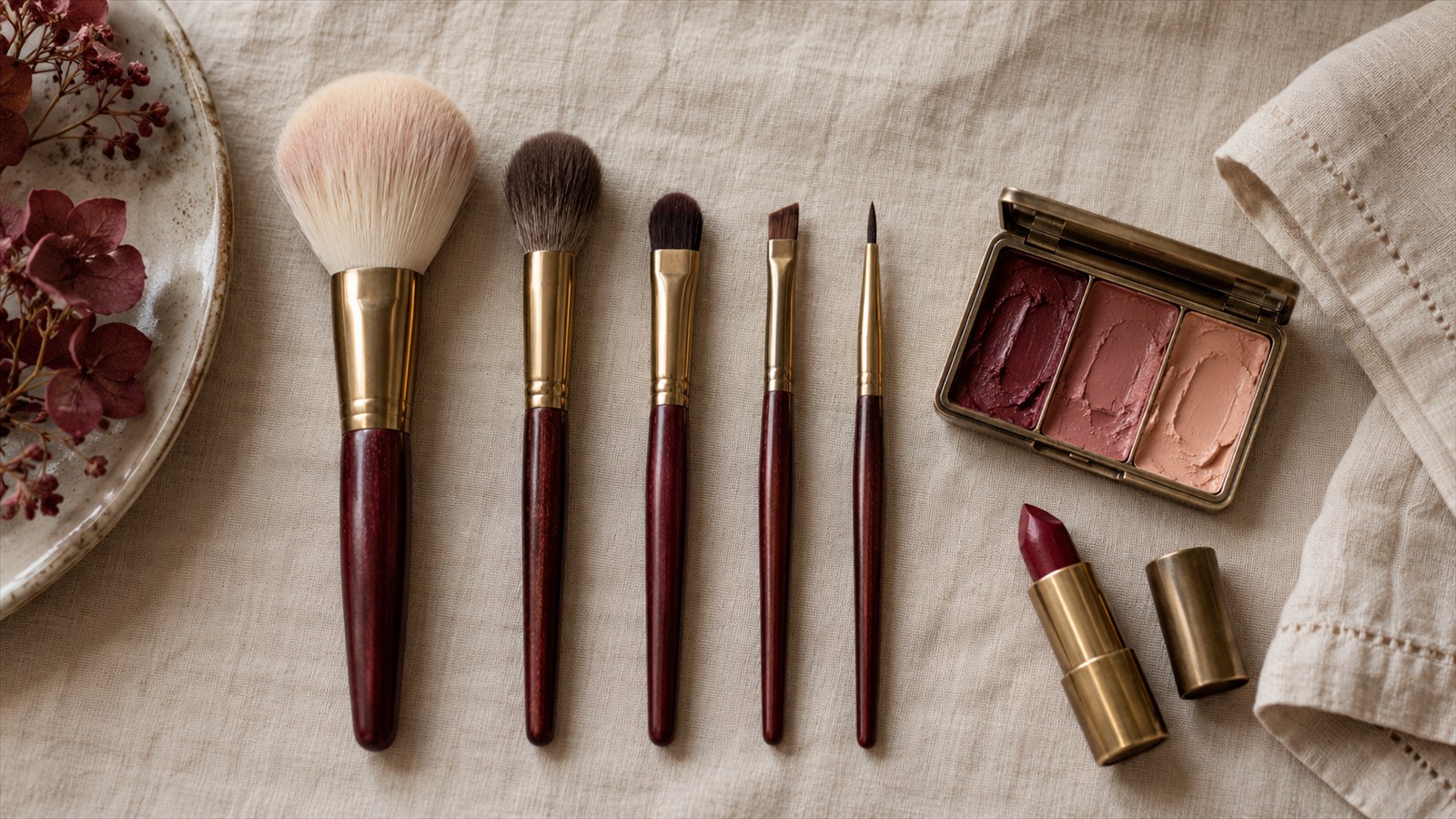
You don't pick a brush by price. You pick it by the texture it has to move.
My brush drawer had two categories: good brush, bad brush.
The good one was the expensive one. The bad one came free inside a compact. And I used both for everything, assuming the only difference was what I'd paid.
Then I read a manual written by a working makeup artist, the kind written to train other artists rather than to sell to readers, and found that the division that matters is a different one entirely. It has nothing to do with price.
Natural hair is for powder. Synthetic is for cream.
I spent the rest of the afternoon rethinking the drawer.
Why that's the line, and not the other one
Natural hair, which the book lists as squirrel, goat, pony or sable, is very soft. It spreads. It turns colour into a transition instead of a patch, which is why it belongs with blush, powder and eyeshadow, the things you want diffused.
Synthetic hair is stiffer. And the book names that stiffness as the virtue: it gives you control and precision. So it's the right one for concealer, gel liner and lip colour, the things you want exactly where you put them.
Notice that the same property switches sides. The stiffness that would be a fault in a powder brush is the thing that makes a cream brush work.
There is no better brush. There is a right brush for the texture.
That became my rule in a shop, because it answers the question I could never answer standing there: not "which is best", but "what am I going to move with it".
The part I'd been doing wrong my whole life
I have to own this one.
The book says plainly: never submerge the head of the brush in water. The reason is mechanical and obvious once somebody says it. The hair is glued into the base. Water sitting in there dissolves the glue, and then "even the most expensive brushes will come apart".
I washed brushes under the tap, head down, water running into them. For years.
The right way takes the same amount of time:
A drop of gentle soap in your palm. The author uses baby shampoo, and so do I now, because it's already in the house.
Wet only the bristles and swirl them on your palm until they're covered in lather.
Rinse until there's no soap left at all. Soap that stays behind makes the hair stiff next time.
Squeeze it out in a clean towel, reshape the head with your fingers, and leave it to dry with the bristles hanging off the edge of the counter.
That last step is the cleverest thing in the chapter. A brush drying flat on a towel traps damp underneath it, and the book warns it can go mildewed. Off the edge, air moves on both sides and the hair dries back into its own shape.
Every month or two is enough. In between, if you want, there's spray cleaner: spritz, wipe on a tissue until no colour comes off, done.
Free
Take the Christmas table checklist
It arrives straight away. After that, my newsletter — leave whenever you like.
The brush that comes inside the compact
On this one the book is brief and a little brutal.
The brushes that come inside most blush compacts are too small and too narrow for the job. The advice is to throw them out and use a brush built for it.
A blush brush, the book says, needs to be wide enough to cover the apple of the cheek, soft natural hair, with bevelled and curved edges.
Which tracks. A narrow brush draws a stripe. A wide brush leaves colour where your face already has colour on its own.
The list that interested me most was the evening bag
The book builds several: the drawer at home, the everyday bag, the desk drawer, the travel kit. The one that stopped me was the small bag, because it's the only list where space makes the decision.
A tiny purse won't take everything. So it takes:
lipstick or gloss, lip pencil, a powder compact, one palette you've built yourself holding concealer, foundation and blush together, mini perfume, breath mints.
Six things. And the palette you build yourself is the trick that makes it work: it turns three pots into one.
That list is the makeup answer to a question I've already written about from the clothes side: an 18th-century woman's pocket was a separate bag tied round her waist, and it existed to answer exactly this. What do I need within reach while I'm on my feet all evening.
The host doesn't sit down. It's worth choosing the bag with that in mind.
The expiry dates, which I didn't know existed
This table caught me out, and it's the most useful thing in the chapter:
Mascara: 6 months. Eye cream: 6 months as well.
Lipstick and pencils: 12 to 18 months.
Foundation, concealer, powder, eyeshadow, blush, moisturiser, sunscreen: 2 years.
Six months on mascara is far less than I'd have guessed, and it's the product that goes closest to the eye.
And one piece of advice that runs opposite to what I'd have assumed: don't throw out the last of it if the product is under eighteen months old. The book says to scrape what's left of a lipstick or cream blush into a small compartmentalised palette, and write the shade name on the back so you know what to repurchase.
It's the same palette that goes in the evening bag. The end of one product becomes the other one's answer to space.
One thing about this book, to be fair about it
It has no history in it. None.
No dates, no origins, nothing about where any of these objects came from. It's a technique manual, written to teach somebody to do a job, and I'd rather say so than pretend I found a story in there that isn't.
If you came for the stories, the lipstick Dior launched in two different bodies in 1953 is here, and that one has dates.
What I'm doing for the season
Three brushes, not fifteen.
One wide natural-hair brush for blush and powder. One small synthetic for concealer. One angled for brows. Washed the Saturday before, drying off the edge of the sink, ready for the whole run of hosting between Thanksgiving and Christmas.
Plus the palette built out of the scrapings, which is the only thing that fits in the small bag.
It isn't a photogenic set. It's what works on a night when I'm going to get up from the table eight times.
If you want the rest of what we're putting together for the season, it's all on one page, with a table checklist to download.
And since the subject is having the right thing to hand at the right moment: The Art of Napkin Folding has the classic folds step by step. Lifetime access.
Tell me: how often do you wash your brushes? I was washing mine wrong, and now I wash them properly and less often.
Free
Take the Christmas table checklist
Everything that matters on a Christmas table, on a single sheet. Print it, or fill it in on your computer.
It arrives straight away. After that, my newsletter — leave whenever you like.