
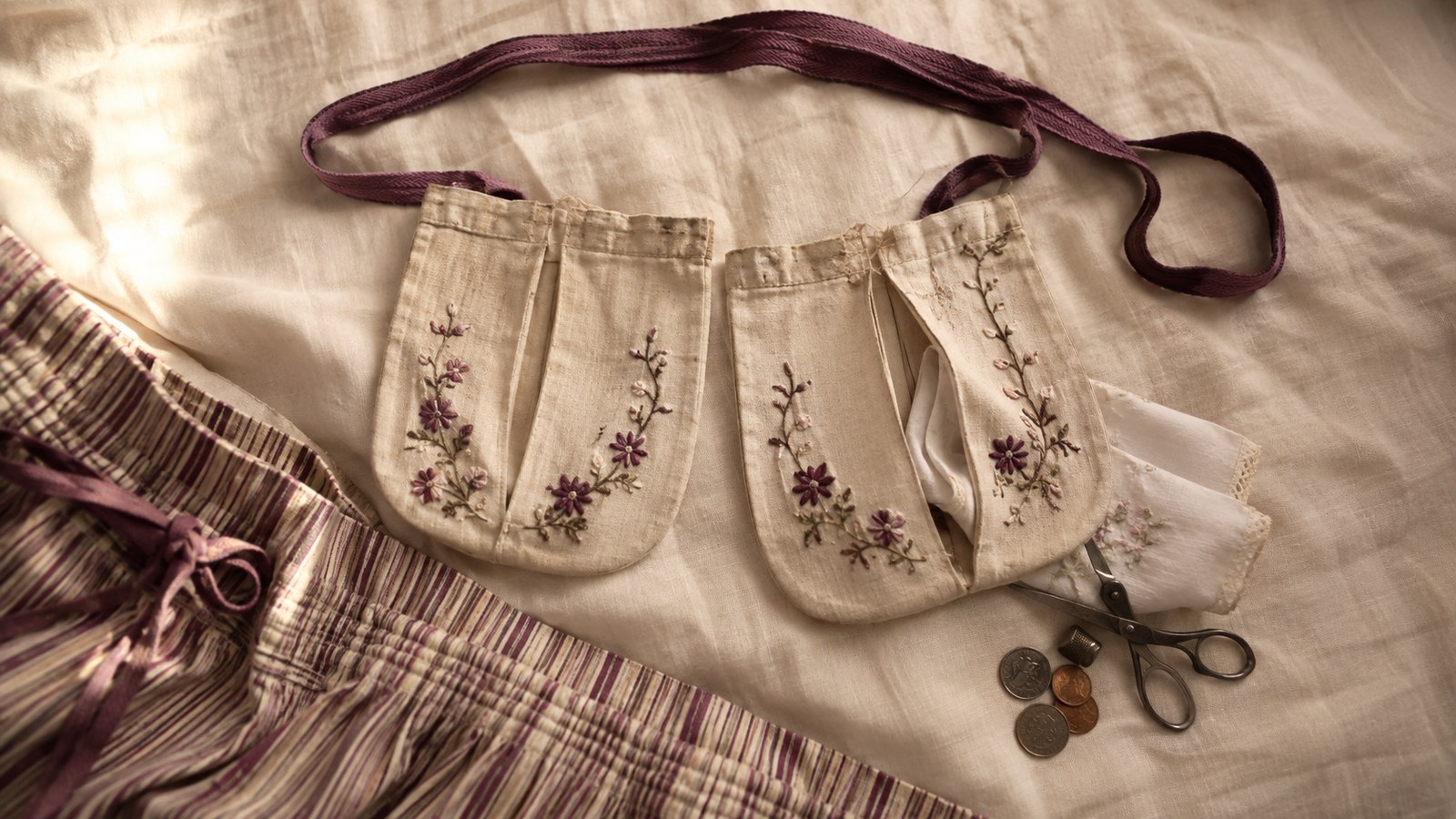
In the 1700s a Woman's Pocket Was a Loose Bag Tied Round Her Waist, Under the Dress
The fashion dictionary I use defines the eighteenth-century woman's pocket like this:
"The pocket was a separate article in the form of a small, flat bag or a pair of such bags attached together by a tape."
Separate. Not sewn into the clothes.
"These pockets, tied on round the waist under the dress, were reached through the placket hole."
And the detail that got me: "They were frequently ornamented with coloured needlework patterns."
Embroidered. A thing that lived under the skirt, that nobody saw, and people embroidered it anyway.
There's a 1701 quotation, and it's wonderful
The dictionary records Jonathan Swift:
"I keep in my pocket, ty'ed about my middle next to my smock" — from Mrs Harris' Petition, 1701.
Tied about her middle, against the body. That isn't a figure of speech, it's a literal description of the object.
The slit had a name of its own: placket, "a short opening or slit near the top of a woman's skirt or petticoat", recorded from the sixteenth century onwards. Your hand went in through there.
What it actually solved
A flat bag tied at the waist under the skirt carries far more than a sewn-in pocket. It doesn't spoil the line of the clothes, because the whole skirt falls over it. And it's attached to the body rather than to the garment, which means you change dresses and the pocket comes with you.
Honestly, it's a better solution than mine.
An honesty note I owe you: the book gives no measurement. None. It never says how big the bag was, how much it held, what it weighed. If you want to know whether a book would fit, this dictionary won't tell you, and I'm not going to guess.
And then, in the first twenty years of the 1800s, it vanishes
"For the first twenty years of the century these tied-on pockets ceased to be worn, being replaced by the indispensable or reticule carried in the hand."
Twenty years. A whole generation of women carrying their things in their hands instead of on their bodies.
Here I have to point at something the book does and never resolves. The Pocket entry says the pocket was replaced by the reticule. The Reticule entry says the reticule was "much used in the absence of dress pockets in this period."
One says the bag pushed the pocket out. The other says the bag filled a gap the pocket had already left. The book doesn't choose, and I'm not going to choose for it. Anyone who knows which came first knows more than this dictionary.
What the reticule carried, the book does say: "a handkerchief, purse, scent-bottle, etc."
Free
Take the Christmas table checklist
It arrives straight away. After that, my newsletter — leave whenever you like.
The pocket didn't die. It became travel wear.
This is the part almost nobody tells.
"However, the tied-on pair of pockets continued to be used when travelling and became known as 'railway pockets'."
They get their own entry, dated 1857 to the early twentieth century: "Flat bags with a side opening worn under the dress and tied on with tapes round the waist. When worn with a crinoline dress this was designed to protect valuables from pickpockets."
Note that the dictionary contradicts itself slightly on the date. The Pocket entry implies the name attached soon after the disappearance, early in the century; the standalone entry starts at 1857. I record it and move on.
The return, and the worst-designed pocket in history
Around 1840 the built-in skirt pocket becomes usual, "accessible through a pocket hole at the back". Alongside it comes a watch pocket hidden in the folds of the bodice at the front of the waist, moved to the waistband a few years later.
And in 1876 something happens that the book describes with perfect dryness:
"A patch-pocket placed low down on the back of the skirt of princess and polonaise dresses in 1876 was a fashion welcomed by pick-pockets."
A pocket at the back, at exactly the height of a passing hand. Welcomed by pickpockets.
Then in 1899 a small kindness arrives: "a pocket for the handkerchief placed in the lining of the skirt or in the border of the petticoat just above the hem."
A comparison that's mine, not the book's
The same dictionary records the man's pocket running at a different speed. A pouch independent of the garment in the fifteenth century, sewn into trunk-hose from the mid-sixteenth, into breeches by the end of that century, into coats in the early seventeenth, with flaps from about 1690, into waistcoats in the eighteenth.
There's even a line quoted from 1633: "The keys of my counting-house are in the left pocket of my coat."
So: in 1633 a man already had a pocket sewn into his coat, and in 1701 a woman was still tying hers round her waist under everything.
The book never makes that comparison. It files the men's and women's entries as two separate lists and never once remarks on the distance between them. The comparison is mine, and I'm flagging it as mine, but both dates are the book's.
The twentieth century closes the story flatly: "Pockets were often omitted if they spoiled the line of a garment."
Why this is a subject for anyone who has people over
Because the question a pocket answers is always the same: what do I need within reach while I'm on my feet?
And whoever is hosting is on her feet all night. Up eight times, back and forth to the kitchen, answering the door, lighting candles, answering the phone, hunting for the corkscrew.
I've written before about the garment invented for exactly that: the apron is the only thing in the wardrobe designed to be ruined, and the bib is the tell that says whether it's for work or for show. The pocket is the other half of the same question. One protects the clothes, the other carries the things.
What I'm doing about it
Choosing the outfit for the meal by where the phone goes.
It sounds silly written down, but it's the most practical decision I've made about dressing to host. A beautiful dress with nowhere to put anything means an entire evening spent looking for where I left my phone and the wine key.
Two hundred years of women solved this by tying a bag round the waist, under everything, and embroidering the bag. They weren't waiting for anyone to see it.
If you want the rest of what we're building for the season — as useful for Thanksgiving as for December — it's on one page, with a table checklist to download.
And since we're on the subject of folded cloth with a job to do: The Art of Napkin Folding has the classic folds step by step. R$ 47.00, lifetime access.
Tell me: do you pick what you wear to host by whether it has pockets? I spent my life picking by the photograph and I'm reconsidering.
Free
Take the Christmas table checklist
Everything that matters on a Christmas table, on a single sheet. Print it, or fill it in on your computer.
It arrives straight away. After that, my newsletter — leave whenever you like.