
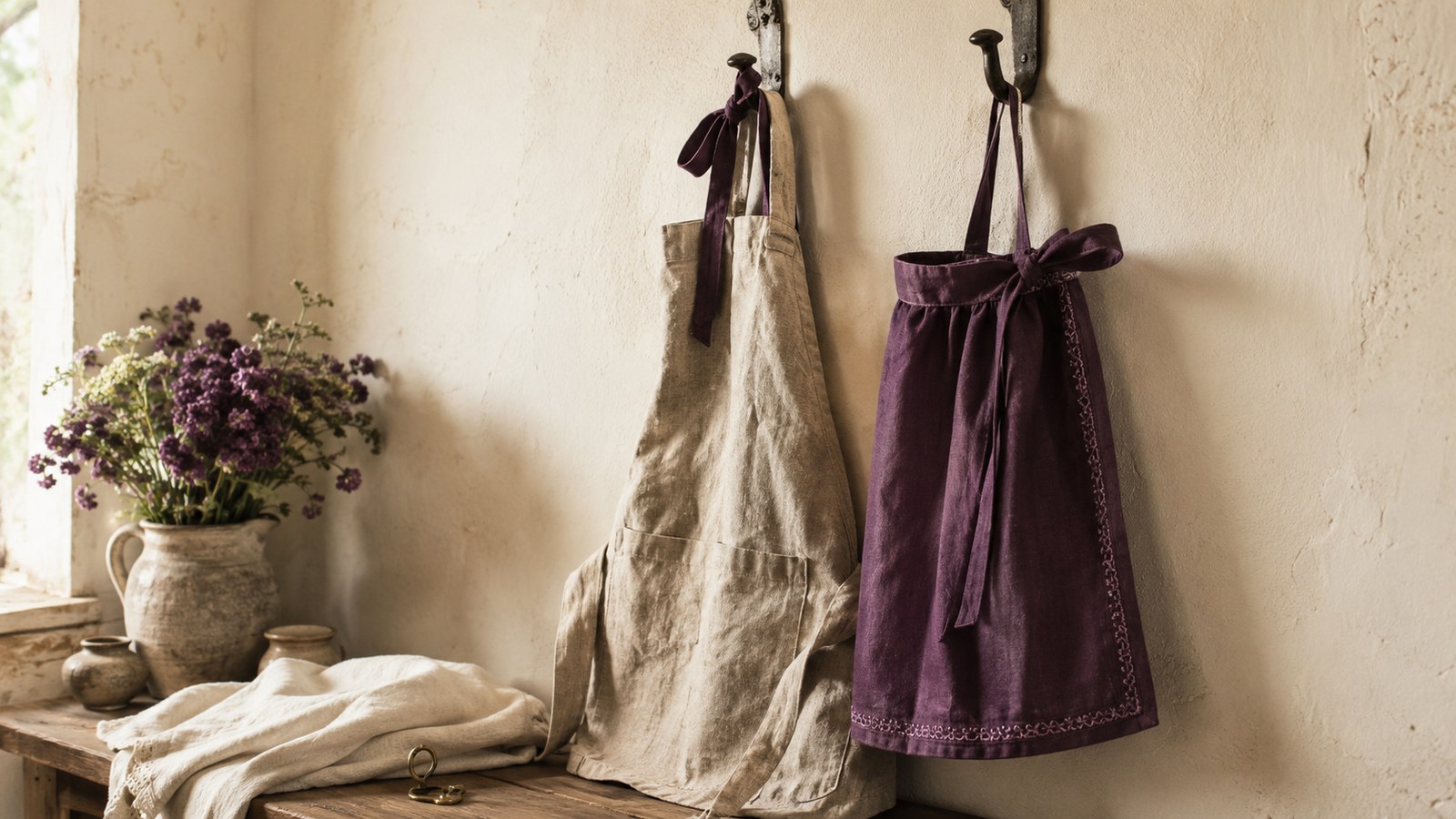
Until the First Half of the 1400s, an Apron Wasn't Called an Apron. It Was a Napron.
Until the first half of the fifteenth century, the word for an apron was napron.
The fashion dictionary I use records it like this: also aporne and napron, the latter "used in 14th and first half of the 15th century; subsequently 'apron' was used."
The dictionary doesn't explain why the word changed. There's a famous explanation in circulation about "a napron" being misheard as "an apron" — but my book doesn't say that, so I won't write it as though it did.
What it does say is better: the apron is the oldest and most stubborn garment in a host's wardrobe. It's recorded from the thirteenth century onwards.
The words that came before
Before napron there were others, and the list alone tells a story.
Barme cloth, lap cloth, runs from the early medieval period to the end of the fourteenth century, when it's gradually replaced by apron.
Barmfell or barmskin, fourteenth to seventeenth century, was a leather apron.
Bratt, from the tenth century onwards, was a makeshift outer garment, often a rag, and also served as an apron or pinafore for a child or a woman.
And from the sixteenth century comes my favourite: belly-chete, recorded as "slang term for an apron."
Four words in six centuries for one idea. The thing is so constant it outlives its own names.
Your apron announced your trade
This part got me. Before there were uniforms, there was apron colour.
"Checkered apron men" were sixteenth-century barbers.
"Blue-aproned men" often meant tradesmen, from the sixteenth to the eighteenth century.
"Green-aproned men" meant London porters in the eighteenth century, and in the nineteenth, green baize aprons were worn by furniture removers and in auction rooms.
You crossed a street and knew what everyone did from the colour of the cloth on their front.
I record that as history, not as a suggestion. It's exactly the kind of code that tells a person what they may and may not wear, and I don't want that part back. What's interesting is that we're the first generation in eight centuries who can put on an apron without declaring a trade.
Free
Take the Christmas table checklist
It arrives straight away. After that, my newsletter — leave whenever you like.
The bib is the detail that settles everything
Here's the line that turned the key on this whole post.
The dictionary separates two kinds of women's apron. Some working aprons had an attached bib extending up from the waist to protect the bodice. Decorative aprons were of fine fabrics, usually without bibs, and often embroidered.
Read the second half again: decorative, usually without bibs.
The bib is the entire argument sewn into one garment. The moment an apron stops covering the chest, it has stopped being for work and become something worn over work.
That's a test that works today, in your own cupboard. Look at the apron you own. Does it come up? Then it believes you're going to make a mess. Doesn't come up? Then it's clothing.
The era when it protected nothing
The decorative apron had three peaks: from the late sixteenth century to around 1640, then throughout the eighteenth century, and again in the 1870s.
And the 1870s ones are a rare case of a fashion telling on itself: they were "very small, of black silk sometimes embroidered in colours and popularly known as 'fig-leaves'."
Fig-leaves. The women wearing them knew exactly how much they covered.
A century earlier, on the French side, my other book is blunter still about a flounced apron: "flouncy aprons served no purpose — they were purely for decoration. This impractical fashion was inspired by the French Queen Marie Antoinette, who enjoyed dressing up and pretending she was a milkmaid."
A queen playing at labour, and a work garment becoming a costume. I record it without softening the irony, because the irony is the point.
From the same book, a list that shows the scale of getting dressed then: what a woman fastened round her waist might include a chemise, corset, several petticoats, a pair of hidden pockets, the dress, a belt, and a fancy apron.
And then it went back to work
The end of the story is short and a complete reversal: "from the 20th century onwards aprons were practical rather than decorative, and came in washable cotton and wipeable PVC."
Six centuries protecting, three centuries off decorating, then back to work, now in plastic.
Two smaller notes I liked
The bib, from the sixteenth century onwards, is defined as "a small square of linen hung in front of a child's neck to protect the clothes from being soiled." The bib-apron, from the seventeenth century, is simply the apron with a bib.
And the pinafore, from the late eighteenth century, is "a child's washable covering of the front of the frock to protect it from becoming soiled; similar to an apron." The pinafore gown arrived in 1906 and pinafore dresses became popular in the 1930s.
There's also a word that spans both tables: muckinder, early fifteenth to early nineteenth century, was a handkerchief — and also a child's bib, or a table napkin.
One object, three jobs, all of them protecting somebody from themselves while they eat.
What I took into the season
Picture me in the kitchen from six in the evening to midnight with the oven on. Three decisions:
Buy the apron by the bib. If you're actually cooking, you want the version that comes up. Eight hundred years of practical people agree.
Own a second, decorative one, without guilt. The whole history shows the pretty apron is a legitimate tradition and not a modern affectation. A linen apron, no bib, put on to receive people and taken off to eat, has precedent going back to about 1590.
The swap is the gesture. This is what I've started doing: cook in the work apron, and just before everyone sits down, change into the good one — which doubles as the signal that the kitchen is closed. It's the cheapest thing I've ever done to mark the line between working and hosting.
And the most important part: an apron is the only garment designed to be ruined. That's a permission, not a limitation. On a night when you'll get up from the table eight times, putting on the thing that expects a mess is the calmest decision of the day.
If you want the rest of what we're writing for the season, I've gathered it on one page. And on the other half of this question, there was once a dress made only for having people over, and it had no corset.
And since we're on the subject of cloth protecting clothes: the napkin folds are all in the course, with the classic ones step by step. R$ 47.00, lifetime access.
Tell me: do you wear an apron while hosting, or take it off before anyone arrives? I used to take it off. I stopped.
Free
Take the Christmas table checklist
Everything that matters on a Christmas table, on a single sheet. Print it, or fill it in on your computer.
It arrives straight away. After that, my newsletter — leave whenever you like.