
In 1953 Dior Launched the Same Lipstick in Two Bodies: One for the Handbag, One for the Dressing Table
In 1953 Dior launched the house's first full lipstick range, Rouge Dior. Nine thousand lipsticks, in eight shades.
And launched every shade in two different bodies.
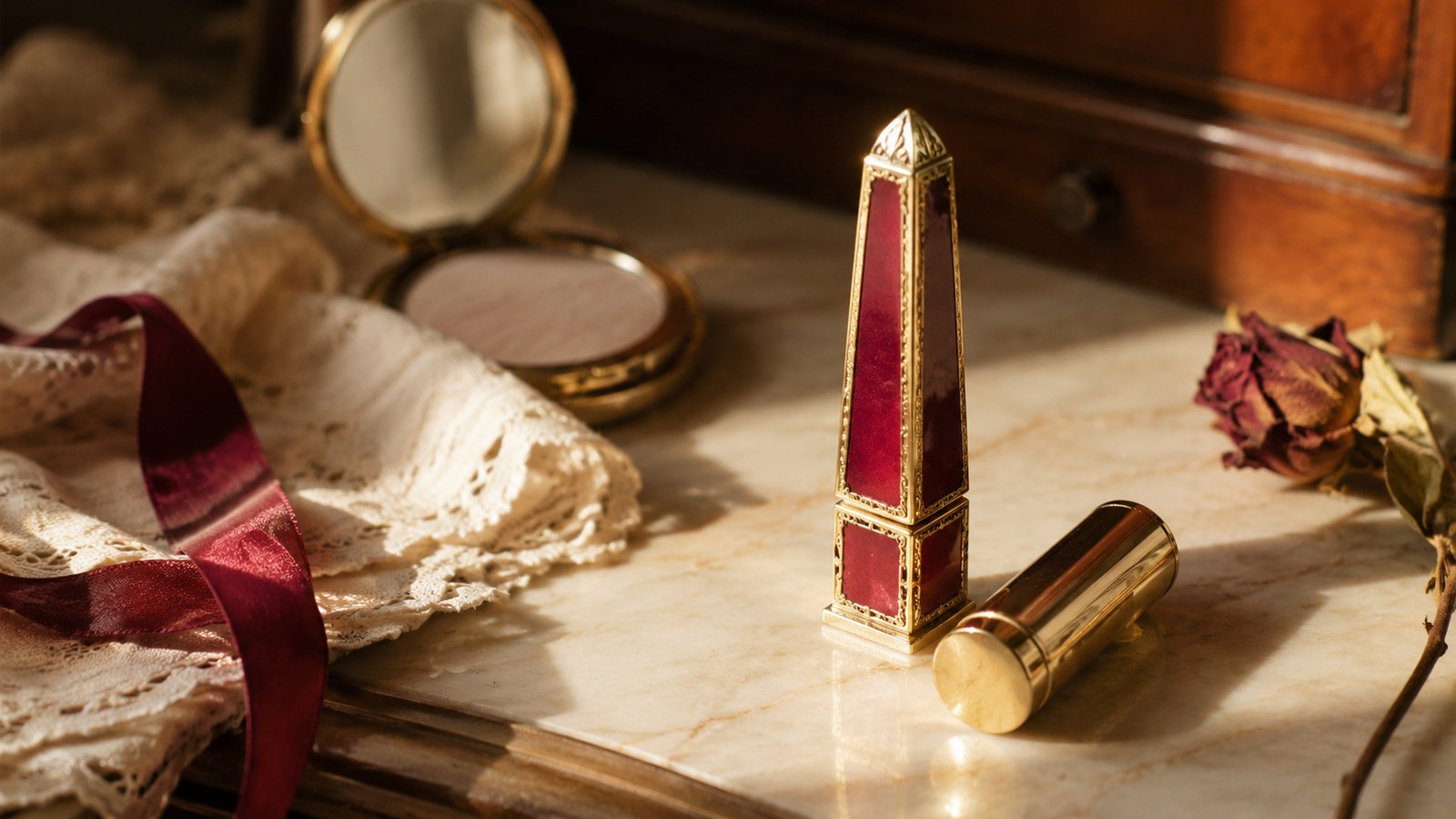
One was for the dressing table: a plastic obelisk, which the book calls "fabulously decadent", made to be displayed. The other was for the handbag: a chic, simple metallic case.
Both refillable. Same lipstick. What changed was where it lived.
I read that and spent the rest of the afternoon looking at the things on my sideboard.
What Dior had worked out
That an object which sits still and an object which travels in a bag are not the same object, even when the contents are identical.
The one on display has to be good-looking motionless, from every angle, all day, with nobody touching it. The one that travels has to be smooth, tough, free of any corner that snags a lining, and discreet enough to come out mid-dinner without becoming a topic.
Two pieces of engineering, one lipstick.
Honesty note before I go on: the book names no designer for either body and does not claim the idea was a first. It records only that Dior did it this way, and that the archive holds a dressing-table version in its own box, hand-signed by Christian Dior himself for a client.
Before 1915, lipstick simply didn't travel
This is the part I didn't know.
The book is blunt: "one couldn't really transport lipstick safely in her handbag." It existed. It stayed home.
That changes around 1915, when lipstick starts being made in metal cartridge containers. And there is an exact date: the Scovill Manufacturing Company of Connecticut produced in October 1915 the first tube lipstick container, "with side levers enabling one to push up the lipstick."
Side levers. Not the twist we know. The swivel is patented in 1923, and after it, the book says, "more than a hundred other variations would follow."
So lipstick took eight years to learn to turn. I find that oddly comforting.
Free
Take the Christmas table checklist
It arrives straight away. After that, my newsletter — leave whenever you like.
Powder, and the first time a package became a display object
The compact has a similar history and a better punchline.
Before it, women carried loose powder, "often housed in a little box or concealed in a piece of jewelry", or improvised a container. The book is honest about the results: "it wasn't ideal and spillages were an issue."
The compact solves that and takes off in the 1920s. And then comes the sentence that made this post exist:
"The fact that powder compacts were displayed in public before anything else explains why there was such a huge variety of styles available."
Read that again. The packaging got beautiful because it was the first thing that came out. Nobody saw your cream, nobody saw your dressing table, but everybody saw the little case you opened at the table.
The book finishes the thought: "Women loved showing off their compacts, and they were a status symbol." And in a caption: "The glamorous act of touching up one's lipstick with a beautiful mirrored compact became an important cultural gesture."
A number that makes me dizzy
By 1930 there were around three thousand types of face powder on sale across the United States.
Three thousand.
The book gives a reason for powder's rise, and it isn't the one I expected: "advances in technology meant that cosmetics companies started producing more shades", from rose to beige to tan. Scent mattered too, and several houses made powders perfumed to match their own successful fragrances.
Then, almost in passing, it drops this: "Just think that women's public bathrooms became known euphemistically as 'powder rooms' in the late twenties."
Notice that it doesn't say one caused the other. It sets them side by side and moves on. I'll do the same, because the cause it actually gives for powder's popularity is a different one, and swapping them would be dishonest.
The war, and the proof that the package was the product
During the Second World War packaging was "completely stripped back to the basics", and from Chanel to Coty everyone fell back on plain cardboard.
The detail I won't forget: one Bourjois powder shipped with a note inside explaining that there was no puff, because of wartime restrictions.
Afterwards it comes roaring back, and through the 1950s decorated compacts appear at every price point.
Chanel went further still
In 1954 Chanel made a creamy lip colour in a rectangular tube, "the exact replica of the iconic No. 5 spray bottle". And built for it a leather compartment inside the 2.55 quilted handbag, which still exists today.
An object with a fixed address inside another object. It is almost absurdly precise, and it is the same idea as Dior's: form follows location.
The rule I took from this, which isn't about makeup
The same logic organises a table.
Some objects stay: the candlestick, the pitcher, the piece you look at daily and never use. They are judged standing still, so they are allowed to be more beautiful than practical.
Other objects circulate: the platter going hand to hand, the gravy boat, the serving spoons. Those are judged in motion, and they need to be tough, well-balanced, with no handle that heats up.
When we shop only for "pretty", we buy everything as though it belonged to the first group. And then the beautiful platter burns the hand of whoever passes it.
That's worth knowing before a Thanksgiving table in particular, because Thanksgiving is a passing meal: almost everything travels down the length of the table twice. On the case for keeping the things that stay, there's a whole post about why an object with a story outlasts every other one you own. This is the mechanical half of the same thought.
What I'm doing about it
Two lists, not one.
Stays: candlestick, cloth, pitcher, the cup that came back from a trip. Bought with the eye.
Circulates: platter, servers, gravy boat, napkin. Bought with the hand.
And a lipstick touch-up with a mirror at the table after dessert, without apologising for it. Seventy years of women did that in front of everyone and it got called a cultural gesture.
If you want the rest of what we're writing for the season, it's gathered on one page, with a table checklist to download.
And since we're on the subject of objects that go hand to hand: the folded napkin is the cheapest of them. The Art of Napkin Folding has the classic folds step by step. R$ 47.00, lifetime access.
Tell me: what object lives on display in your house and never gets used? Here it's a white teapot that hasn't poured tea since 2019.
Free
Take the Christmas table checklist
Everything that matters on a Christmas table, on a single sheet. Print it, or fill it in on your computer.
It arrives straight away. After that, my newsletter — leave whenever you like.