
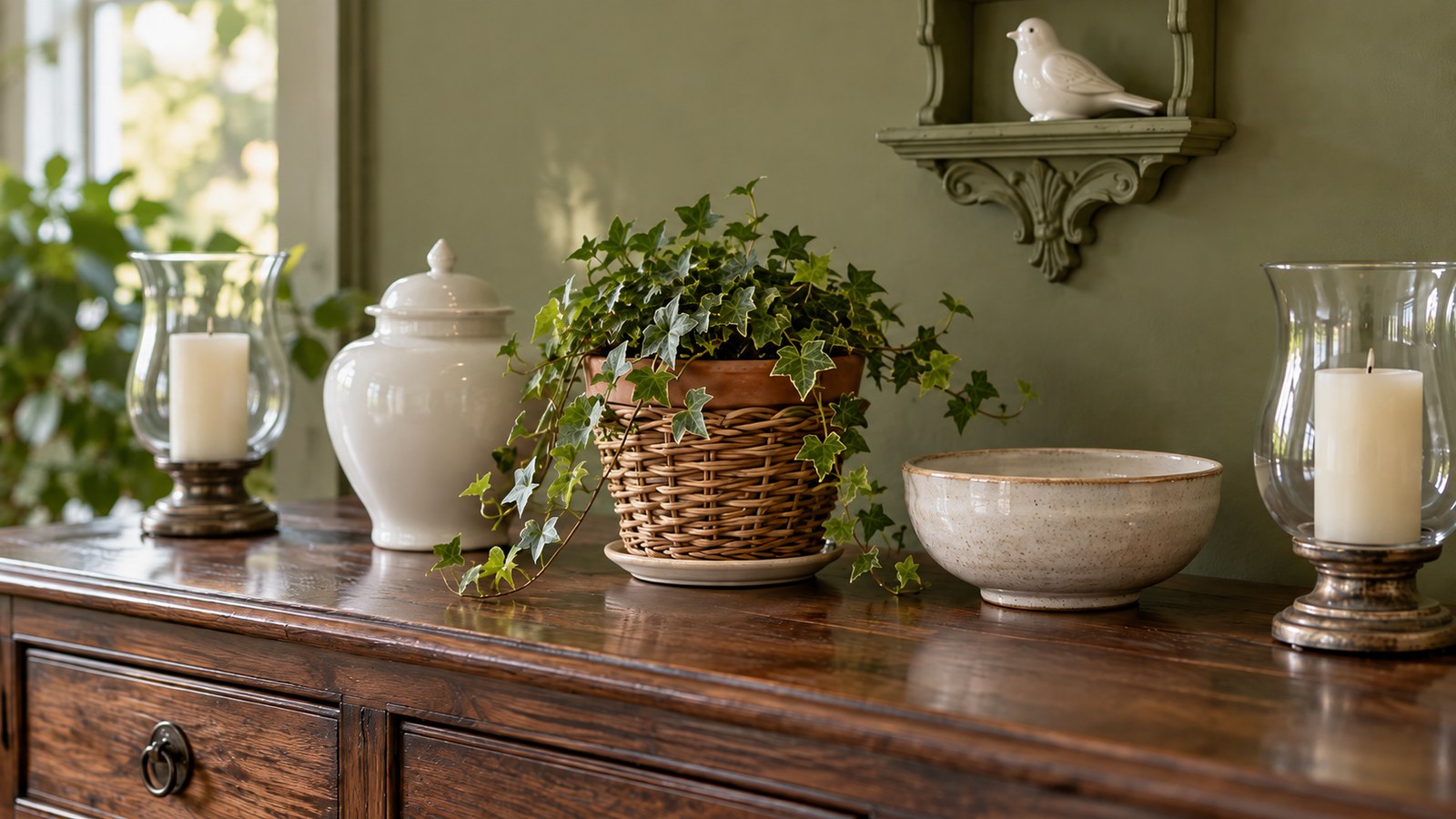
There's a whole class of object whose only job is to present another object
I was reading through a dictionary of classic decorating, entry by entry, and noticed something that connects four headings a long way apart from each other.
There's an entire category of object that isn't about itself. Its job is to present something else.
And the names of two of them say so outright:
Cachepot is French and means, literally, hide the pot. Garniture comes from garnir, to garnish — the same verb as the garnish on a plate.
They aren't ornaments. They're presenters.
The cachepot solves the plastic pot
A cachepot is a small decorative container for holding a potted plant, meant to sit on tabletops and other surfaces.
Its usefulness is more prosaic and more welcome than the name suggests: it deals with that green plastic pot the plant comes home in, without you having to repot anything. You drop the plastic pot inside, and that's the job done.
And almost anything works as a cachepot. The book lists a woven basket, a plain terracotta nursery pot, and — this one I loved — an old silver-plated champagne cooler, which turns up in antique shops and flea markets for almost nothing, because nobody uses a champagne cooler any more.
Two practical details worth the paragraph:
- if you dislike the orange of terracotta, the decorator Dorothy Draper's instruction was to paint the pot black or white. Solved, for the price of a tin of paint.
- if the container has a drainage hole, put a saucer underneath, or the moisture ruins the surface of the furniture.
And there's a line in the entry, from the American decorator Michael Taylor, that I'll be repeating next time someone calls houseplants clutter: "Plants have a way of preventing a room from appearing overdecorated."
It's true, and it's freeing. The plant is the thing that undoes the stiffness.
The garniture, and the method you can copy today
A garniture is a matching set of decorative objects meant to be displayed together — traditionally on a mantelpiece. Identical porcelain vases, or an ornate clock with candlesticks that go with it.
Here's the part I didn't know: historically garnitures were composed of three, five and occasionally seven pieces, because an odd-numbered group was believed to be more pleasing to look at than a symmetrical even-numbered one.
Odd numbers. It's the same rule we already use for flowers and candles without knowing where it came from.
And the book gives a concrete method, from the English decorator John Fowler, that works on any surface:
- Start with a pair of anchors. Two matching things — two small lamps, two glass hurricanes — one at each end.
- Put one object at the centre. An urn, a cachepot, a single piece. That gives you symmetry.
- If you want a looser look, keep the pair at the ends and put three objects in the middle that are different from each other but clearly related.
- Spread it along the whole length, so one end doesn't get the lion's share.
And the rule that holds it together: objects displayed together have to be harmonious in scale, finish and theme. Otherwise it reads as off-kilter. They don't have to match — they have to belong to one family.
There's also a use I'd never considered that solves a real problem: a garniture on top of a low cupboard kills that ugly gap between the furniture and the ceiling, adding decorative height exactly where it's missing.
Free
Take the Christmas table checklist
It arrives straight away. After that, my newsletter — leave whenever you like.
A bracket is a parenthesis
A bracket is that small ornamental wall shelf, just big enough to hold one object.
The image the book uses is precise: a pair of brackets flanking a large painting or mirror works as decorative parentheses — they exist to emphasise what's between them.
The rule is cohesion: both the shelves and the objects on them have to be close in style, or the group looks messy.
And the exception is elegant: if you collect antique brackets in different styles, you can hang them all together and treat them as an art collection — but then put nothing on them. The shelf becomes the object on display.
One last trick: paint the bracket the same colour as the wall and it disappears visually, so you get the function without the interference.
The drinks trolley, and the most practical rule in the book
The trolley is the presenter on wheels: shelves for bottles and glasses, a handle and casters so you can push it to wherever the party is.
And the book gives two instructions I'd never seen written down, which are the most useful thing on the page:
Put the trolley in the room before the party starts. If you're pushing it around among your guests, it reminds them of being on an aeroplane. It's a slightly cruel line and it's exactly right.
Leave the trolley set up all the time, in the room where you actually gather. If it lives ready, your only job before anyone arrives is to fill the ice bucket. That's the kind of arrangement that works for you all through December.
If a trolley won't fit in your house, the book offers the small-flat version: the butler's tray on a folding base, which closes and goes in a cupboard. Or simply a large tray on a sideboard with the bottles and glasses on it — it defines the space and disappears when you need it to.
And the part that convinced me most: the trolley isn't only for drinks. It works as a tea trolley for taking coffee and dessert through after dinner, it works as a bedside table, and it even works in the bathroom for towels.
You already own all four
Here's the translation of the whole chapter into an ordinary house, which is why I wanted to write this:
- cachepot — the woven basket, the terracotta pot, the handsome tin
- garniture — the group of things on top of the sideboard
- bracket — the little shelf that's currently empty
- trolley — your grandmother's tea trolley, or a large tray
None of this is a purchase. It's a name and a method for things already in your house without any organisation.
One inference of mine, and I'll flag it as inference: the book is by an American decorator and assumes a fireplace. Most houses here don't have one. So the anchor-pair-and-odd-number rule has to change address — it moves to the dining room sideboard, the top of the bookcase, or the hall console. The surface changes; the method doesn't.
What I'm going to do
Clear the sideboard completely and rebuild it with the method: two matching things at the ends, three related ones in the middle, nothing wildly out of scale. And put a saucer under the terracotta pot that has already marked the wood, which I'd been pretending not to see.
If you'd rather hunt for the pieces than buy them new, the arithmetic of secondhand is more favourable than it looks. And if you have no fireplace but wanted the effect of one, everything the fireplace used to do for a room got shrunk onto the table.
If you'd like the rest of what we're putting together for the season, I've gathered it all on one page, with a table checklist to download.
And if the presenter missing from your table is the napkin, The Art of Napkin Folding has the classic folds step by step, with the starch detail that decides whether a fold stands up. R$47.00, lifetime access.
Tell me: which is the empty shelf in your house? Here there are two, and they've been empty since we moved in.
Free
Take the Christmas table checklist
Everything that matters on a Christmas table, on a single sheet. Print it, or fill it in on your computer.
It arrives straight away. After that, my newsletter — leave whenever you like.