
The Bang of a Christmas Cracker Is an Imitation Fireplace. It Took Seven Years to Get Right.
In 1840, a London confectioner called Tom Smith brought back from Paris the idea of wrapping sweets in twisted paper. The product was dull and sold badly.
It was a log crackling in his own fireplace that solved it. Smith spent seven years working on a friction strip that would make a paper tube bang when pulled, and in 1847 he put the first ones on sale under the name cosaques.
The company that still carries his name now makes an estimated 38 million of them a year, shipping about 15 percent to some 34 countries.
Hold on to the mechanism, because it's the subject of this post: the noise of a fireplace, shrunk until it fitted beside a plate.
What the fire actually did for a room
Before it was a lovely thing, fire was the clock the party ran on.
In medieval England, tenants gave a Yule log to their landlord, and in return he fed them for as long as that log burned.
That's a unit of time made of wood. The length of the meal wasn't a decision anyone made. It was decided by the thickness of the log you had chosen.
In some parts of England the custom went further. The log was hooped with bands cut from its own tree, and each time a band snapped in the heat, the master of the house owed his guests another round.
Two more rules, recorded: the Yule log was never bought, and a piece of last year's was saved to light this year's.
And the fire ended up on the table
Three hundred years summarised in one sentence, and it's the book's own: "in France, the Yule log survives only as a log-shaped cake, the bûche de Noël."
The fire that heated the hall became a dessert. Then it became a paper bang beside a plate. The entire trajectory of domestic Christmas is a large dangerous thing being shrunk until it fits on a dining table.
Free
Take the Christmas table checklist
It arrives straight away. After that, my newsletter — leave whenever you like.
The decoration used to hang above your head
Before Christmas trees became fashionable in England in the mid-1800s, the main decoration was hung overhead.
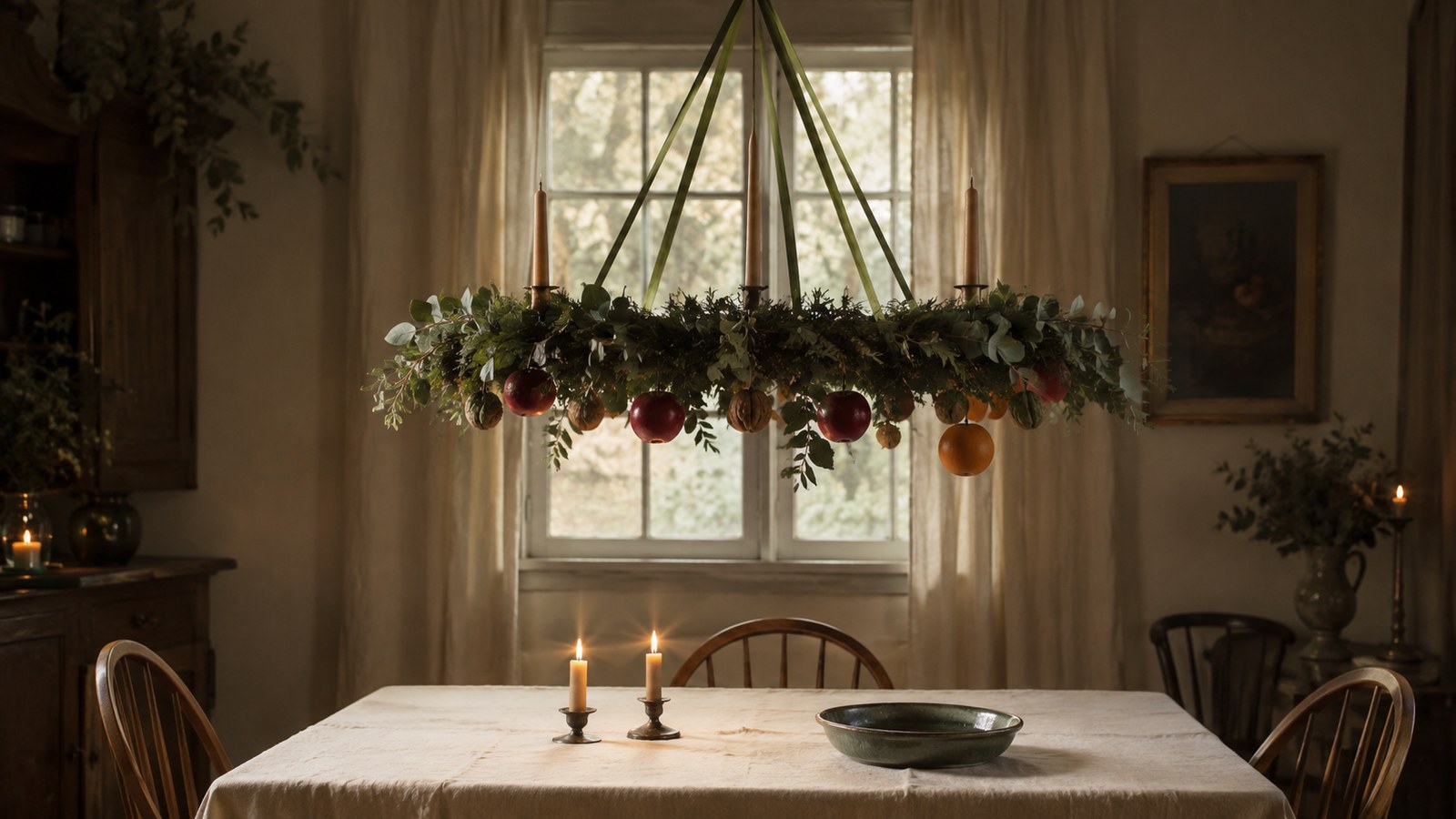
It was called a kissing bough: hoops overlaid with evergreen garland, streamers rising to a central point, mounted above the table and hung with apples, nuts, oranges and lighted candles.
In Croatia, wreaths are recorded hung in a cluster above the Christmas table, or simply a bunch of red apples suspended over it.
Notice what that solves, and what nobody solves today: a high decoration takes up no table and blocks no faces. It decorates the volume of the room rather than the surface people are eating off.
In my house that's the difference between having and not having room for a serving dish.
The rule a florist repeats three times
Here's the one instruction I'd take to any table, at any time of year.
The florist Natasja Sadi writes that she cannot emphasise enough the need to keep table decorations at a low height. And the reason she gives isn't aesthetic.
A tall arrangement blocks two things: eye contact, and the sound of the voice of the person opposite.
I'd heard the eye-contact half. The sound half had never occurred to me, and it's true: we understand half of what we hear by watching the speaker's mouth. A tall arrangement makes conversation harder to follow in a way nobody can quite name.
Three of hers I've adopted:
If you have a tall arrangement and won't give it up, put a small side table next to the dining table and move the arrangement across while people are being seated. You go on looking at it all evening.
If the table has more seats than guests, one large arrangement in the centre works as a divider, with small low vases scattered around it, and the empty end of the table is hardly noticed.
Choose flowers by smell, not only by colour. She keeps hyacinth, lilies and tuberose off a dining table, because their fragrance can be unpleasant for some people and interferes with the enjoyment of the food. On a night when the whole house should smell of dinner, a strong flower is competition.
What a candle's light actually is
A figure I wasn't expecting, and it changes the arithmetic of how many to buy.
A burning candle is, in order of magnitude, a 7-watt bulb. That's the bulb one American designer specifies for eighteen-arm chandeliers precisely because it matches a candle.
Seven watts. One candle lights nothing. Candles work in number, and Sadi's instruction is blunt: never scrimp on candles for evening celebrations — candlelight softens the atmosphere and gives everyone in the room a glow.
And there's a surface built for it. A photographer describes her own unfinished-walled dining room by saying that at night it feels cavernous and cosy when the candles are lit and pick up the texture of the wall.
A smooth white wall gives smooth candlelight back. A wall with texture, wood, brick, uneven plaster: the same candle becomes ten points of light. If your house has an ugly, alive wall, December is the month it wins.
For a terrace or anywhere open, Bugsy Drake's note is worth having: flameless candles solve wind, and solve having anything flammable nearby. Her criterion is a good one — enough light to see the food, not so much that you lose the magic.
Two historical ideas I'm stealing
From Wales, the Calenigg: an apple propped on three sticks, decorated with almonds, raisins, greenery, coloured ribbons and one candle wedged on top. A fruit centrepiece with a flame in it. Costs nothing, looks wonderful.
And from the Middle Ages, rosemary: it was strewn on the floor at Christmas, the aroma pervading the home as people walked on it.
A decoration that only exists while somebody treads on it. That's the least magazine-house thing I've read and the most like an actual house.
What I'm doing this year
Low arrangements, always. More candles than seems reasonable, because they're seven watts each. Something hanging instead of one more thing on the table.
And I'm going to stop treating the fireplace I don't have as an absence. What it did for a room — noise, warmth, smell, a clock — can be assembled in pieces.
If you want the rest of what we're writing for the season, I've gathered it on one page — the table, the house, the meal. And on decoration height and full surfaces, the tabletop tree is the original and I explained why.
Tell me: does the meal happen in the dining room at your house, or somewhere else entirely? Here it moved outside three years ago and never came back.
Free
Take the Christmas table checklist
Everything that matters on a Christmas table, on a single sheet. Print it, or fill it in on your computer.
It arrives straight away. After that, my newsletter — leave whenever you like.