
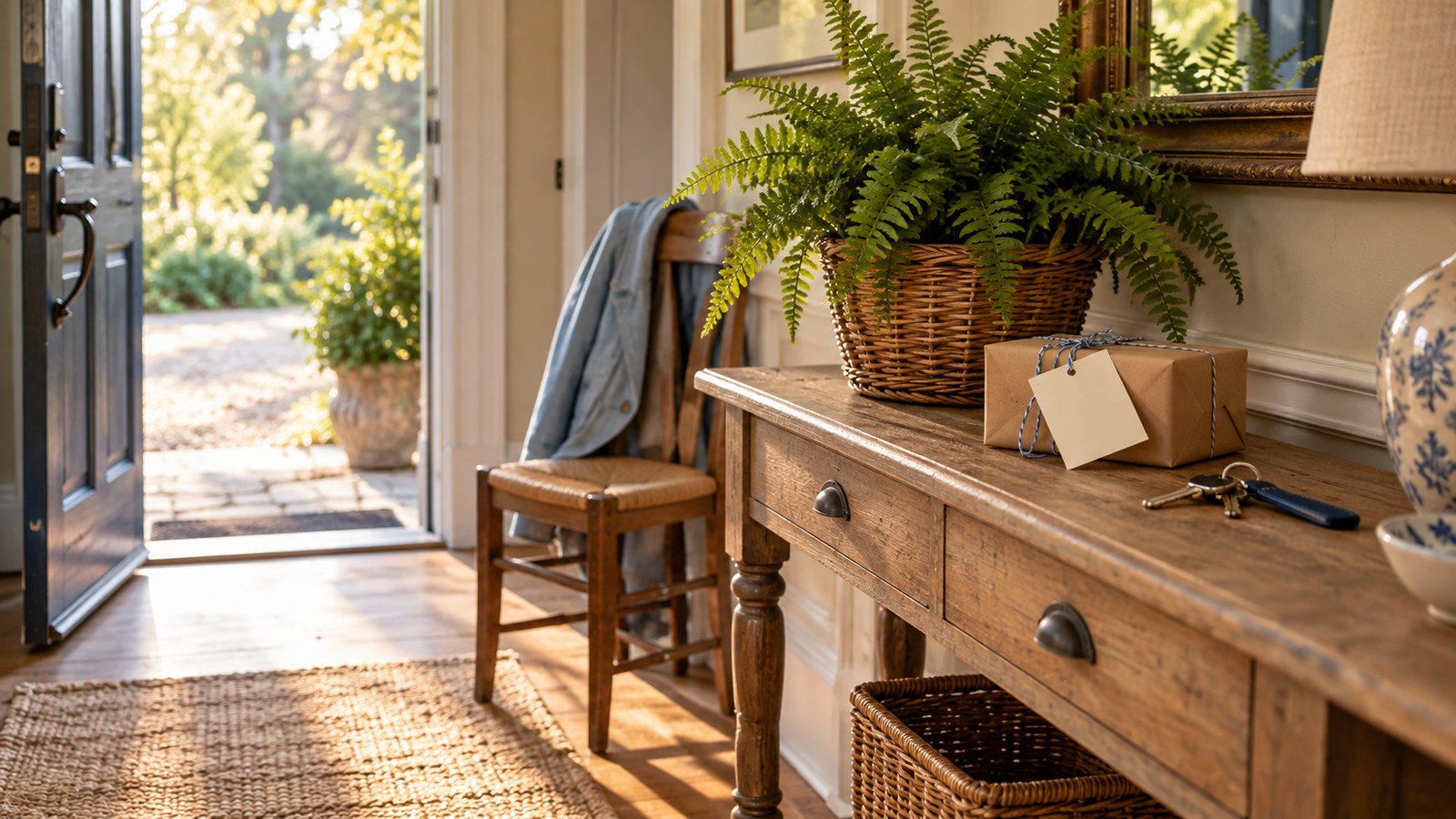
The guest has a job too. And the first one is not arriving with flowers in your hand.
The ancient Greeks had a party rule I'm relieved we didn't inherit: each guest was responsible for a portion of the entertainment. After dinner, people took turns performing. Those who played, played. Those who sang, sang. The rest recited a monologue or told a story.
That part of Greek etiquette did not survive, thank goodness.
But the book makes an observation that stayed with me: today's guest still has a job. It just stopped being artistic and became logistical. And almost all of it is free.
I always read these books from the host's side. This week I read the guest's chapter, and it caught me out on something I've always done.
Flowers in your hand are a problem
I'd never thought about this, and now I can't un-think it.
When you arrive at someone's house with a bouquet in your hand, you've just handed over a task. Your host now has to: find a vase, decide which vase, trim the stems, add water, work out where to put it. At exactly the minute she should be greeting the people coming through the door.
It isn't ingratitude if her face tightens for half a second. It's that she has fifteen things in her head and you've just put the sixteenth in her hands.
The book gives the order of preference, and it's simple:
- Best: have the arrangement delivered by a florist on the morning of the event. It arrives when she has time, and it dresses the house before anyone sees it.
- Second best: arrange them yourself at home and bring them in the vase. Done, nothing to do at the door.
- Last option: bring a potted plant. No vase needed, no water needed on the spot, and it outlives the bouquet.
And the third option talks to the last two things I've written here: I'd just finished explaining that a little pot of herbs tied into the napkin dresses a place at the table, and yesterday I wrote about the cachepot, which exists precisely to hide the plastic pot a plant comes home in. Put all three together: a potted plant inside a woven basket, handed over at the door, zero work for the person receiving it.
RSVP already means "please"
This one is small and I love it:
RSVP is short for répondez s'il vous plaît — please respond.
So "Please RSVP" is redundant. The please is already inside.
And the practical deadline rule, which is the useful part: if the invitation asks for a reply by a date, reply by the date, full stop. If the invitation gives no deadline at all, reply no later than ten days before the event. Your host needs to know how many are coming to decide on food, chairs and plates — and the sooner you answer, the easier her arithmetic.
Free
Take the Christmas table checklist
It arrives straight away. After that, my newsletter — leave whenever you like.
The time to arrive isn't always the time written down
Here the book is subtler than I expected, because it depends on the kind of gathering:
- Coffee or lunch at someone's house: arrive on time.
- A dinner that starts with drinks: it's better for the host if arrivals are staggered. Anywhere from ten to thirty minutes past the stated time is acceptable, and even kind.
- A work reception, even in cocktail-party form: on time. It's a professional commitment.
- A six-hour open house: nobody expects you to stay for six. Pick a two-hour block.
And the funniest and most useful instruction in the chapter: if you've arrived early, take a walk around the block before ringing the bell. Don't interrupt the preparations, don't make your host rush. Ten minutes on the pavement are worth more than ten minutes in the living room while she finishes drying a glass.
The gift, and what happens to it
Hand it over at the door, or just after your coat is dealt with. And don't expect it to be opened then — opening presents takes time away from guests, and at most parties the gifts aren't opened until everyone has gone. Showers are the exception, because there the gift is the reason for the event.
Which is why you should attach a signed card to the gift. The book is blunt about it: there is no host alive who can remember who brought what, even having taken it from your hand.
And the part I had to read twice: if your gift is food or drink, assume it will not be served — unless they asked you to bring it. The wine you brought goes to the shelf, not to the table. That isn't a slight: the menu was decided before you arrived.
Exception: at a potluck, where everyone brings a dish, the dish is your gift. And the book gives a mother's trick: write your name on the bottom of the serving plate, with masking tape or a permanent marker. It's the only way it comes back to you.
Four things you don't have to do
This is the part I call the relief, because every etiquette rule has a side that lets you off:
You don't need a gift if the party is at a restaurant or a hired room, outside someone's home. Handing your host a bottle of wine at an elegant restaurant is out of place.
Don't ask to see the house. And the disguised version doesn't count either: wandering off "looking for the bathroom" is poor form. Your host prepared some parts of the house for guests, not all of them. Complimenting the house is allowed, and sometimes the compliment prompts the offer of a tour — but if the offer doesn't come, contain your curiosity.
If you offer to clear the table and she says no, stay seated. Plenty of people have their own system and would rather have nobody in the kitchen. And there's another reason I found rather lovely: sometimes the host wants everyone at the table between courses, to talk and to digest, and you standing up opens a hole in the circle.
And if she says yes: don't stack the plates. That builds an unstable tower in the dining room, and it's how inherited china dies.
The time to leave is earlier than you think
The book uses a comedian's image: get off the stage while everyone is still laughing.
Being the last to leave tests the limits of your host's generosity. And there's an explicit signal: when your host says "it was so nice of you to come", it's time to go. Don't wait for her to appear in her pyjamas.
On the other hand, leaving too early also lands badly. If you were invited for a meal, the end of dessert is the earliest you can go. If you already know you'll have to leave before the end, tell your host in advance so she isn't caught out.
And the last one, a golden rule almost nobody follows: you leave empty-handed. You don't take back the half-finished bottle of wine you brought, or the rest of the cake you baked. Once you've given it, it belongs to the house. Unless your host insists on sending you home with leftovers — then accept and say thank you.
The serving dish from the potluck does come back. Whether the leftovers come with it is her decision.
What I'm going to do
Stop buying flowers on the way. And write my name on the bottom of every serving dish I own, today — because I've already lost three and never knew where they went.
If you want the other side of the coin, a laid table tells the guest what's coming before anyone says a word.
If you'd like the rest of what we're putting together for the season, I've gathered it all on one page, with a table checklist to download.
And if your December job is the table, The Art of Napkin Folding has the classic folds step by step, with the starch detail that decides whether a fold stands up. R$47.00, lifetime access.
Tell me: do you arrive with flowers in your hand? I used to. They were always the last thing I bought and the first thing that made work.
Free
Take the Christmas table checklist
Everything that matters on a Christmas table, on a single sheet. Print it, or fill it in on your computer.
It arrives straight away. After that, my newsletter — leave whenever you like.