The table already told you how many courses are coming, and when the toast is, before anyone spoke
I always thought a laid table was decoration with too many rules attached.
This week I read the dining chapter of an American etiquette book and changed my mind. A laid table is a notice. It is telling you things, silently, before anyone sits down.
And once you can read it, you can't unread it.
However many utensils, that many courses
This is the first one and the most useful.
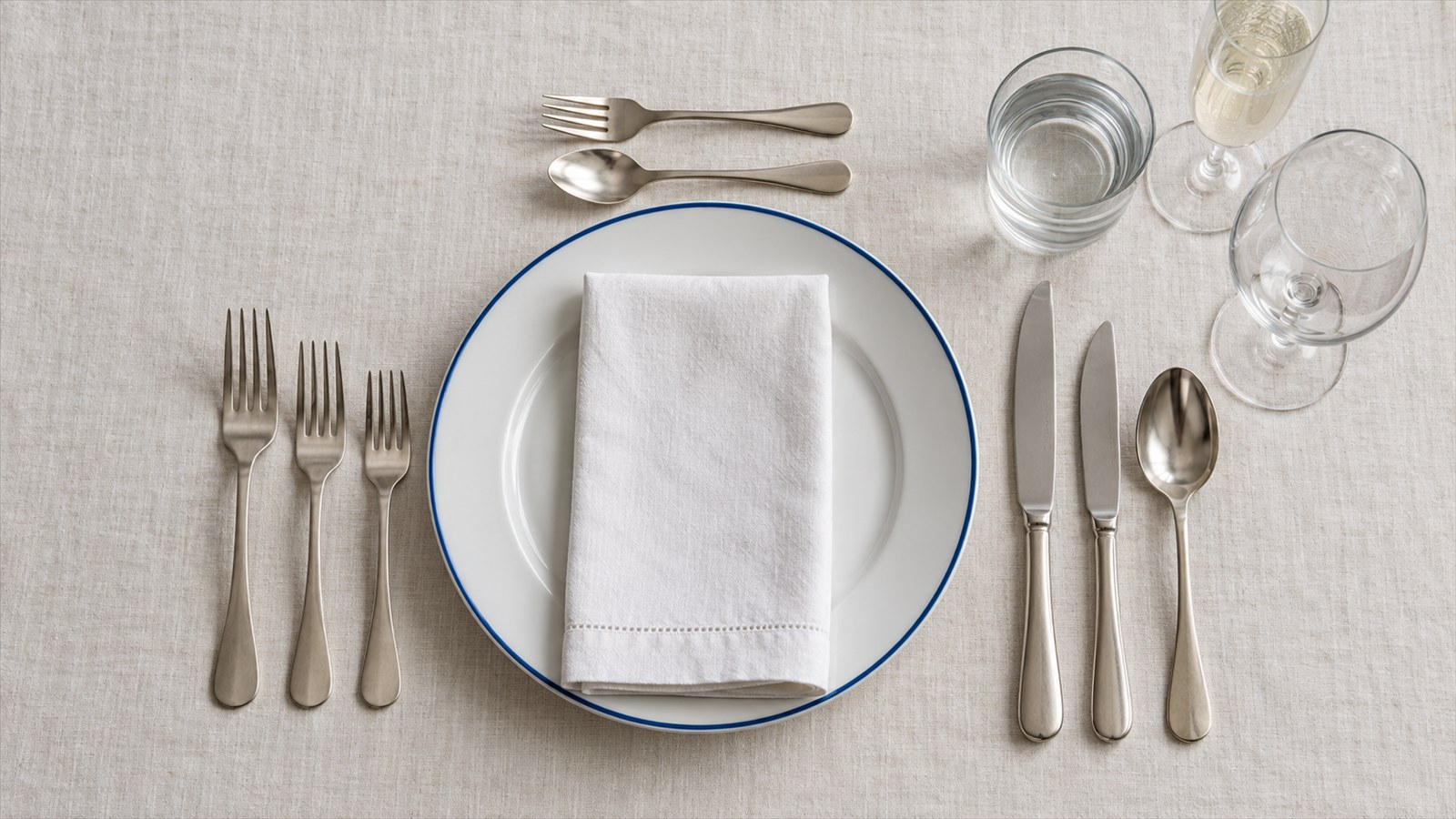
The number and combination of utensils tells you how many courses are coming. It isn't decoration, it's a contents page.
The example the book gives: two smaller forks and one larger fork to your left, two knives and a soup spoon to your right, and a fork and a teaspoon lying above the plate. That's a five-course meal: appetiser, soup, salad, main, dessert.
And the reason to want to know isn't to show that you know. It's to pace yourself. If five courses are coming, you eat the first one differently.
The rule for using them is outside in, and when you aren't sure, watch the host and do what they do. That line comes up again and again in the chapter and it's the most reassuring thing in it: when in doubt, follow whoever invited you.
The champagne glass tells you when the toast is
I read this one twice to be sure.
If the champagne glass sits furthest to the right of all the glasses, the toast happens before the meal begins.
If it's tucked back, to the left of the wine glasses, the toast comes after the main course and before dessert.
Somebody set that table already knowing the shape of the evening, and left the information in plain sight for anyone who can read it.
I'd already written that clinking glasses began as an imitation of a bell, to drive off whatever came in through the drink. Now I find the table doesn't just keep the gesture, it schedules it.
Free
Take the Christmas table checklist
It arrives straight away. After that, my newsletter — leave whenever you like.
BMW, left to right
The most common crisis at a full table is using your neighbour's bread plate.
The book's trick is BMW, read left to right the way you read anything: Bread, Meal, Water. That's the order.
There's a second one that works on word length: "eats" has four letters like "left", "drink" has five like "right".
And the book advises against a third trick, the one where you make a lowercase "b" with your left hand and a "d" with your right, for a practical and funny reason: whoever is sitting next to you will see you making signs and start to wonder.
If someone takes the wrong water, the instruction is not to correct them. Ask for another and move on.
The napkin fold I had never seen written down
This is the part that made me open a notebook.
The napkin doesn't go on your lap open. It goes like this:
Unfold it completely. Fold it in half into a rectangle. Put it on your lap with the folded edge toward your knees, the open edge at your waist.
And then the reason, which is engineering.
When you need to blot your mouth, you take the right-hand corner nearest your waist and use the underside of the top layer. The mark stays hidden between the two layers, and never touches your clothes when the napkin goes back down.
When that corner has done its work, you refold, moving the used corner over to the left, and you have a clean top-right corner again.
By the end of the meal, if someone lifted your napkin, the outside would be spotless. Every mark would be concentrated in the inside corners.
I've used cloth napkins my whole life and never once thought that one is folded in order to be dirtied in a particular order.
That sits alongside the story of how the fork shrank the napkin: the object changed size when its job changed. Here it changes fold for the same reason.
The napkin also says whether you're coming back
Two silent signals, both useful at a long dinner:
Napkin on the chair, chair pushed in: I'll be back.
Napkin on the table: I'm done, I'm leaving.
That settles the small awkwardness that happens at every dinner, where someone gets up and nobody knows whether to wait.
Why we now wait for the host
Older books say you sit down and put the napkin straight on your lap. Modern ones say wait for the host to take theirs.
The book gives two reasons and I liked both.
The first is what it calls the symmetry of dining: on a well-laid table each setting mirrors the next, and pulling your napkin too early breaks the pattern.
The second is practical. If someone arrives late and you stand to greet them, either the napkin drops on the floor or you're standing there holding it in your left hand like a comfort blanket.
And now the part I have to say
This is an etiquette book, and I'm not handing you a test.
Half the chapter is about business lunches, gala dinners and what to do when dining with royalty, none of which is happening at your table or mine. The other half is useful mechanics, and that's what I've pulled out here.
None of it is a condition for hosting well. Nobody has ever left a house thinking the hostess got the fork order wrong. People leave remembering whether they were looked after.
What I like about these rules isn't their authority, it's that nearly all of them exist for a physical reason somebody worked out and passed on. The fold protects your clothes. The glass marks the hour. The utensils count the courses.
It's a language, not a courtroom.
What I'm doing this season
Folding my napkin into a rectangle, fold toward the knee, and seeing whether it really works.
And laying the table thinking about what it announces: if the toast is at the start, the champagne glass goes furthest right.
If you want the rest of what we're putting together for the season, it's all on one page, with a table checklist to download.
And since the napkin is the cleverest object on this entire list: The Art of Napkin Folding has the classic folds step by step. Lifetime access.
Tell me: do you put your napkin on your lap as soon as you sit, or wait? I went straight in, and I'm going to start waiting.
Free
Take the Christmas table checklist
Everything that matters on a Christmas table, on a single sheet. Print it, or fill it in on your computer.
It arrives straight away. After that, my newsletter — leave whenever you like.