
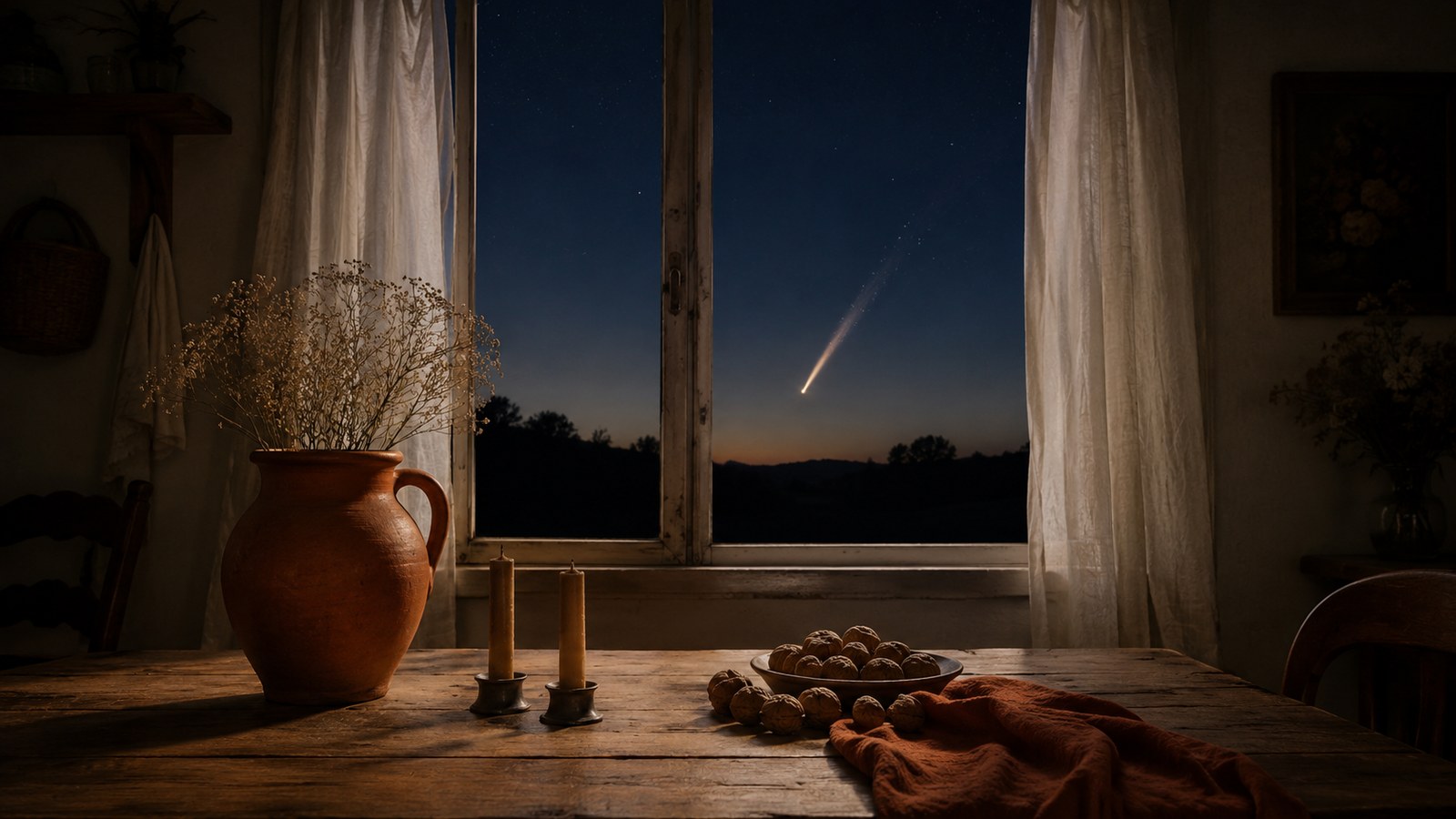
Halley's Comet Appeared in 1301. Giotto Painted It Where the Star of Bethlehem Should Be.
In 1301 Halley's Comet made one of its rare appearances. The book I was reading records what happened next in two sentences:
"Many saw it as a bad omen, but Giotto incorporated the comet into the Adoration of the Magi fresco in the Arena Chapel. Instead of the traditional star of Bethlehem, he depicts a flaming comet."
Notice that the book doesn't hedge. No "is thought to have", no "possibly". It states it.
And notice what the sentence doesn't say, because I nearly wrote the opposite: it does not say Giotto saw the comet. It says he incorporated it. Whether he was in Padua with his head tipped back that night, the book doesn't tell me, and I'm not going to invent it.
Why that's a big deal
Because the star of Bethlehem is a symbol. It's there to be read, not looked at.
The comet is a thing that crossed the sky of living people and frightened them. Swapping one for the other is swapping the expected for the observed.
Which is exactly what the whole chapter is about. Byzantine art was "intentionally mysterious and distanced from the real world of humankind", and Giotto and his contemporaries "began to tell the Christian story in real, human terms."
The Arena Chapel frescoes are dated c.1303–06, in Padua. One honesty note I owe you: the book gives that date for the whole cycle, not specifically for the Adoration. Joining the two is my arithmetic, not the book's.
The method, which explains the style
There's a lovely technical reason Giotto paints the way he does, solid and plain.
The power of his work "is partly a function of the fresco technique, which involved working methodically and rapidly on sections of wall prepared daily with wet plaster."
Wet plaster, prepared daily. The wall dries. You get one day, and whatever you haven't finished won't take paint any more.
No redoing, no glazing over it later. The monumentality is a child of the clock.
Free
Take the Christmas table checklist
It arrives straight away. After that, my newsletter — leave whenever you like.
A detail the book gives that changes the mood
The cycle has an owner, and the owner had a reason.
"In an attempt to expiate his father's crimes of usury, in around 1303 Enrico Scrovegni commissions Giotto to paint the narrative cycle of frescoes in the Arena Chapel, Padua."
Fifteen words of motive, and it is the only patron's motive the entire chapter offers.
Second honesty note: the book never connects that commission to the comet. The two facts sit on different pages and it does not cross them. The Adoration is part of the cycle, so the link looks obvious, but it's mine and not the book's.
A hundred and twenty years later, the other Adoration
In 1423, Gentile da Fabriano paints another Adoration of the Magi. It hangs in the Uffizi now.
And here the book is disarmingly frank:
"Painted for one of the wealthiest citizens in Florence, Palla Strozzi, this spectacular altarpiece is a masterpiece of the International Gothic style. It displays a courtly elegance designed to underline Strozzi's own wealth and rank."
Designed to underline the wealth of the man who paid. Written like that, without a flinch, in an art-book caption.
The Magi appear "dressed in splendidly luxurious garments". The frame is "magnificently ornate". And the predella, that strip of small pictures beneath the main panel, holds a night scene whose treatment of light the book calls remarkable.
One thing the book does not say, and I wanted it to: where the altarpiece originally hung, who saw it, and whether Strozzi is painted inside it. None of that is in the text. I'm not filling it in.
Both things are true at once
Which is the reason this post exists.
Same scene, same three kings, two commissions. In one, a painter swaps the settled symbol for something that genuinely crossed the sky. In the other, all that beauty is doing several jobs, and one of them is telling you what the owner was worth.
It isn't that one is pure and the other corrupt. They're the two halves of anything beautiful that somebody assembles for other people to see.
A holiday table is the same. It's affection and it's a shop window, and pretending it's only the first is a silly lie. On how light settles that question inside a painting, there's a whole post on the Nativity always being a night scene, with the Child as the light source.
Two footnotes I loved
Giotto was the first artist since antiquity to become a famous name. Dante, Boccaccio and Petrarch praised him. In 1308 Dante begins the Divine Comedy, and in it "expresses keen admiration of Giotto's naturalism."
And in 1311 there's a scene I wish I'd seen: on June 9, Duccio's altarpiece the Maestà was "carried in triumphal procession to the sound of church bells from the artist's workshop to Siena Cathedral."
A commissioned object, carried through a city, with the bells going. The most elegant delivery in history.
What I take from this to the table
One thing, and it's the comet.
Everybody knows the repertoire already: red, gold, pine, the star. It's a good repertoire, it works, and I use it.
But what makes a table yours is the item nobody expected to find on it. Seasonal fruit instead of a bauble. The wrong candlestick. The pitcher that exists in your house and no other.
Giotto didn't throw the Adoration out. He left everything in place and swapped one element, the highest and most visible one, for something he knew from the real world.
If you want the rest of what we're building for the season — useful for Thanksgiving on 26 November as much as for December — it's all gathered on one page.
And if your table will have dishes travelling hand to hand, the folded napkin is the cheapest detail there is. The Art of Napkin Folding has the classic folds step by step. R$ 47.00, lifetime access.
Tell me what your comet is: the off-repertoire thing that turns up on your table every year. Here it's a ceramic cow that has nothing to do with anything.
Free
Take the Christmas table checklist
Everything that matters on a Christmas table, on a single sheet. Print it, or fill it in on your computer.
It arrives straight away. After that, my newsletter — leave whenever you like.