
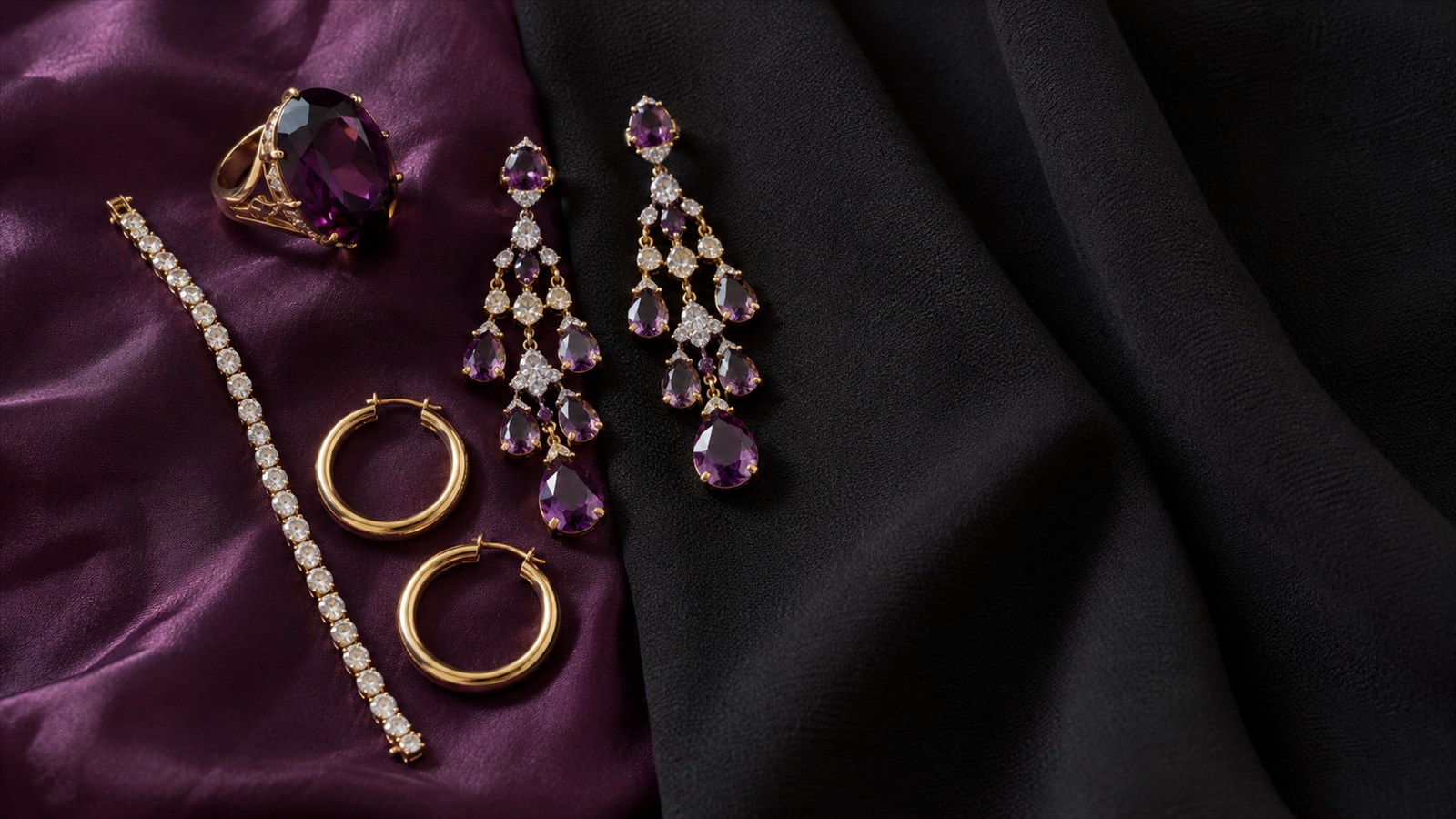
The cocktail ring exists because the dress got simple
Here's a question I'd never asked: why is a cocktail ring big?
Not big the way one person's ring is big. Big as a category. There's a kind of ring whose definition includes its size.
The answer is one short line in a fashion book, and it rearranged how I think about getting dressed to host.
The cocktail ring became popular in the 1920s, the era of the cocktail party. Silhouettes had quietened down, and the jewellery grew to balance them.
The book names the little black dress as an example of that cleaner line. Quiet clothes, loud jewellery.
The jewellery didn't grow out of vanity. It grew because room had opened up.
The same logic shows up in the earring
And once you spot the pattern, it turns up again three paragraphs later.
The chandelier earring, the long tiered one, came into vogue in the 1920s. The reason the book gives is physical: a lot of women had cut their hair into bobs, and necks were suddenly on show.
A bare neck is new territory. Somebody filled it.
It isn't that taste changed and the earring followed. It's that the hair went up, an empty surface appeared, and the object was designed for that surface.
I'd already seen the same mechanism running the other way: in the late 16th century glove fingers were slashed precisely so the rings underneath would show. The clothing opened a hole for the jewellery to fit through. Now the clothing simplifies and the jewellery fattens up.
The two are in constant conversation. Neither decides alone.
The bracelet that changed its name because of a match
This is my favourite thing in the chapter, because it's small and exact.
In the 1920s and '30s there was a bracelet of diamonds set in a straight row. It was called, very sensibly, a straight line bracelet.
In 1987, the tennis player Chris Evert wore one during a televised match. It caught the attention of tens of thousands of people watching at home, and the style took off.
Under a different name: the tennis bracelet.
The object is from the 1920s. The name is from 1987. And today the name is so much better known than the object that almost nobody knows it had another one.
I find that lovely and slightly alarming. One broadcast renamed a thing that had already existed for sixty years.
Free
Take the Christmas table checklist
It arrives straight away. After that, my newsletter — leave whenever you like.
The pieces that are far, far older than they look
The chapter has a short run of dates that dismantles the idea of jewellery as a modern subject.
Hoops: the oldest type of earring there is. Records indicate Sumerian women wore them around 2500 BCE.
Studs: worn as far back as 1559–1085 BC. And the original shape was a mushroom, with the "stem" pushed through the hole in the ear. The back that holds it came much later.
The cuff bracelet: Tutankhamun wore several at once, around 1300 BC.
Four and a half thousand years of hoop earrings. I wear hoops. My grandmother wore hoops.
And the cameo, which became a fashion because of a present
A cameo is cut from a stone with two layers, like agate or onyx. The figure, usually a head in profile, is carved into one layer so the colour of the layer beneath shows through behind it as a background.
The part I enjoyed: around the turn of the 18th century, Napoleon gave Joséphine more than eighty cameos, and that was enough to start a fashion.
Eighty. And the fashion ran for decades, peaking in the Victorian era, turning up on belts, brooches and bracelets. Victoria and Albert went as far as giving their wedding guests cameo rings carved with the queen's portrait.
A large piece of honesty about this book
This is a pop reference book, not a history.
It's built as a quick guide: a paragraph per piece, a date where there is one, and an example of somebody famous wearing it. A good share of those examples are 1990s and 2000s celebrities, and they've aged. I've deliberately left all of that out, because it adds nothing to the object itself.
The book is also uneven on dates. For hoops and studs it gives you centuries. For the cocktail ring it gives a decade. For several pieces it gives nothing at all. I've followed exactly what's written and haven't filled the gaps with guesses.
So: treat it as a map, not an encyclopedia. Its value is in showing that every piece is answering something, not in telling you precisely when.
What I'm taking to the table
Two things, and both are about deciding together rather than separately.
First: choose the jewellery after the clothes, looking at what's left over. If the dress is plain, there's room and you can take it. If the dress is already talking, the jewellery can be quiet. The question isn't "what matches", it's "what's still empty". It's the same order I argued for when I wrote about the dress you receive people in: the clothes decide first, and they decide how much room they're willing to give up.
Second, much less poetic: think about what your hands are going to be doing. A big ring is beautiful and gets in the way of passing a dish. A wide cuff knocks the rim of a plate and rings against a glass. A long earring catches your shoulder when you lean sideways to hear someone.
I'm not saying take anything off. I'm saying the host spends the evening on her feet with both hands full, and it's worth knowing what will annoy you before you find out mid-dinner.
If you want the rest of what we're putting together for the season, it's all on one page, with a table checklist to download.
And for the part of the table that passes from hand to hand all evening: The Art of Napkin Folding has the classic folds step by step. Lifetime access.
Tell me: do you have a piece that only comes out for the holidays? There's a pair of hoops here that is practically a uniform.
Free
Take the Christmas table checklist
Everything that matters on a Christmas table, on a single sheet. Print it, or fill it in on your computer.
It arrives straight away. After that, my newsletter — leave whenever you like.