
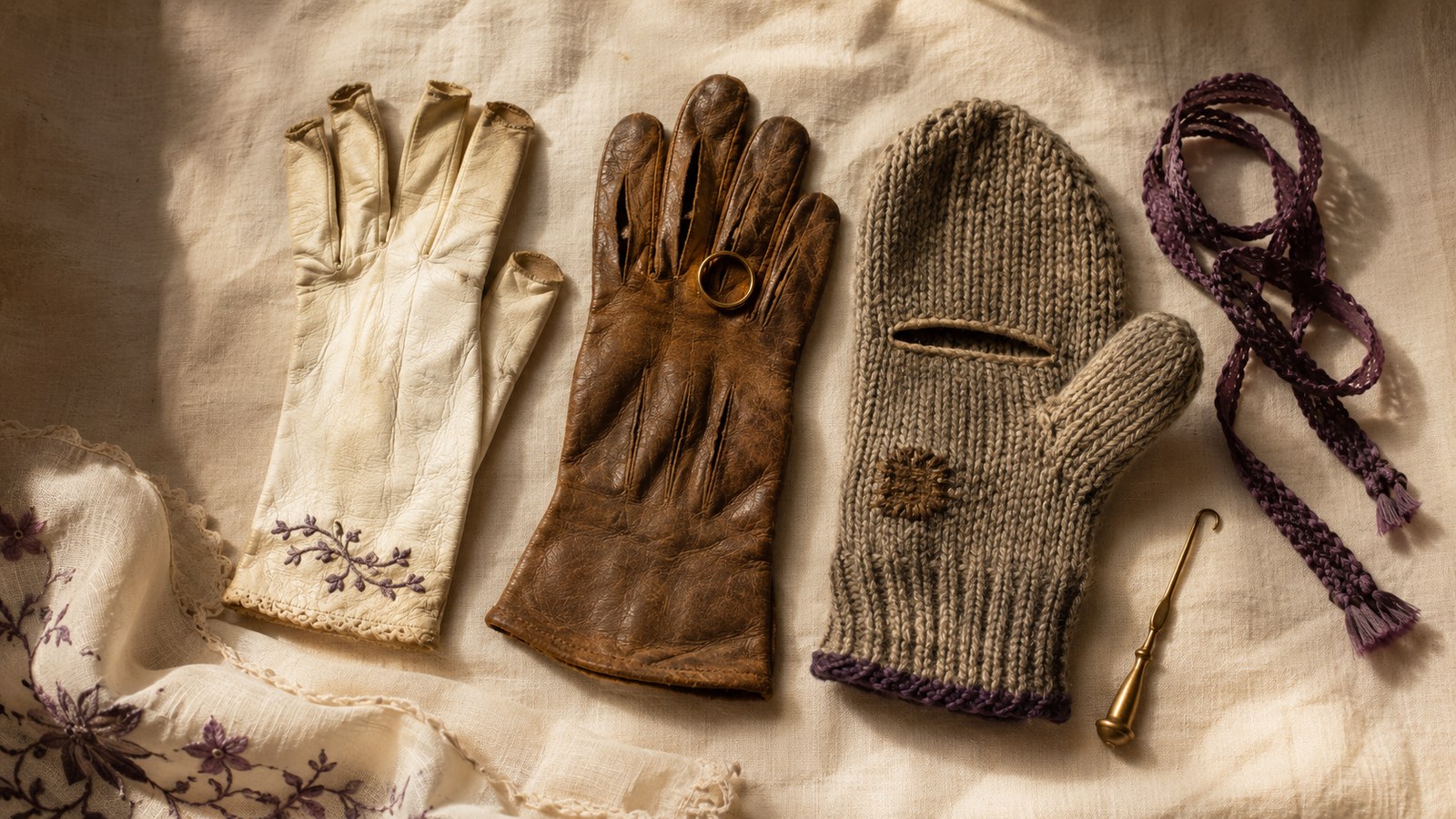
Between 1700 and 1750 There Were Women's Gloves With the Fingertips Cut Open. Nobody Wrote Down Why.
The fashion dictionary I use has an entry called cut-fingered gloves, and it holds two completely different fashions under one name.
The second is this:
"Period: ca. 1700–1750. The tips of the fingers were cut open, a fashion confined to women."
Fifty years. Women only. And two purchase records to prove it:
"Half a dozen of cut-fingered gloves" (1719, Earl of Thanet Accounts). And "2 pair of fine white thread gloves that are open-fingered" (1740, Purefoy Accounts).
And that's all.
The book doesn't say why. Not one line. It doesn't say what the open tips were for, how much was cut, whether it was all five fingers or some, who stopped wearing them, or when the fashion ended.
I spent a while trying to guess and gave up. What the dictionary records is that it existed, for half a century, and nobody thought it needed explaining.
The first version does have a reason
A hundred years earlier, the same name describes something else.
"Period: End of 16th century. The fingers of the glove were slashed to reveal the underlying rings."
Slashed, not cut at the tip. Openings along the finger, so the ring showed.
And the dictionary supplies the couplet that catches the fashion out:
"But he must cut his glove to show his pride / That his trim jewel might be better spy'd" — from 1597.
A glove deliberately cut so a ring can be seen. Vanity is four hundred and twenty-nine years old and has an address.
The same problem, solved by a countryman
This is my favourite part and it comes from an entirely separate entry.
Mitten, from the thirteenth century onwards: "a glove with a single covering for fingers and one for the thumb."
And then:
"The palm was sometimes slit horizontally, to allow the fingers to protrude without having to remove the mitten."
A slit across the palm. You push your fingers out through the hole, do the thing, and pull them back in.
Notice that it's exactly the same question as the cut-open fingertip, only answered by someone working outdoors rather than someone going to a ball: how do you keep the hand covered and still use it?
Six hundred years of people solving that differently.
Free
Take the Christmas table checklist
It arrives straight away. After that, my newsletter — leave whenever you like.
And then, around 1640, the glove climbs to the elbow
"Until ca. 1640 when elbow-length gloves, close-fitting, of fine leather or silk, and often white, sometimes embroidered, began to be fashionable and essential for full dress."
By the eighteenth century they were "universal except with riding habits."
And with that comes an engineering problem I had never once thought about: a long glove falls down.
The solution has its own entry. Glove-band, ca. 1640–1700: "A band of ribbon or plaited horsehair tied at the elbow over a long glove to keep it in place."
Plaited horsehair. Tied at the elbow. Under everything, where nobody saw it.
In the eighteenth century it becomes the glove-string, ribbon or horsehair, "tied or buckled at the elbow". And then the dictionary quotes a magazine from 1783:
"Diamond buckles to the glove-strings" — for full dress.
Diamond buckles on a strap that exists purely to stop a glove sliding down. I find that magnificent and slightly absurd, in the right proportions.
The glove with the lying name
Chicken-skin gloves, late seventeenth to early nineteenth century.
The name suggests one thing. The reality is another, and the dictionary settles it by quoting a shop bill from 1778, from a perfumer called Warren:
"The name induced some to think they were made from the skins of chickens; but on the contrary they are made of a thin strong leather which is dressed with almonds and spermaceti."
Almonds. For a glove.
Careful with the attribution: that's the perfumer talking, on his own shop bill, not the dictionary asserting it. In its own voice the dictionary says only that "the gloves were frequently made of other leathers".
And what were they for? A couplet from 1690, by John Evelyn: "Some of chicken-skin at night / To keep her Hands plump, soft, and white."
At night. They were sleeping gloves.
There's a neighbour with the same naming problem: Limerick gloves, ca. 1750–1850, "long or short gloves made of very fine leather, said to be made from the skins of unborn lambs." That "said to be" is the dictionary's, and I'm keeping it.
The evening-glove curve, in dates
This is the cleanest sequence in the whole entry, and it's about one thing: length.
Nineteenth century: "Either short to the wrist or long to the elbow; coloured during the day, but white in the evening."
And then:
"A short evening glove was fashionable from 1830–1865; subsequently it lengthened and by the 1890s spread up beyond the elbow."
Thirty-five years short, then thirty years climbing. The evening glove spent the entire century moving.
One contradiction I have to flag, because it's inside the same book. The men's gloves entry says that in the nineteenth century they were "often coloured for day, with white for evenings and lavender for weddings", until ca. 1870. But the wedding-suit entry says lavender was worn from ca. 1870.
One says before, the other says after. The dictionary doesn't choose, and I'm not going to choose for it.
The only table fact in the entire glove family
And it's about a card table, not a dinner one.
Muffetees, eighteenth and nineteenth centuries: "Small wrist muffs made in pairs, worn for warmth or to protect the wrist ruffles when playing cards."
Protecting the ruffle at the wrist during a game. That's a garment invented for one very specific problem on one very specific kind of evening.
And there's a letter from 1748 ordering a pair: "Pray buy my mother a pair of black silk French muftees for the hands…they must be with thumbs to them."
They must have thumbs. That is an eighteenth-century woman knowing precisely what she wants.
What the dictionary doesn't say, and it's a lot
Two absences worth recording.
First: it never says gloves came off at the table. Not once. The word "table" appears in no glove, mitten or muff entry. Nor dinner, nor eat, nor food. If there is a rule about gloves and cutlery, it isn't here.
Second: there is not a single measurement. No inch, no centimetre, no button count, anywhere in the whole family of entries. Length is always given by a landmark on the body: to the wrist, to the elbow, "beyond the elbow", "reaching the knuckles". The dictionary measures in parts of a hand and arm, and never in numbers.
Why this matters to anyone hosting
Because the glove answers the same question I'd already run into from the pocket side: what you need from your hand, and what you need inside it, while you're on your feet all evening.
Only the glove answers it more radically, because it covers the tool. Every version of it across six hundred years is a negotiation: how much of the hand do I give back?
The mitten gives back the fingers through a slit. The late-1500s glove gives back the ring. The 1700s one gives back the fingertips, for a reason that got lost. The muffetee covers no hand at all, and only guards the ruffle.
And then the twentieth-century line closes the whole thing: "gradually gloves became less essential, except for winter warmth."
Six hundred years of negotiating with the hand, and in the end the hand won.
If you want the rest of what we're building for the season — as useful for Thanksgiving as for December — it's on one page, with a table checklist to download.
And if you want the folded cloth that has a clear job at the table: The Art of Napkin Folding has the classic folds step by step. R$ 47.00, lifetime access.
Tell me whether you have an inherited piece of clothing nobody wears any more. Here it's a pair of my great-grandmother's white lace gloves, which don't fit my hand and which I'm not giving to anyone.
Free
Take the Christmas table checklist
Everything that matters on a Christmas table, on a single sheet. Print it, or fill it in on your computer.
It arrives straight away. After that, my newsletter — leave whenever you like.