
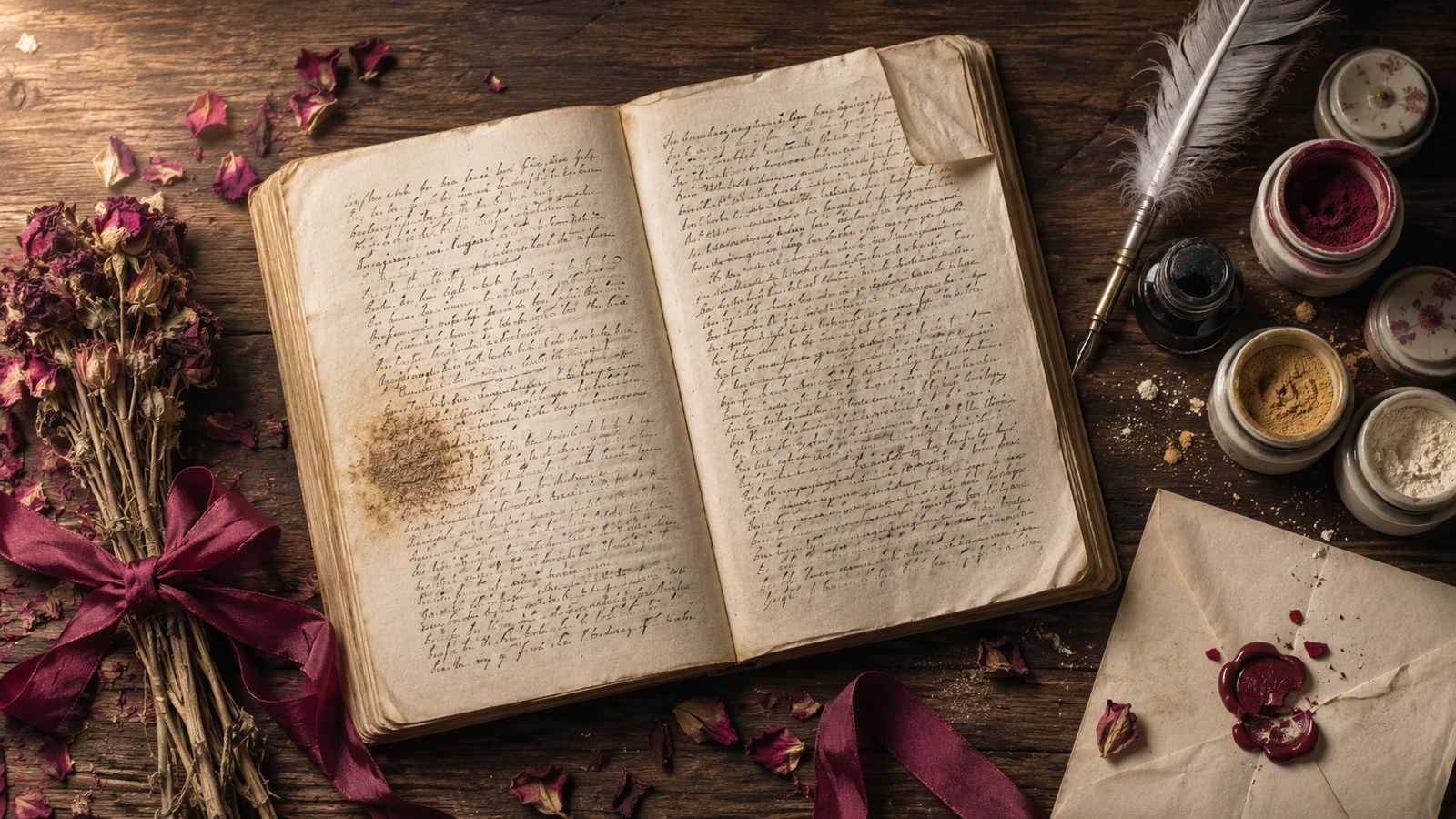
Around 1500, an Italian Noblewoman Collected 454 Recipes. Nearly Half Were About Beauty.
Around 1500, the Italian noblewoman Caterina Sforza collated a set of recipes and experiments called Gli Experimenti.
There are 454 recipes in it. Sixty-six are classified as cosmetic.
But the academic Jacqueline Spicer, who translated the manuscript, points out that the actual number concerning beauty and cosmetics, "from making skin clear and blemish-free to dyeing hair", is much higher at 192.
Nearly half the book.
And she didn't write it alone
That's the part that got me.
The book describes Sforza as someone who "established one of the earliest known beauty communities, writing and receiving letters from many sources to discuss, exchange, and collect recipes."
Trading recipes by letter. With a lot of people. Over years.
The contents, the book says, come from "the traditions of the community around Sforza as well as knowledge gleaned from classical medicine". Half social network, half Galen.
Gli Experimenti is called "the first beauty book that we are able to definitively confirm as being female authored."
One honesty note I owe you, because it's a big one: the book attaches no footnote to this passage. The figures 454, 66 and 192 appear unsourced. It also doesn't say where the manuscript is, what language it was written in, or whether it was ever printed. It says "collated", not published.
What put all of it into circulation
Technology, and the date is a good one.
"The earliest known system of printing was invented in China around AD 1041, but it was the invention of the printing press with movable characters by Johannes Gutenberg in Germany around 1450 that heralded a sea change in the exchange of information."
And the effect on beauty is immediate, and cheap:
"During the Renaissance in Italy, a culture emerged in which cosmetics were widely promoted on the streets, with recipe books sold for the equivalent of 'a flash of wine' — in other words, they were exceedingly cheap."
A beauty manual for the price of a mouthful of wine, sold in the street.
Others followed. The Secrets of Lady Isabella Cortese, 1561, also credited to a woman, did well enough to be reprinted six times, which the book reads as evidence of "a public hungry for this community-sourced miscellany of medical and cosmetic knowledge."
Free
Take the Christmas table checklist
It arrives straight away. After that, my newsletter — leave whenever you like.
The first English women's magazine didn't cover beauty
That was the surprise of the reading.
"The earliest magazine aimed specifically at women in England was The Ladies' Mercury, first published in 1693."
And what was in it? "An advice column on love and relationships, written by men."
Sixteen ninety-three. Men handing out relationship advice to women in a magazine. Some things age less than we'd like.
Between 1880 and 1900, "almost fifty new women's magazines appeared", and they instructed women in how to dress and act.
And there's one case I loved: La Belle Assemblée, 1806, one of the first British fashion magazines. The book records that it "never discussed cosmetics" — and that, even so, "its illustrations depict women who are quite obviously rouged and lipsticked, with flushed cheeks and small, dark rosebud lips."
The text didn't say it. The pictures did.
That tension between what may be said and what may be shown is old. In 1650 the English Parliament actually tried to ban blusher, and gave up.
1909: two facts in the same year
The first is almost touching in how inconvenient it was.
American Vogue ran a beauty column called On Her Dressing Table. To find out where to buy the products it mentioned, a reader had to write in to the magazine, enclosing a self-addressed stamped envelope.
You read about a powder. You wrote a letter. You waited. You got the shop's address back in the post.
And in the same year, 1909, Selfridges opened on Oxford Street in London and became "the first British department store to display cosmetics openly."
The book sets the two side by side and moves on. So will I.
The 1913 line I'm keeping
The actress Billie Burke wrote a column for a Chicago paper between June 1912 and January 1914, much of it aimed at removing the stigma from cosmetics.
One of them says:
"I am deluged with letters asking me if I believe in using powder. I certainly do; every actress does . . . All actresses are artists in 'make-up'; they have to be. But the make-up for the stage and the make-up for the lights of the streets are very different."
Stage and street. Two different faces.
And the book gives the technical background to that in a single sentence: "With the developments in lighting — from the introduction of gas illumination to limelight and the first completely electrically lit theaters — came necessary developments in stage cosmetics to match."
Notice what it does not say: it names not one product, ingredient or technique that changed. Only that the change had to happen.
What I take from it
That the recipe always circulated.
Five hundred years of women swapping formulas by letter, buying a street manual for the price of a mouthful of wine, writing to a magazine to find out where a powder was sold, and reading in pictures what the text wasn't allowed to print.
What we now call a "beauty community" is not an invention of social media. It's the original format, and it came back.
There is one concrete application of that for a holiday season, and it's the only one I'll give: ask for the recipe. Your mother-in-law's, your neighbour's, the aunt who makes the thing. Write it on paper. Keep it.
Caterina Sforza's book survived five hundred years because somebody took the trouble to write down what other people told her.
If you want the rest of what we're building for the season, useful for Thanksgiving on 26 November as much as for December, it's on one page, with a table checklist to download.
And if the recipe you want is the one for making a table look better without spending: The Art of Napkin Folding has the classic folds step by step. R$ 47.00, lifetime access.
Tell me which family recipe you have written down somewhere. Here it's a note in my grandmother's handwriting, wrong quantities and all.
Free
Take the Christmas table checklist
Everything that matters on a Christmas table, on a single sheet. Print it, or fill it in on your computer.
It arrives straight away. After that, my newsletter — leave whenever you like.