
In 1650 the English Parliament Tried to Ban Blusher
In 1650, under Cromwell, someone put a bill before the English Parliament against the "vice of painting". Against blusher, essentially. And against those little black patches women stuck on their faces.
It was read once. Then it died.
I think about that on the mornings when I'm rushing and put on nothing but blusher. There was a moment when an entire parliament thought my cheek was worth legislating, and gave up, because it was already too late. The habit was too deep to outlaw.
The oldest cosmetic there is
Red on the face is older than almost anything else in your drawer.
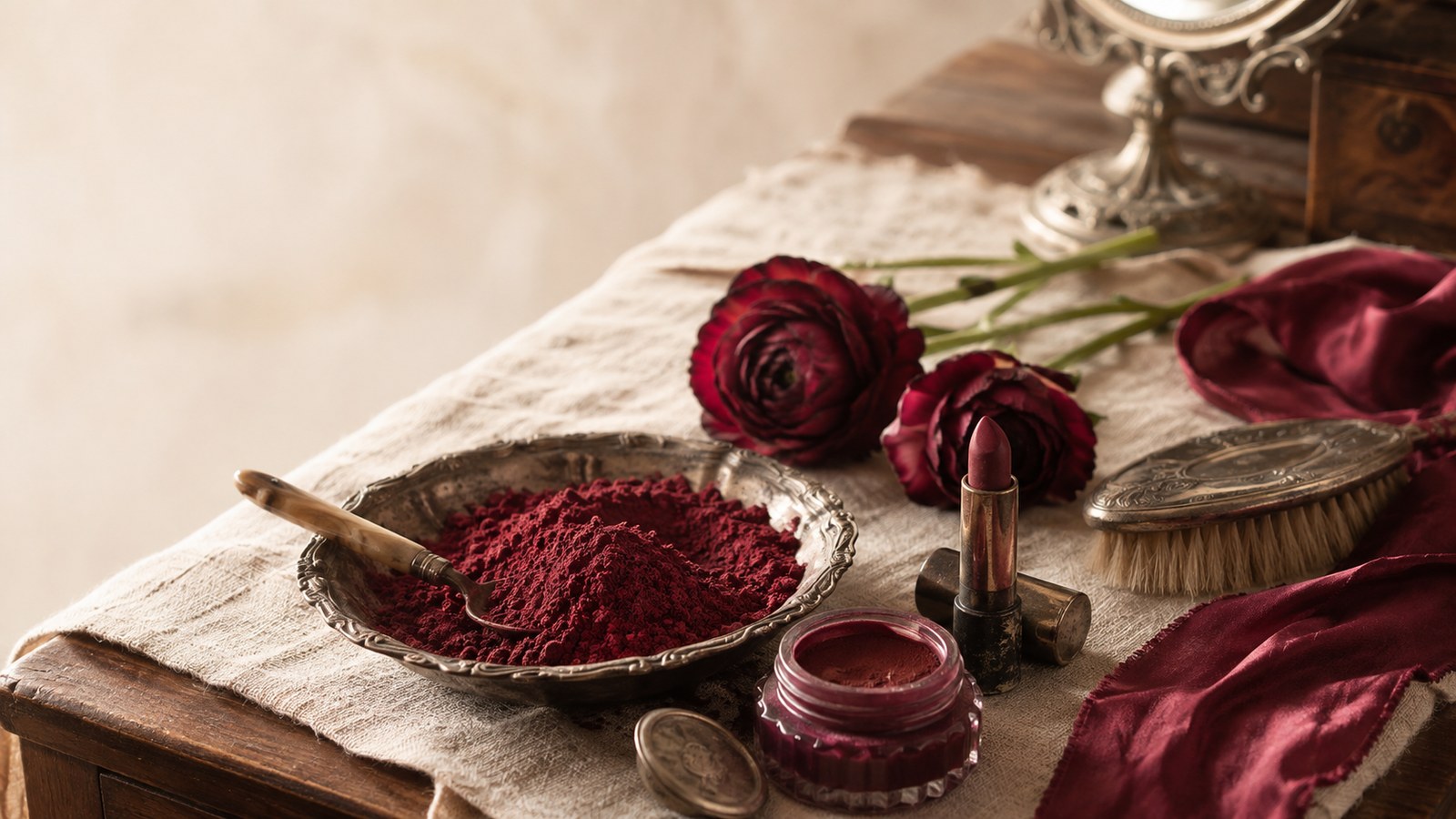
The earliest rouges were sticks of red ochre: iron oxide mixed with animal fat or vegetable oil, in a shape and size not far off the chunky cream shadow sticks we use now. Thousands of years between them, and the object is nearly identical.
Other sources followed. Insects, cochineal and kermes, dried and turned into carmine. Plants: safflower, alkanet root, crushed mulberries, strawberries, beetroot, amaranth, madder. And minerals that were beautiful and thoroughly poisonous, like cinnabar, which nobody should be recreating today.
Until the nineteenth century rouge was made at home, recipe by recipe. Only then did pharmacies start selling it ready-made.
The same thing on lips and cheeks
One fact that let me off a hook I'd put myself on: historically, red pigment always did both jobs. Mouth and cheek, one product.
The idea that you need a lipstick, a liquid blush, a powder blush and a tinted balm is commercial, not historical. A cream or a stain that works in both places is how this was done for centuries. It isn't a shortcut for people in a hurry.
In Japan, geisha use beni: a small pot lined with dried safflower that turns vivid red the moment it's wet. One product, two places, and the small ritual of wetting the brush first.
Free
Take the Christmas table checklist
It arrives straight away. After that, my newsletter — leave whenever you like.
Where exactly to put it
History offers two options here and both still work.
In ancient Greece, as early as the fourth century BC, the red went on the apples of the cheeks. Which is where most of us still put it.
Sixteenth-century portraits show something else: an inverted triangle, starting at the apple and running downward. Longer, more dramatic. If you've ever felt that blusher on the apples makes your face rounder than you'd like, try taking it lower. That isn't a tutorial invention. It's from the 1500s.
There's also Count Axel von Fersen's account of a Frenchwoman building her rouge from six different pots, two shades at a time, over a base that looked more black than red. Layers. Mixed tones. The notion that blusher is one flat product is much newer than the notion of mixing.
A pause on Marie Antoinette
Her routine was two separate things.
There was the private toilette in the morning: washing, powder, hair. And the public toilette, which began at noon, with an audience. The rouge application was the most attended stage of the whole performance. People came to watch that part.
The detail I find most human in the entire story: by around 1780 she had all but given rouge up. After years as the most copied face in Europe, she simply stopped.
At the very end, what remained of her kit was powder, a sponge and a small box of pomade.
Then red disappeared for a while
Queen Victoria pronounced makeup vulgar, and for decades pallor was the rule again. Not because anyone had discovered anything. Because a woman with influence said so.
It was Queen Alexandra, decades later, who wore powder and rouge openly and made it acceptable again. Two women, two opinions, and half a continent's face changing behind them.
What I take from that: the rule about what counts as "too much" was never technical. It was always someone with power having a view.
The right tool for the texture
This is the practical part that actually changed my mornings.
Historically the tool was chosen by the texture of the product, not out of habit. Fingers, a camel-hair brush, a hare's foot, a powder puff. Each formula asked for something different.
Now most of us own one brush and use it for everything. Try it this way instead:
- Cream or stick: fingers. The warmth of your skin melts the product so it merges instead of sitting on top.
- Powder: a large soft brush, tapped off first so you're not depositing a stripe.
- Stain or liquid: a barely damp sponge, pressed rather than dragged.
Three minutes of experimenting and the blusher you already own behaves like a different product.
What survived, hiding in your makeup bag
Two old inventions are still with us in disguise.
Spanish wool: discs of fabric about four centimetres across, dyed with cochineal, dabbed onto lips and cheeks. And Spanish paper, the portable version, sheets soaked in pigment that fitted into a pocketbook.
Look at your cream blush stick and your blotting papers and tell me that isn't the same idea.
One thing I'll say plainly
Red is the oldest colour in human vanity. It survived a parliamentary ban, a bored queen, and two hundred years of people calling it the preoccupation of silly women.
Coco Chanel settled it in eight words: "red is the colour of life, of blood."
If an entire Parliament couldn't take it off our faces, I'm not going to waste an afternoon feeling foolish for liking it.
Tell me something: do you wear blusher every day, or only when you're going out? I'm trying to work out whether I'm the only one who puts it on to stay home.
Read next
- In 1937 an Italian Launched a Pink Nobody Found Sweet — The colour that became a rule without ever having been one.
- Rembrandt Painted Himself His Whole Life — and the Best-Loved Portrait Is the Least Flattering — The face without disguise, and why it moves people more.
Free
Take the Christmas table checklist
Everything that matters on a Christmas table, on a single sheet. Print it, or fill it in on your computer.
It arrives straight away. After that, my newsletter — leave whenever you like.