
In 529, the Punishment for a Late Monk Was Eating Alone, With No Wine and No Tablecloth
In 529, the Rule of the Order of St Benedict decreed that a monk who arrived late to the table must eat alone, with no wine and no tablecloth.
Read that last part again. The cloth sat in the same list as the wine and the company. It was a thing that could be taken away from you.
That rearranged how I think about a piece of fabric I had been treating as decoration.
Before the cloth there was something else
The Romans had no tablecloth, because they ate reclining on couches. What they had was the gausape, a woollen cloth shaggy on one side and smooth on the other, which served as napkin, hand towel and sheet.
The cloth becomes a separate object only when people start eating sitting up at a table, a custom the books date to the fifth century, under Merovaeus, king of the Franks.
And here is the etymology I loved: the table of that period was a board on two trestles. A plank. So the fabric was a "borde cloth", a board cloth. Only in the sixteenth century, when the nobility moved to solid tables, did it become a table cloth.
From the sixth century, a poem by Venantius Fortunatus written for Queen Radegunde describes a tablecloth made of roses.
The cloth hung down one side only
This is the part that delighted me, because the reason is practical to the point of comedy.
In the Middle Ages the table stood against a wall, so that nobody could be attacked from behind. So the cloth reached the floor on the diners' side only, with two stated jobs: protecting the guests' knees from draughts, and stopping animals walking over their feet.
When cloths did eventually reach the floor on all four sides, the corners were knotted to keep them clean. According to the book, that decorative custom continues today.
And a medieval table didn't have one cloth, it had three at once: an overcloth, whipped away after the first course; a clean undercloth beneath it; and a third hanging down the side that served as the communal napkin. Dessert was eaten on a bare table.
Free
Take the Christmas table checklist
It arrives straight away. After that, my newsletter — leave whenever you like.
Why white
The answer is older than taste.
Overcloths were white because it was "a color symbolic of purity, the original sacred meal, and the sanctity of the altar cloth." The undercloth was darker. Stripes, plaids and checks were a rural thing.
Then came the second reason, which is optical. From the sixteenth to the nineteenth centuries the noble cloth was damask — reversible, woven in Damascus, brought to Europe by the crusaders, patterned with coronations, battles and coats of arms.
And the sentence that explains everything: "in an age without electricity, the sheen of white damask offset the dark wood furniture and paneling."
The table is white because by candlelight, white was the only thing throwing light back up at the faces of the people sitting at it. The cloth was lighting.
One detail I can't get over
Oriental rugs were enormously popular as tablecloths.
They were considered too valuable to lay on the floor. So they went on the table, and at mealtimes they were protected with an overcloth of white damask, lifted afterwards to show the pattern.
The rug on the table, the white cloth over the rug. The exact inverse of our houses.
How many cloths a house needed
In the early seventeenth century, the chests of a modest home might hold no fewer than forty tablecloths. Forty.
Fabric was measured in ells: 27 inches in Holland, about 45 in England.
The number collapsed in the nineteenth century because of a change in service. Under French service everything went on the table at once, and several cloths were needed to keep it presentable through dinner. When Russian service arrived, with dishes offered one at a time, one cloth was enough.
The Victorians hedged in between, with so-called "accident cloths" laid over the ends of the table and removed before the last course.
The placemat has a surname
This is true and I did not know it.
The placemat evolved in the seventeenth century when a London draper named Doyley lined an underplate with a small linen mat to keep the bowl in place. An etiquette manual of 1906 approved placemats on the grounds that they kept the tablecloth clean.
And the padded cloth that goes under the tablecloth is called a silence cloth. In the nineteenth century silence cloths were considered vulgar, with one exception: baize, coarse reddish-brown wool often dyed green, which insulated the table and, tied at the corners, stopped the cloth bunching.
What the cloth becomes on Christmas Eve
Across a lot of Europe, the cloth on the twenty-fourth of December isn't decoration. It's the central object of the night.
In Ukraine two cloths are laid, one over the other. The first is white, symbolising family members who have died. The top one is heavily embroidered, symbolising those living in the present. A band of string or chain is tied round the table legs, for family ties.
In Slovakia, fish scales go under the plates or under the cloth, for luck.
In Romania, a coin, corn, a mirror and a lump of coal are hidden at the four corners beneath the cloth, and the children uncover them.
In Lithuania, at Kūčios, hay lies under the white cloth and twelve meatless courses are served.
Notice the pattern. In every one of these, the cloth is a layer that hides something. It isn't there to look nice. It's there because there's meaning underneath it.
The measurements, for your table
The book's figures are in inches; the centimetres beside them are my arithmetic.
The average dining table is 27 inches high, about 69 cm, and a chair seat 16.5 inches, about 42 cm.
The drop of the cloth at a dressed dinner is 10 to 15 inches, 25 to 38 cm — and the reason is that the hem rests in the diner's lap. Informal, about 25 cm. A tea table takes up to 45.
A runner is 14 to 17 inches wide with a 15-inch drop, and the minimum gap between placemats is 4 inches.
On my 1.20 by 0.80 metre table, that comes to a cloth of roughly 1.70 by 1.30.
What ended all of it
Synthetics, in the late 1960s.
Before them, tablecloths were, in the book's words, "cherished, mended, and bequeathed in family wills". A cloth moved down through a family because nobody was going to buy another one.
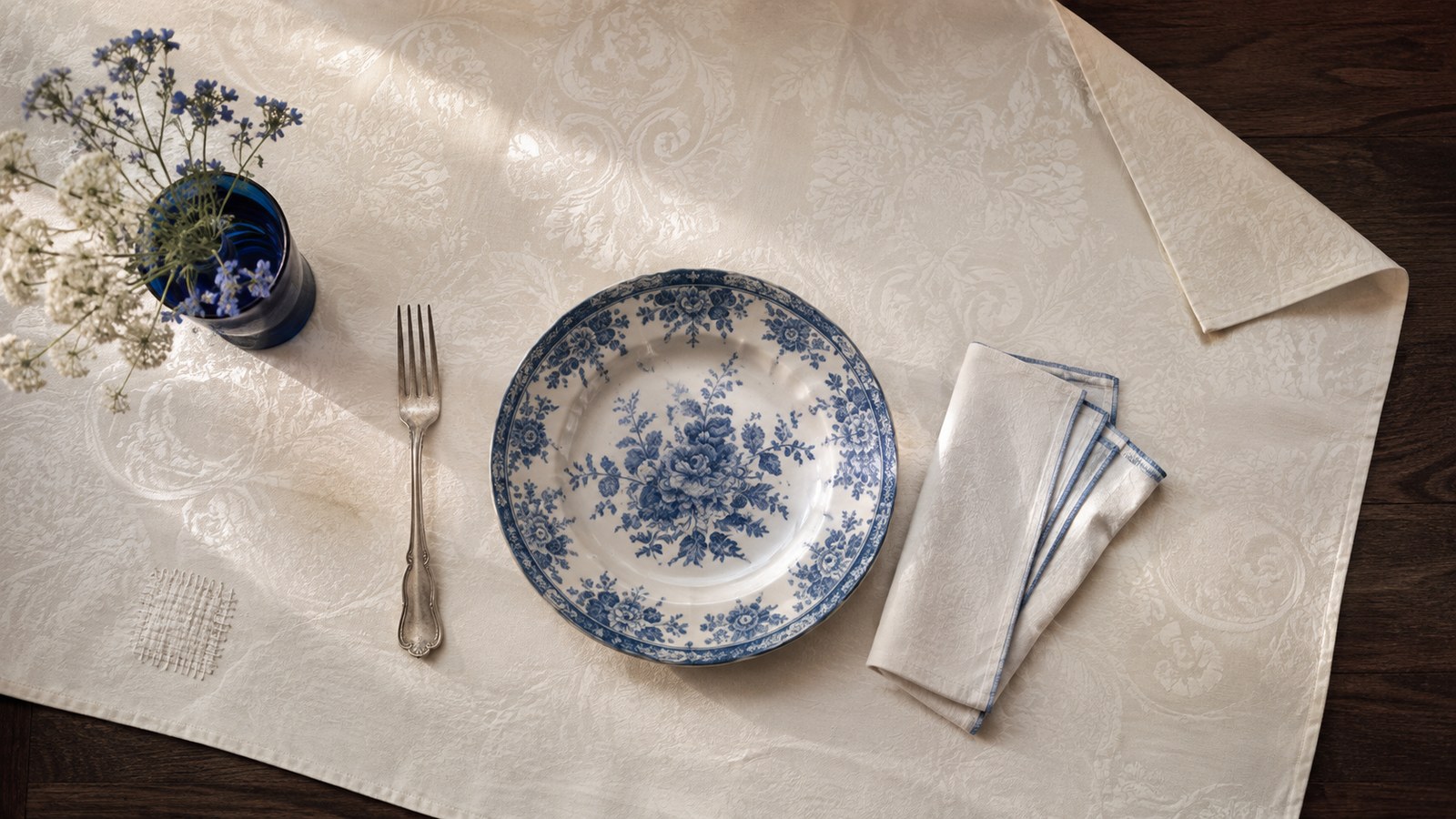
I have one of my grandmother's. It has a stain that won't come out and a mend in one corner, and I spent years treating it as the worse version of a new cloth. After reading this, it's the other way round.
What I do now
A cloth rather than mats whenever there are too many people — a cloth lets elbows sort themselves out, a mat marks territory.
And white, not for elegance, but because the table will be lit by candles and white is what throws that light back at everyone's face.
If you want the rest of what we're writing for the season, I've gathered it on one page — the table, the house, the meal. And since the third medieval cloth was everyone's shared napkin, I told the napkin's story here.
Tell me: do you have an inherited cloth? I want to know whose it was and what became of it.
Free
Take the Christmas table checklist
Everything that matters on a Christmas table, on a single sheet. Print it, or fill it in on your computer.
It arrives straight away. After that, my newsletter — leave whenever you like.