
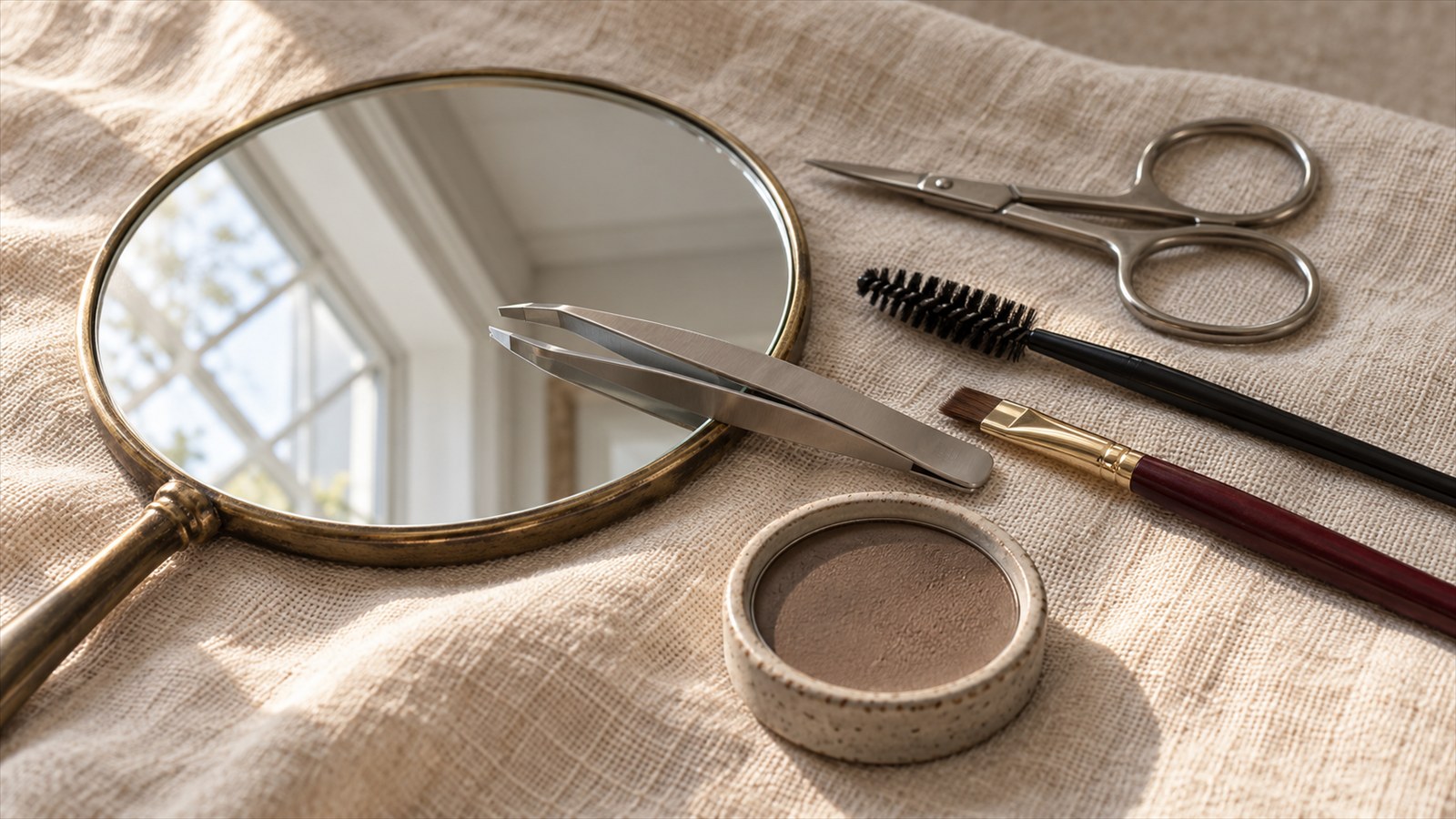
If you're right-handed, it's probably your left eyebrow that's too thin
There's a line in a makeup book I read three times over, went to the mirror to check, and came back slightly embarrassed.
It comes from a brow specialist interviewed in the book — someone who works hair by hair and spends half an hour with each client. She says she can usually tell whether a person is right- or left-handed just by looking at their eyebrows.
Because if you're right-handed, the tweezers in your right hand have to cross your own face to reach your left brow. And in that crossover you lose perspective. So the left one ends up thinner.
I'm right-handed. I went and checked. She was right.
Why this matters more than it sounds like it should
I had always treated brows as a detail. The book treats them as structure, and its argument convinced me.
When your two brows don't agree with each other, the perspective of your whole face is thrown off. The person looking at you stops seeing your face as a whole — their eye can't settle anywhere, particularly in eye-to-eye conversation.
Think about that on an evening when you're hosting. You're on your feet, talking to people all night, most of it from less than a metre away. No other part of your makeup is looked at that closely for that long.
It isn't vanity. Brows are the frame, and a crooked frame draws attention to itself.
The two danger zones
This is the practical part, and it's the part I didn't know.
Not every part of the brow responds the same way to having hair pulled out. Two areas are far more prone to follicle damage — meaning the hair may simply not come back:
- The middle, between the brows. It's where everyone fiddles most, and it's where over-plucking leaves the two sitting too far apart.
- The ends, at the tail of the arch. It's also where plenty of people lose hair naturally, with age or for hormonal reasons.
The combination is unkind: the tails thin out on their own over time, and they are exactly the region where taking too much can't be undone.
The rule she repeats is short and I've adopted it: when in doubt, don't pull it out.
Free
Take the Christmas table checklist
It arrives straight away. After that, my newsletter — leave whenever you like.
Three ways to remove, and why she picks one
The book compares the three methods through someone who does this all day. An honest summary of what she says:
| Method | What she observes |
|---|---|
| Waxing | Pulls hard on the thin skin around the eye. Hair comes out against the direction of growth and grows back unmanageable. Leaves the area shiny and unnatural, which shows up more once you put makeup over it. It's where she sees the most mistakes, and one slip can damage follicles permanently. |
| Threading | Catches even the finest hair, which is impressive. But it's the most painful and least precise of the three, and it frequently takes the highest point of the arch with it — which is why you can spot it across a room: two straight lines. |
| Tweezing | What she prefers. More control, more options on shape, less irritation, and the hair doesn't come back as fast or as erratically. |
I didn't read that as "waxing is wrong". I read it as: each method has a cost, and waxing's cost is charged to the shape rather than to the appointment.
The small things that change the result
These are immediately usable and none of them costs anything.
Don't tidy your brows every day. The minimum interval she gives is three days, for everyone. Plucking is a habit that installs itself.
Be careful with a magnifying mirror. If a hair can't be seen with the naked eye, chances are nobody else is going to see it either.
Brush up and trim before you think about removing. A good share of what reads as "messy brows" is just long hair, and trimming fixes it without losing anything. Cuticle scissors, and don't cut close.
Fill first, then remove. With an angled brush and a matte shadow, draw the shape you actually want, and only then take out what falls outside the drawing. That way you're removing against a map instead of a guess. And you can throw the stencils away.
The angled brush is the one I described last week writing about why natural and synthetic hair do different jobs — the angled one is what gives you a line, and matte shadow is a powder, so the same material logic applies.
Gel locks the colour in. Powder or pencil alone migrates; gel over the top holds it. It's also what keeps long hairs in place between appointments.
Where I changed my mind about filling
The book is refreshingly blunt here: brows don't need to be filled all the time, especially in daylight. Over-groomed and over-filled reads as unnatural.
And one detail got me from the real-life angle: the specialist says she often goes out with no makeup at all, but with her brows done. If you're picking one thing, that's the one.
For a December evening in low light this matters more. I've written here about how candlelight erases definition and swallows contour — brows are one of the few things candlelight does not flatten, because they're hair rather than pigment sitting on skin. They go on holding the frame while everything else softens.
On tattooing, with a caveat I hadn't considered
The book isn't categorically against it — it says some professionals do remarkable work — but it raises an argument I'd never heard.
Over time the face drops. And it doesn't drop evenly or symmetrically on both sides. With tattooed brows you lose the ability to correct that asymmetry, because the drawing is fixed and the face isn't.
It also notes that brow tattoos generally need redoing roughly every two years depending on your colouring, and that the pigment commonly turns blue or green.
And one thing about age I've filed away: past a certain point, bringing the arch down tends to flatter more than lifting it. A very high arch can age you.
This book's limits, said plainly
It's a beauty guide, not a scientific text. The brow section is an interview with a practitioner — which means it's the experience of someone who does this, not the result of a study.
The right-handed/left-handed thing is a good example. She says she can tell; that's salon observation accumulated over many years and many faces. It isn't a measured finding. I checked it against my own face and it held, but one case proves nothing — it's only enough to send you to the mirror, which is all I'm asking.
And the book is explicit about something I'll sign my name to: there is no correct eyebrow. There's no compulsory trend. Everyone is born with their own shape, and the hair grows differently on every one of us.
Over the last century a new brow trend has turned up every five to ten years — brows have been shaved off entirely, built up with animal hair, painted every colour there is. All of that was mandatory at some point, and all of it passed.
If you'd like the rest of what we're putting together for the season, I've gathered it all on one page, with a table checklist to download.
And for the table itself: The Art of Napkin Folding has the classic folds step by step. R$47.00, lifetime access.
Now tell me, because I need to know whether it's just me: are you right- or left-handed, and which of your brows is the thinner one?
Free
Take the Christmas table checklist
Everything that matters on a Christmas table, on a single sheet. Print it, or fill it in on your computer.
It arrives straight away. After that, my newsletter — leave whenever you like.