
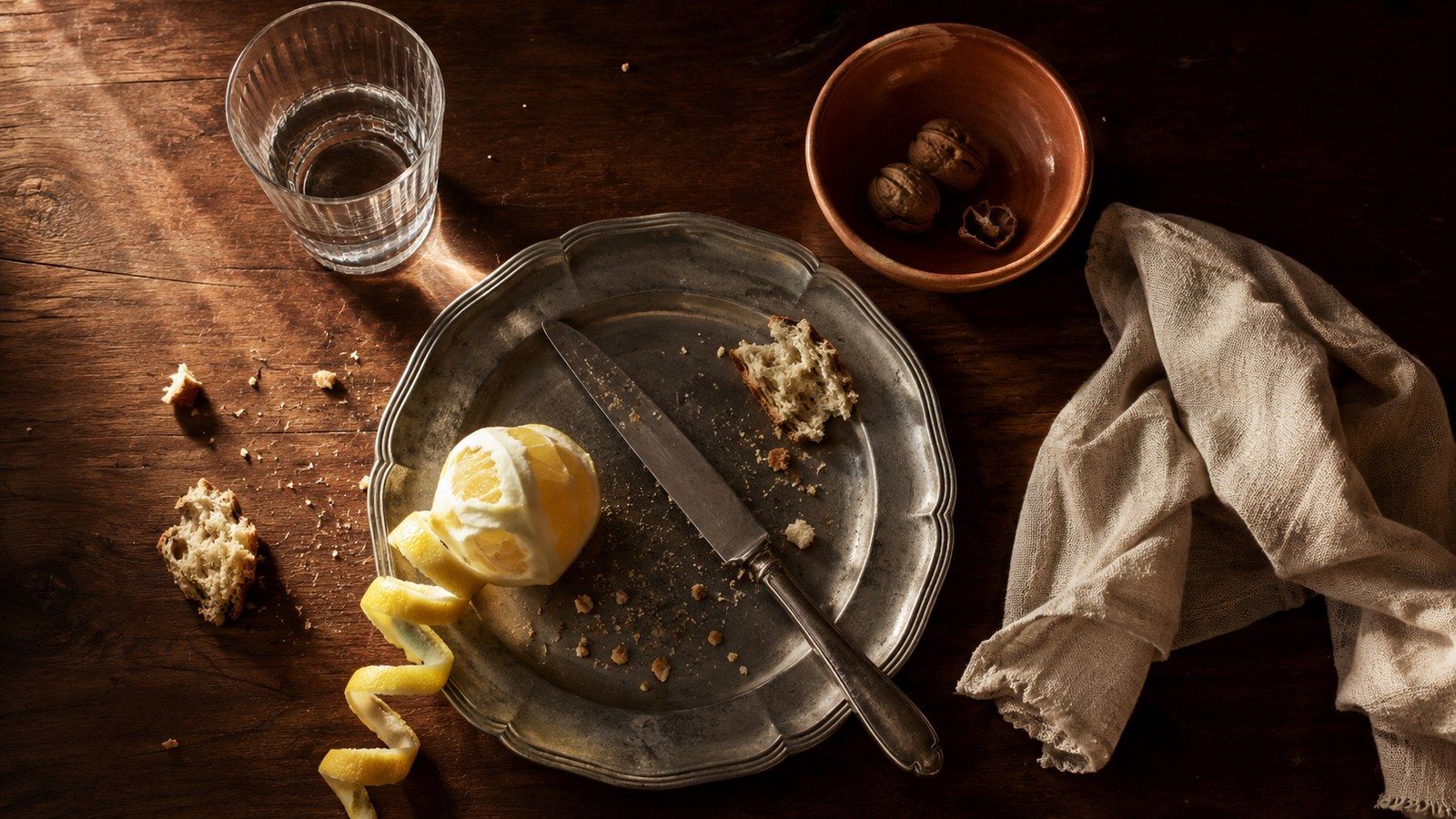
Among the Walls Buried at Pompeii in AD 79 There Is a Still Life of Lemons and a Glass of Water
Among the wall paintings buried by Vesuvius at Pompeii in AD 79 there are still lifes. One of them shows lemons and a glass of water.
Sixteen centuries before Dutch painters turned the laid table into an entire genre, someone had already decided that fruit beside a glass deserved a wall.
I went looking into this because I've been thinking about tables all month, and I expected to find decoration. What I found was a three-hundred-year argument about what is worth painting.
Why the Dutch ended up painting tables
The explanation is economic and I loved it.
In seventeenth-century Holland, a painter with no gift for portraiture could no longer rely on commissions. He had to paint the picture first and look for a buyer afterwards — at market stalls, or through dealers who bought as cheaply as they could.
With so many competing in one town, the only route for a minor painter to build a reputation was to specialise in a single branch. So there were painters of fish. Of seascapes. Of moonlight. Simon Vlieger, 1601 to 1653, is named as one of the oldest seascape specialists.
And there were painters of tables.
It wasn't a spiritual decision about the beauty of simple things. It was a tight market pushing people into niches.
The two men who painted leftovers
Pieter Claesz, born around 1597 in Burgsteinfurt and dead in Haarlem in 1661, had his characteristic subject recorded like this: tables laid for a meal, or holding the remnants of one.
The remnants. Somebody built an entire career painting what's left after people get up.
After 1630 he tightened those compositions into geometric schemes based on the Golden Section. The dated works run almost one a year, like a diary: Still Life with Glass of Beer, 1627. Luncheon with Pewter Jug, 1643. Still Life with Pitcher, 1644. Still Life with a Pâté, 1647. Large Glass, 1649.
Willem Claesz Heda, born around 1593 and dead around 1680, both in Haarlem, began with portraits and religious works before specialising. His earliest dated work is a vanitas of 1621.
And Heda had a preference I find telling: he preferred the table settings of bourgeois homes to sumptuous ones. Ordinary houses, ordinary crockery.
He's celebrated for so-called "monochrome" still lifes, built from half tones and transparent glazes over a single colour. The Dessert, 1637, is done in ashy and silver greys. From the same year, one where a pewter pitcher in shadow stands against a brilliant white pipe. And another, still 1637, described as gold on gold.
Three paintings in a year, each solving a different problem of light falling on a table.
Free
Take the Christmas table checklist
It arrives straight away. After that, my newsletter — leave whenever you like.
What a table was, to a painter
The laid table became a laboratory.
Willem Kalf used it to study how light is reflected and broken by coloured glass, and spent his career looking for new harmonies between Persian carpets, bright blue china and intensely coloured fruit.
It's the same thing a candle does in your dining room in December, except he could sit and look at it for three weeks.
There's a practical lesson in that, and it's why I wrote this in the middle of a month about the table: a table is interesting because of its materials, not because of the food. Glass, metal, ceramic, peel, cloth. What the Dutch were painting was a set of surfaces behaving differently under one light.
If you've ever laid a table and felt something was missing, it's almost always that. A surface that behaves differently from the others.
The ranking that put all of this at the bottom
There was an official hierarchy and it was severe.
Seventeenth-century critics held that painting a portrait or a landscape from nature was menial work, because the hand merely copied what the eye saw. History painting, the noble subject, demanded erudition and imagination.
Reynolds, first president of the newly founded Royal Academy, filled his discourses with exhortations to lofty and dignified subjects.
An honest footnote: the book I read names portrait and landscape in that reckoning and does not state where still life sat on the ladder. I'm not going to invent the rung. But it's not hard to guess it wasn't the top one.
So the laid table was painted for two centuries by people who were, officially, doing the least important thing you could do with paint.
The man who got into the Academy with a fish
Chardin, 1699 to 1779, started in his father's carpentry workshop.
He exhibited for the first time in 1728, at the Exposition de la Jeunesse in the Place Dauphine — an open-air show held for one morning a year. He took a rayfish and a sideboard. Two still lifes.
He was admitted to the Académie Royale two months later.
One morning a year, a fish and a piece of furniture, and two months later he was inside the institution that called it the bottom rung.
By 1738 his paintings sold before the Salon opened and he was forced to paint replicas.
He also painted Saying Grace, a woman setting dinner on the table and asking two children to give thanks. On the date I have to be tedious: one of my books gives 1739 for the painting and the other says it was exhibited at the Salon of 1740. Painted and exhibited aren't the same thing, and neither book reconciles them. So it stands as that.
And then somebody dismantled the table
The last painting in this story is from about 1878, by Cézanne.
In one of his still lifes the foot of the fruit bowl isn't in the middle. The table slopes from left to right and simultaneously looks tilted forward. The napkin, which in a Dutch picture would be soft and fluffy, looks as if it's made of tinfoil.
The reading I took away: the Dutch master painted his table to display virtuosity, and Cézanne repainted it as if nobody had ever painted a table before.
Two hundred and fifty years to arrive at a man who looked at a laid table and decided it didn't have to lie flat.
What I'm taking into December
Three things, none of which needs a museum:
Materials, not food. What makes a table work is glass next to metal next to clay. Choose by surface.
The leftovers count too. Claesz painted the after. The table at eleven at night, with peel and crumbs and a half-empty glass, is the picture they chose to make.
Light is the subject. Kalf spent a life on it. You have a candle and a warm evening.
If you want the rest of what we're writing for the season, it's all on one page — the table, the house, the meal. And on the real table, the story of the chair nobody sits in is here.
Tell me: have you ever photographed the table after everyone got up? I took one last year without thinking and it's the best picture of the night.
Free
Take the Christmas table checklist
Everything that matters on a Christmas table, on a single sheet. Print it, or fill it in on your computer.
It arrives straight away. After that, my newsletter — leave whenever you like.