
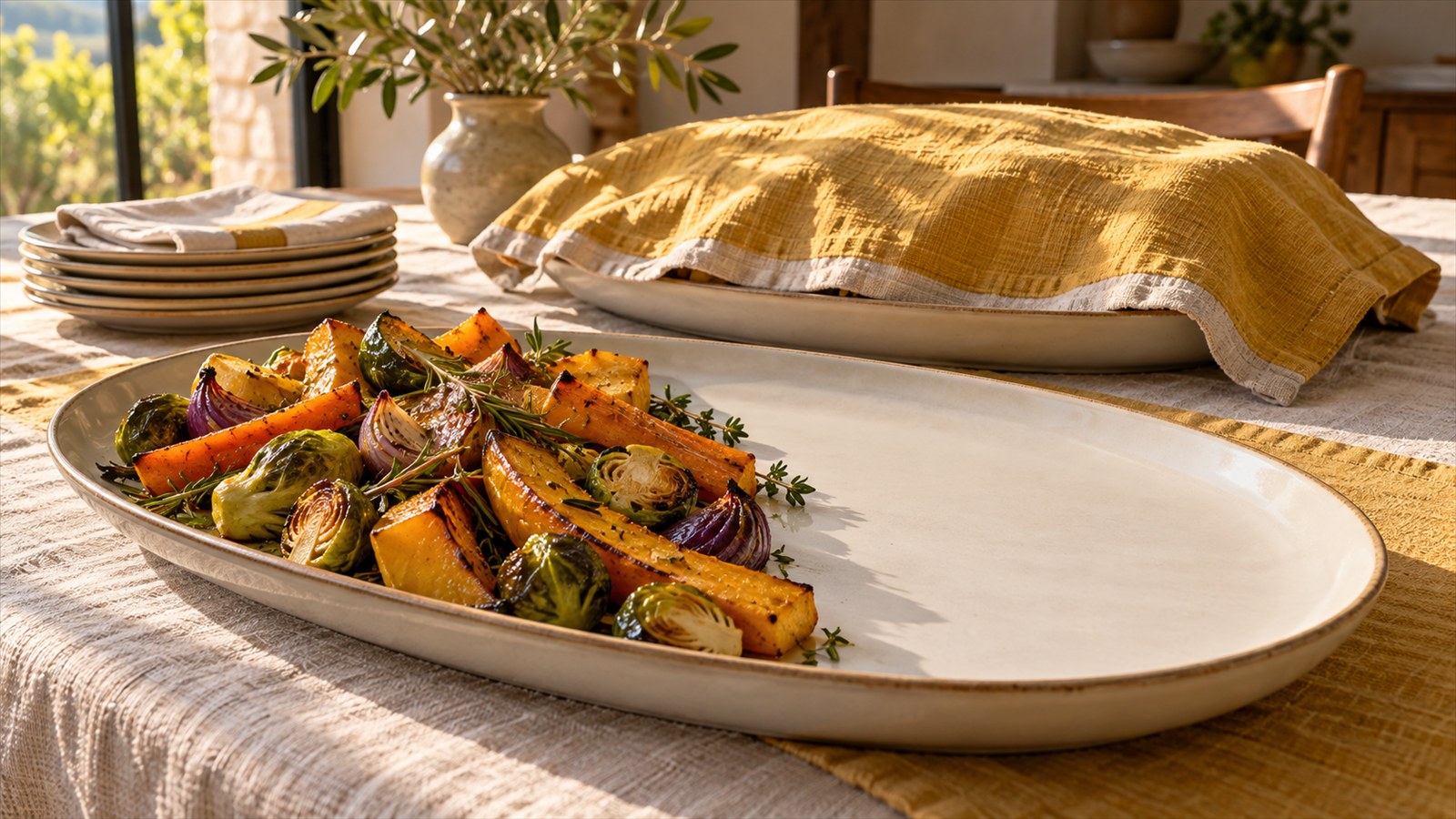
Food on the table has two hours. In the heat, it has one.
I have always put everything on the table at once.
In my head it made sense: a full platter looks good, a full table reads as generous, and nobody wants to be the host who rationed the bread. So it all came out together at seven and stayed there until somebody got up to clear.
Then I read, in a book of menus for having people over, an instruction that struck me on first pass as stingy.
Put out half. Hold half back. Replenish in batches.
My first thought was that this was a photography concern — bread doesn't dry out in the picture if you swap the bread. And it is that. But it isn't only that, and the part I didn't know is the part that matters.
The clock
The same chapter says it twice, flatly: food at room temperature has a maximum of two hours.
The book gives the number and moves on. No reason, no authority cited. For a menu book that's normal — but I went and checked, because two hours is exactly the sort of rule we all pass along without knowing where it came from.
It holds up. And there's a second half the book doesn't give you.
The food inspection service of the United States Department of Agriculture calls the band between 40°F and 140°F — roughly 4°C to 60°C — the Danger Zone, the range where bacteria multiply fast. Perishable food shouldn't sit in it for more than two hours. And above 90°F, for no more than one hour.
Read that again. One hour.
This is where the book is British and your Christmas isn't
The book is by a Greek-Australian writer living in London, and its menus assume a temperate house. Two hours is the number for someone entertaining in a room sitting in the low twenties Celsius.
A Brazilian Christmas dinner happens in December.
December here is in the thirties Celsius — the nineties Fahrenheit. The table is near a window, the kitchen has been working all afternoon, the oven was on, there are too many people in one room and half the houses have no air conditioning. Your Christmas table is not in the two-hour band. It is, fairly often, on the far side of 90°F.
The number that applies to your dinner is one hour, not two.
And that changes the whole calculation — because the clock does not start when the first person serves themselves.
The clock starts before anyone arrives
Counting starts when the dish leaves the oven or leaves the fridge. Not when the guests sit down.
Picture the actual evening. You put everything on the table at seven because you want to be free when the doorbell goes — the book itself recommends setting the table in advance, and it is completely right about that. Someone runs late. There's the round of hellos, the round of drinks, the conversation that happens in the doorway. People serve themselves at half past eight.
In the two-hour band, you spent three quarters of your window before the first plate. In the one-hour band, you blew the deadline and nobody has eaten yet.
The platter does not look any different. That is precisely why this mistake is easy to make.
Free
Take the Christmas table checklist
It arrives straight away. After that, my newsletter — leave whenever you like.
Which is where "serve half" stops being about looks
Because holding half back isn't making the same food wait longer. It's having a second lot of food whose clock hasn't started.
The first half comes out at seven and has its window. The second is in the fridge, cold, and its window only opens when it comes out. You haven't stretched anything — you've split the evening into two windows instead of one.
That solves the dry bread and the clock with one gesture. That's why the instruction existed, and I had only understood the pretty half of it.
The rest follows the same logic:
- Store components separately. Vegetables apart from sauce apart from the roast. Kept separate, you can reheat what needs heat without re-cooking what was already done.
- Prep the raw things ahead and keep them sealed. Salad, crudités, cut fruit, in a closed container in the fridge. Washed and, above all, dried properly: water on a leaf kills a salad faster than anything else.
- Top up in batches. And holding some of everything back has an obvious second use: the guest who arrives at ten still gets food, not leftovers.
The structure that makes the whole evening work
The book has an idea about menu architecture that I had never seen written down this way, and it's more useful than any single recipe in it. Every one of its menus balances three states:
| State | Example | What manages it |
|---|---|---|
| Raw | salad, crudités, fruit | the fridge |
| Cooked, room temperature | roast vegetables gone cold, grains, dips | the counter |
| Hot | the dish that comes out of the oven | the oven, and only that one |
The point isn't variety. It's that only one of the three categories depends on timing. If your menu is all hot, you spend the night in the kitchen watching a clock while your guests have dinner without you. If it's all cold, you're missing the dish that makes the table feel like a meal.
The author is explicit about who does this work: the vegetables. They show up in all three states, and they're the part of a menu you can build in three temperatures without spending much.
And one oven thing that matters enormously at a big dinner: don't load it all in at once. A crowded oven cooks more slowly, and the recipe's timings stop being true. Stagger them. If you've ever watched a turkey come out dry and underdone at the same time, that fight between breast and leg has anatomy behind it, and it has a fix — and a jammed oven is the fastest way to lose both ends of it.
The most generous part of the chapter
There's one line I read three times, because it's rare in a cookbook: you're allowed to cheat a little. Buy things in.
Some made from scratch, some bought, and that's balance rather than a character flaw. The book puts "what to buy ready-made" on the same planning list as "what to make from scratch" — not as a fallback, as an item.
I wish I'd read that about ten years ago.
Because the point of the evening, and the book is blunt about this, is to be with the people. The host who stayed in the kitchen all night doing everything by hand did not serve a better meal. She served a similar meal, plus her own absence.
On the table itself, the advice is from the same family: the best decoration is a good ingredient. A bowl of lemons, a vase of flowers, a few pots of herbs. And don't crowd it — a table full of ornament leaves the food nowhere to go, and the food is the ornament. That goes for the cloth too, which is the first thing that decides whether a table looks laid or thrown together.
Sorting out whose is whose
From the book: serve half and replenish in batches; store components separately; the raw / ambient / hot balance; don't crowd the oven; buying things in is legitimate; restraint in decoration. And the two hours, stated twice with no explanation.
What I went and checked: the 40–140°F Danger Zone, the two hours, and the one hour above 90°F — from the USDA's Food Safety and Inspection Service, linked at the bottom.
What's mine and isn't in the book: the conclusion that a Brazilian Christmas falls in the one-hour band. The book never discusses hot weather, because it didn't have to. I did.
Where it doesn't transfer: the pantry list belongs to a London kitchen, with miso, sriracha and Worcestershire sauce. It isn't wrong, it's from a different house. Take the structure, not the list.
So: a platter has a deadline, and the deadline starts when it leaves the cold or the oven. Two hours in a mild room; one hour above 90°F, which is your December. Half on the table and half in the fridge are two windows, not one stretched thin. And one hot dish is enough — the rest can be raw or room temperature, and you get to sit down.
If you'd like the rest of what we're putting together for the season, I've gathered it all on one page, with a table checklist to download.
And for the part of the table with no deadline at all: The Art of Napkin Folding has the classic folds step by step. R$47.00, lifetime access.
Tell me something: what time does the food go on the table at your house? I've already moved mine because of this and I'm still getting used to it.
Source checked: USDA Food Safety and Inspection Service, USDA Urges Consumers to Keep Clear of the Danger Zone this Summer.
Free
Take the Christmas table checklist
Everything that matters on a Christmas table, on a single sheet. Print it, or fill it in on your computer.
It arrives straight away. After that, my newsletter — leave whenever you like.