
Water is the slowest thing in your kitchen, and that's exactly why steam burns
I went after something small and found something large.
The question was: why does a water bath work? I used one, it worked, and I had never understood the mechanism.
The answer sits in a chapter of kitchen chemistry, and it explains a pile of things I thought had nothing to do with each other.
Water is stubborn about heating up
The number that got me is this one:
It takes ten times the energy to raise a portion of water by one degree as it does to raise the same weight of iron.
In the time it takes an iron pan to become too hot to hold, the water in a pan beside it is still tepid.
The reason is that water molecules cling to one another. Before heat can make them move faster — which is what heating up means — some of the energy has to be spent just breaking those bonds. It's a toll.
That's why a covered pan of water takes more than twice as long as a pan of oil to reach the same temperature. And it's why, once you turn the heat off, it holds that temperature for far longer.
Water is slow going up and slow coming down. That's the whole property.
That's what a water bath is
Now the mechanism becomes obvious.
When you set a custard inside a tray of water, you aren't "protecting" it from the oven, which was roughly my vague idea. You're placing between the oven and the custard a substance that refuses to change temperature quickly.
And there's a second layer, which is the good part: the water in the bath is evaporating the whole time, and evaporation consumes an enormous amount of energy. That energy leaves the system and goes off into the air.
So a water bath isn't only a cushion. It's a cushion that is actively throwing heat away.
Which is exactly what a custard's margin of error needs. I've written here about why the distance between set and curdled in a custard is a handful of degrees — the water bath is the apparatus that buys you those degrees.
And it's the same principle in two other things we do without thinking: roasting slowly in a low oven, and leaving stock to simmer uncovered. In both cases evaporation is removing energy and holding the heat's hand.
Free
Take the Christmas table checklist
It arrives straight away. After that, my newsletter — leave whenever you like.
Now the part that matters for your safety
I'm going to write this carefully, because it's counterintuitive and because the practical conclusion is the opposite of what the curiosity suggests.
An oven at 100 °C and a boiling pan are at the same temperature. They don't do remotely the same damage.
The hot air in an oven is a gas that's poor in energy. Steam is also a gas — but when it touches a cooler surface and condenses, it gives back all at once the enormous energy it had absorbed in order to become steam.
Your hand is the cooler surface.
The result is that steam at 100 °C burns in a fraction of the time that air at 100 °C would. Neither is for testing. I'm only explaining why a steam burn is worse than logic says it ought to be.
The domestic consequence is simple and worth repeating in December, when the kitchen is full and everyone is in a hurry:
- Open a lid at arm's length, tilting it away from your face. The steam coming off a just-uncovered pan is the most dangerous thing on that stove, more than the flame.
- Take care opening an oven that has a tray of water in it.
- A wet tea towel is not an oven glove. Water conducts heat far better than dry air, so a damp cloth delivers the tray's heat straight into your hand.
Incidentally, it's the same principle in reverse that makes bread rise better: a blast of steam at the start of the bake increases the dough's expansion and gives you a lighter loaf.
The clay water jug, which is pure physics
This is my favourite part and the most useful for our December.
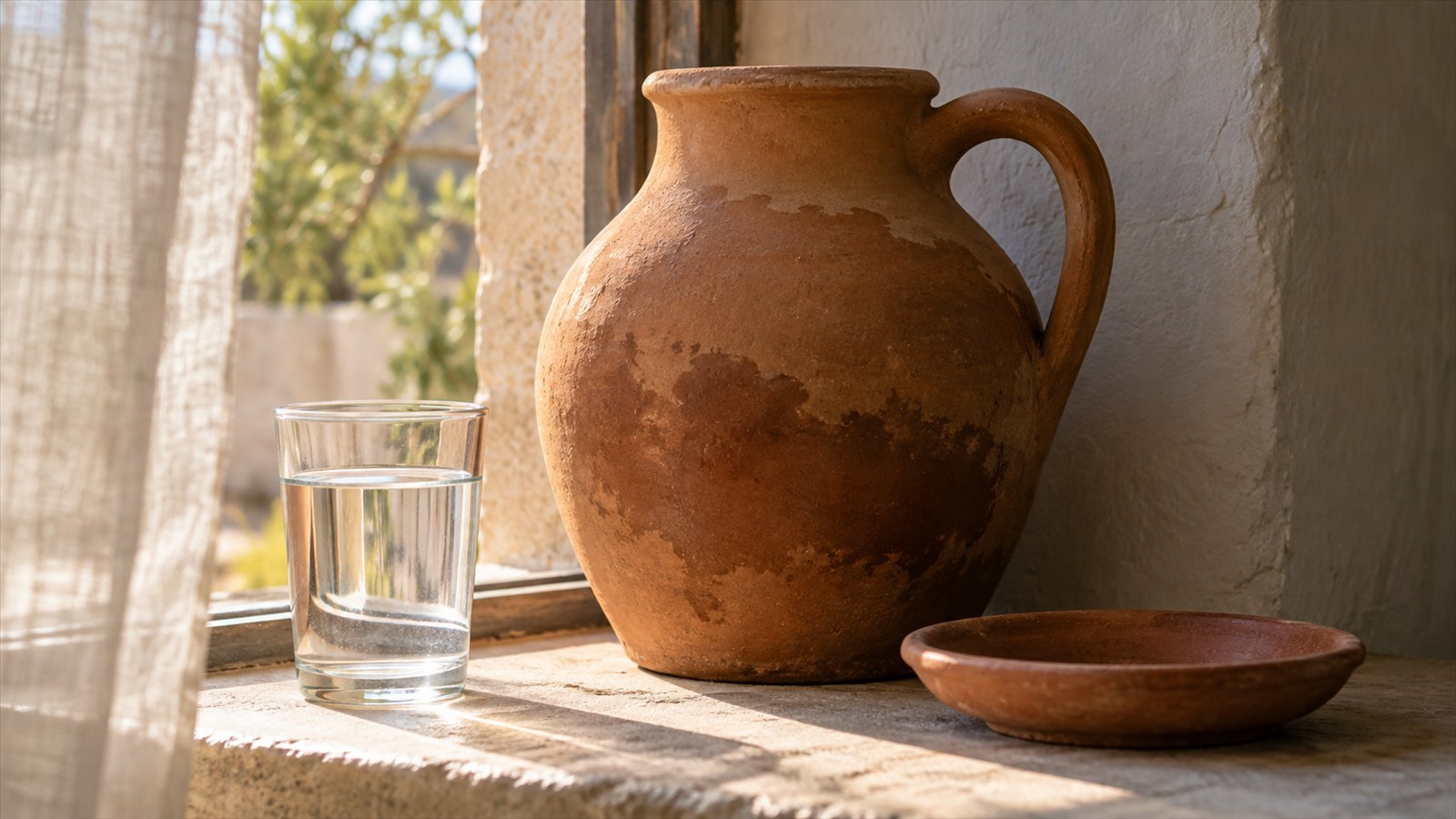
The book describes ancient cultures cooling drinking water and wine by keeping them in porous clay vessels, which evaporate moisture continuously. Evaporation takes energy out of what's inside. The result: water cooler than the room, with no ice and no electricity.
It's exactly the mechanism of sweating. The body puts water on the skin precisely so that evaporating it carries heat away.
And it's exactly the moringa — the unglazed clay water jug still sitting in a lot of Brazilian houses, which works because its wall transpires.
One note of honesty: the book doesn't mention Brazil. It talks about ancient cultures and porous clay vessels, and the connection to the moringa is mine. But the mechanism it describes is this one, and it's also the reason a moringa only works if the clay is not glazed: glaze seals the pores and ends the evaporation.
So if your Christmas dinner is in December heat with a full house: an unglazed clay jug in the shade, with air moving past it, is free refrigeration. It won't replace a fridge and it won't make anything cold — it makes it cool, which for drinking water is better anyway.
That's a solution to the problem I raised a week ago, writing that food at room temperature has one hour in the heat, not two. What you drink has the same problem and an older way out.
Why your freezer damages things
Last, and it explains three domestic frustrations at once.
Almost every substance becomes denser when it freezes. Water does the opposite: in ice, the molecules arrange themselves in a way that demands more space between them — about one eleventh more than in the liquid.
Water, freezing, grows. And it is strong.
That's the same explanation for:
- pipes bursting in winter
- a bottle forgotten in the freezer popping itself open
- an over-full container of soup cracking in there
- and the reason frozen fruit and vegetables leak when they thaw
That last one is the one that matters in the kitchen. During freezing, the ice crystals expand and rupture the cell walls and membranes. When the ice melts, the liquid that was inside leaks out, because there's no longer a wall holding it.
It isn't that the freezer "dries out" food. It's that it punctures it from the inside, and you only find out at the thaw.
Worth remembering how much water is in there: we're about 60% water, raw meat around 75%, and fruit and vegetables run as high as 95%. When 95% of a thing is water and that water has grown inside the cells, there isn't much structure left.
This chapter's limits, said plainly
It's the chemistry chapter of the book — it exists to explain the molecules the other chapters use. It's dense, it has formulas, it has a pH scale, and most of it isn't about cooking.
I took the water section and left the rest. So this isn't "what the book teaches"; it's the piece of the book that answers real kitchen questions.
And one thing I didn't find in it: any figure for how long a porous clay jug takes to cool, or how much it cools by. The mechanism is explained, the application is mine, and the quantity I don't know. If anyone here measures it, I want to hear.
If you'd like the rest of what we're putting together for the season, I've gathered it all on one page, with a table checklist to download.
And for the table that water is being served at: The Art of Napkin Folding has the classic folds step by step. R$47.00, lifetime access.
Tell me something: does anyone in your family still have a clay water jug? Ours did, and I spent my whole life thinking it was an ornament.
Free
Take the Christmas table checklist
Everything that matters on a Christmas table, on a single sheet. Print it, or fill it in on your computer.
It arrives straight away. After that, my newsletter — leave whenever you like.